
Taught Wrong for 40 Years: Ball Flight Laws Fall
For decades, teaching held that path determines start direction and face determines curve. Measurement overturned that in the late 2000s.
28 posts
For decades, teaching held that path determines start direction and face determines curve. Measurement overturned that in the late 2000s.

Closing out thirty pieces on the physics of the miss — the patterns that recurred across the branches, and the claims that did not survive checking.

A practical guide to reading what happened at impact from ball flight alone, using the corrected face-path relationship — no launch monitor required.
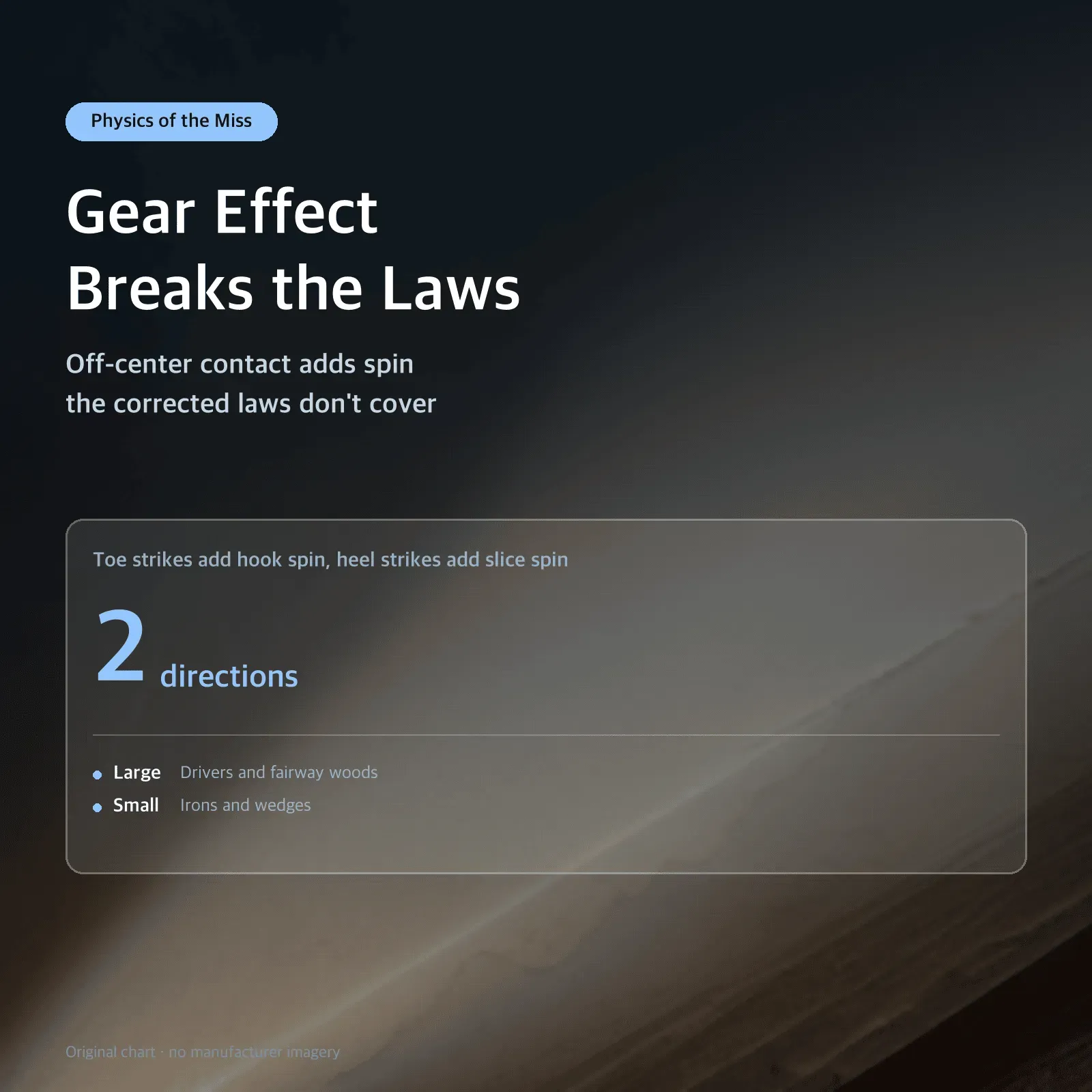
The corrected ball-flight laws assume center contact. Off-center hits add gear-effect spin the laws don't cover — far bigger with a driver than an iron.

Ben Hogan compared the hook to a rattlesnake in your pocket. Unlike other golf legends we checked, this one has a dated, verifiable source.

A draw and a hook both curve right to left, but the boundary between them isn't how much the ball curves — it's whether the face is under control.

Golfers avoid the word because they believe it spreads. That belief is real and documented. Whether it actually spreads is a separate, unconfirmed claim.

The D-Plane model behind modern launch monitors wasn't built by TrackMan. A physicist described it in 1994, twelve years before radar could confirm it.
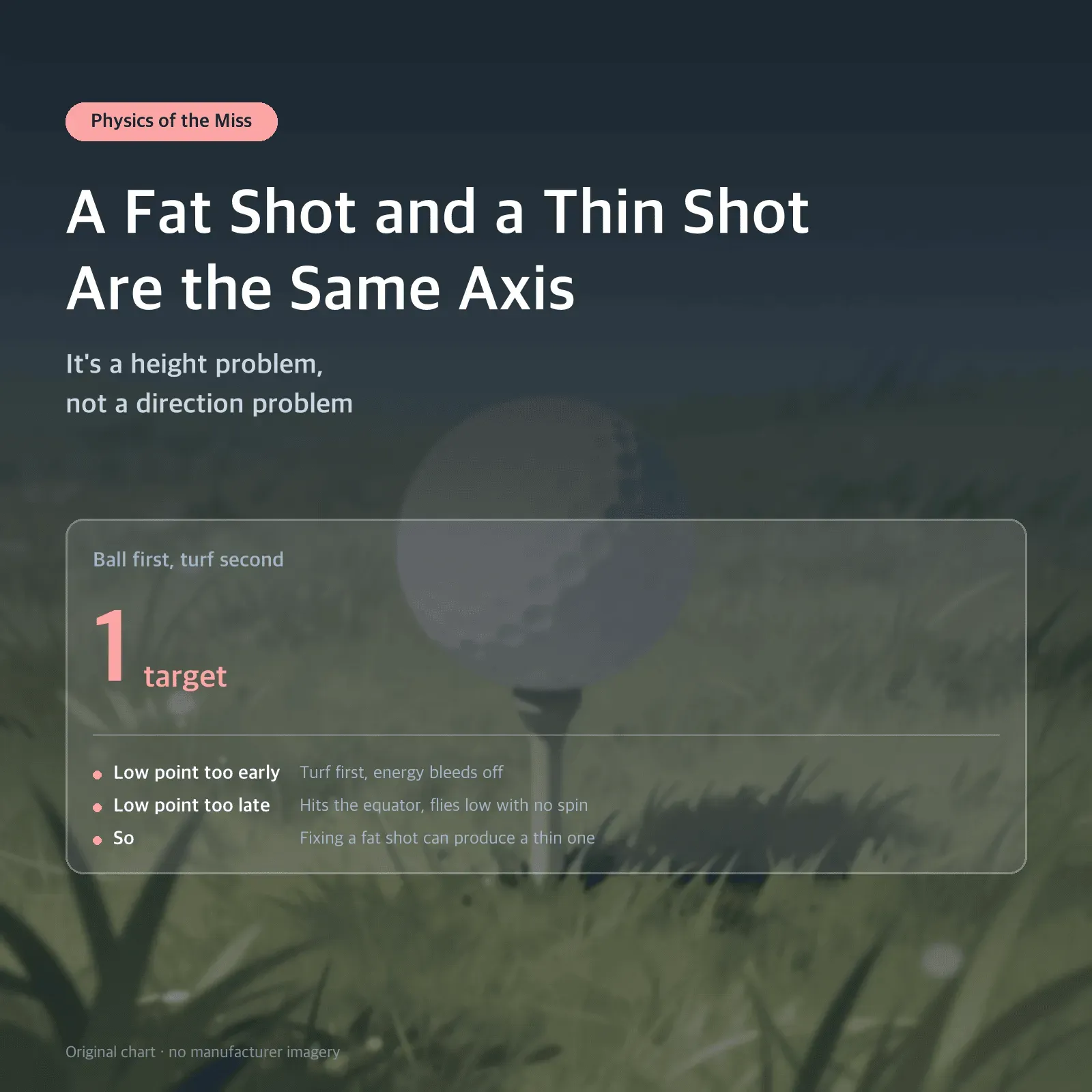
A fat shot and a topped shot look opposite but sit on one axis — where the low point falls relative to the ball. How to check it, and why a mat hides it.

The classic nine-shot ball flight chart still holds, but the old explanation of what causes each box is wrong. Here it is redrawn around face and path.

Standing close is only one of three ways the hands end up outside address position at impact — weight drift and lunging produce the same result.

First aid and a real fix are different things. What narrows a bad outcome mid-round, separated from what only feels better while the miss stays.

Slice fixes push face and path the same direction, and it's common to overshoot into a hook. Here are the three overshoot routes, and how to spot them.

One swing fault shows up as a direction miss with a driver and a distance miss with an iron. Three earlier threads pulled together by club, not miss type.
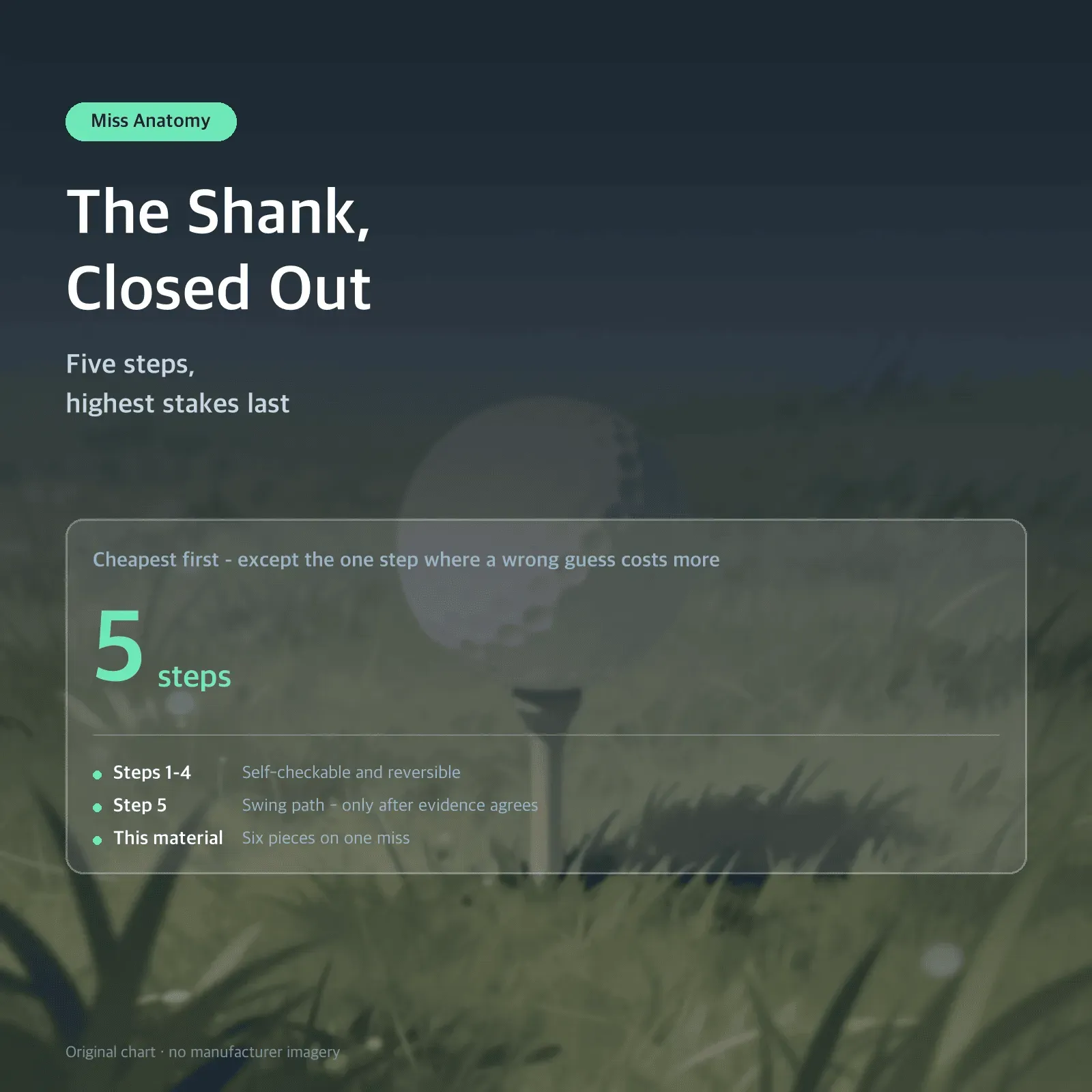
A five-step sequence for isolating a shank's cause, with a twist on 'cheapest first': the highest-stakes step comes last, on purpose.
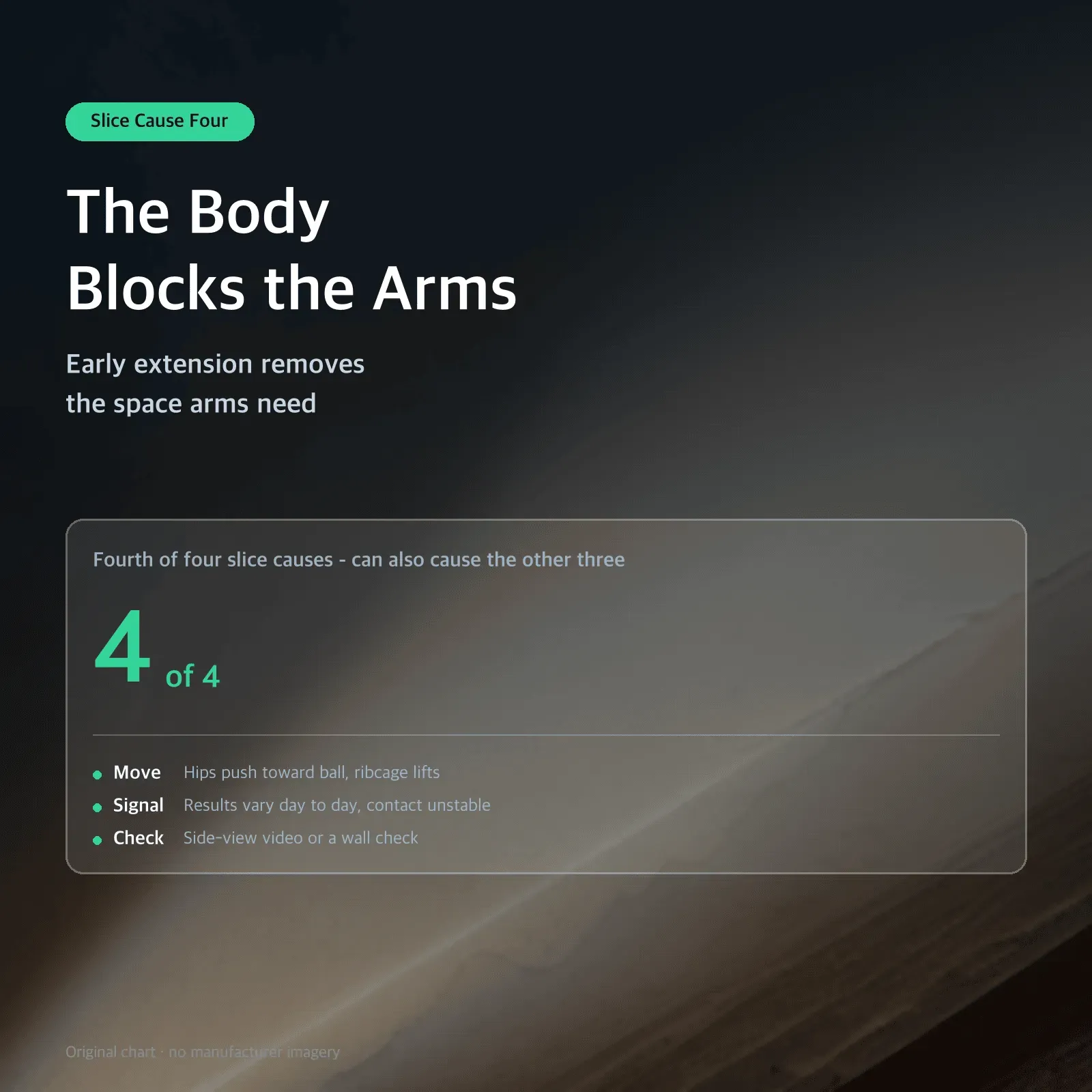
Early extension, the most common fault in amateurs, doesn't break the face or path directly — it removes the space the arms need.
'Square the face' usually means square to the target — but the curve is set by square to the path. That distinction changes diagnosis and the fix.

A weak grip forces the forearms to rotate more than downswing time allows, so the face often arrives open. Here's how to check it in under a minute.
An out-to-in path isn't a slice by itself, and this branch shows the opposite starting direction from the first two. Here's how to tell, and the fix.
A slice always shares the same definition, but not the same cause. Four distinct faults produce it, and the '90% of golfers slice' claim doesn't hold up.
A five-step order for sorting a slice into one of four branches, plus why aiming left to survive a round quietly makes the underlying problem worse.
A snap hook looks different from a regular hook: sudden, low, short. The common mechanism is a rotation that stalls, forcing the hands to catch up fast.
An over-the-top move and an extreme in-to-out path both produce the same shank, so standard advice can make one group of golfers worse.
A shank isn't a curving miss like a slice or hook — it's a ball that never contacts the face. Why it flies low and right, and why usual diagnosis fails.

A closed face reduces dynamic loft, which lowers launch and spin. That makes a hook's stopping point far less predictable than a slice's.

Four factors stack in the same direction to make long irons difficult. Hybrids ease it, but the miss does not disappear — it changes shape.

A shank clusters around wedges and short irons because four factors align. Some club designs push back, but the effect stays small.
A wedge going straight is no proof of a good swing. Higher loft raises backspin, shrinking how much a tilted spin axis shows as curve — physics, not skill.