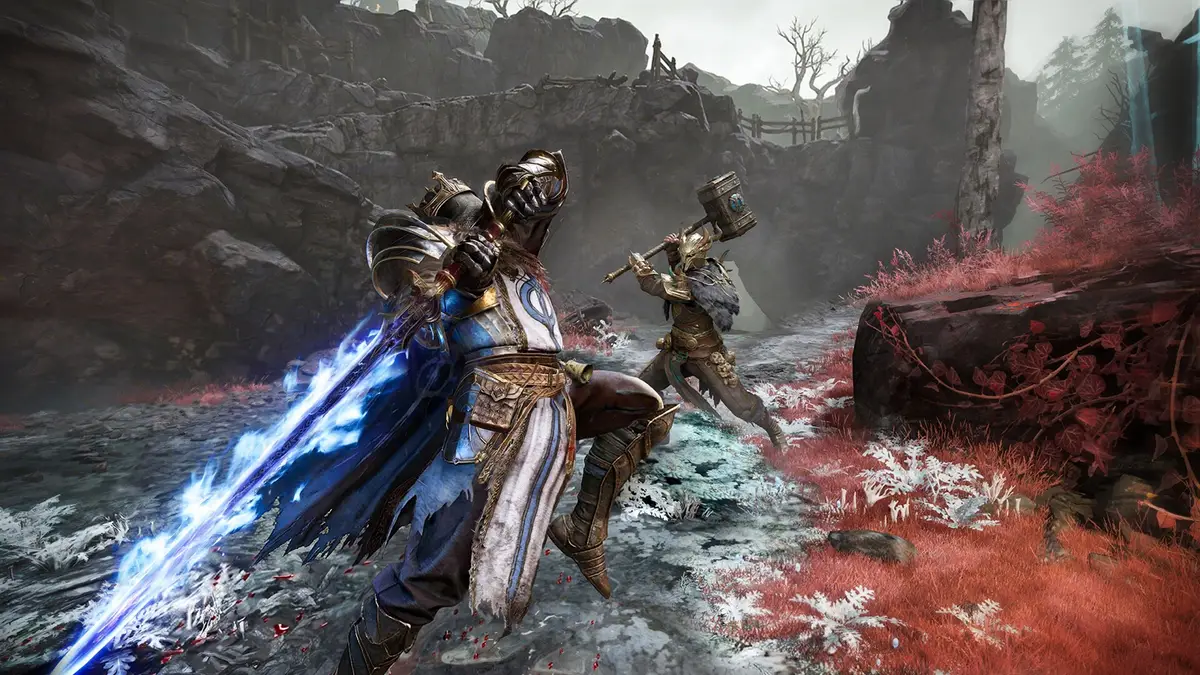
The short answer: if a monster puts you down, you are usually not dead — your soul separates and you can return to your body. If another Gyldhunter kills you, you die immediately, with no soul-separation step. That distinction is stated directly by Bellring Games and it is the single most important rule a new player can know.
Everything below comes from official developer posts. Where a number or a threshold has never been published — and most of them have not — this article says so rather than guessing.
Why the two deaths are different
The developer’s explanation is a lore rule with a hard mechanical consequence. Gyldhunters inhabit a body woven by Dew. When that body takes severe damage, the soul separates and wanders the Mist, usually appearing as a place from the character’s memories. Separation is not death: once the Gyldhunter regains consciousness they can actively return to the body.
But Gyldhunter attacks are stated to strike the soul directly. So a player who kills you skips the separation step entirely — you die on the spot.
The studio’s stated design reason is worth knowing because it tells you how the game wants to be played. In an extraction game, harsh death penalties make players avoid monsters and the PvE turns flat. The in-match revival system exists specifically to give you “a larger margin for error when facing monsters” and to push you into fighting things you would otherwise skip. Take that as an invitation: the PvE risk is deliberately cheaper than the PvP risk.
The recovery framework, in order
Run this top to bottom the moment you go down.
- First, identify what killed you. If it was a monster, you are in the soul-separation path and there is something to do. If it was a rival Gyldhunter, there is not — for you. Skip to step 5.
- If you are in a trio and got knocked down rather than separated, teammates matter first. Being downed and being soul-separated are tracked as distinct states; the 12 August patch fixed a bug where using a Soul Separation Pill and then getting knocked down by a monster pushed a player straight into ghost form, which confirms they are separate states that can interact badly.
- If your soul has separated, return to your body. This is the actual recovery action, and it is described as an active choice you make, not something that happens on a timer.
- Count how many times you have done this. The developer states the opportunity is limited: souls that stay outside the body too long, or separate too often, become damaged, the body loses vitality and turns into a corpse, and that is a true death. The exact number of separations allowed has never been published. Treat each one as expensive and do not farm them.
- If a player killed you, your run is over. Whatever you were carrying is on your corpse for them. There is no player-kill equivalent of soul retrieval, and as of DevNote #8 there is still no way to revive a fully dead teammate in the PvP endgame — the developer confirmed a consumable-based revive (the “bells” idea from the community) is in long-term planning with development not yet begun.
What this changes about how you play the first ten hours
- Fight the monsters. The system is explicitly built to let you lose PvE fights and continue. Learning enemy patterns costs you far less than learning them the cautious way.
- Treat every other player as a hard fail state. No safety net applies. This is why the developer’s matchmaking work — dynamically lowering the number of PvP opponents for new or inexperienced players, and reapplying that whenever you enter a new map or difficulty — exists at all.
- Bots are permanent and intentional. The studio confirmed in the AMA that bots are staying, that they serve new players and combat-intensity tuning, and that improving their AI is a long-term project. If an early opponent felt readable, it may well have been one.
- Extraction is a separate cost. Summoning an extraction point consumes a Soul of Return. We know this because a launch-week bug — repeatedly entering and leaving the area around a Soul Tree while summoning an extraction point consumed an extra Soul of Return — had to be fixed on 30 July. Budget for it.
What is not confirmed
Do not let anyone tell you otherwise on these points, because the developer has never published them:
- How many soul separations a character gets before true death.
- How long a soul may remain separated before it is “damaged.”
- Whether the limit resets between matches or persists on the character.
- Any durability or repair cost figures attached to dying.
Those gaps are real, and this is a game less than a month old whose systems are being edited weekly. The post-launch update cadence dataset shows how often the in-match rules moved in the first three weeks, and several of those entries are direct fixes to the downed, ghost-form, and revival states described above. If you are trying to work out which of the developer’s stated intentions have actually landed in the build you are playing, the roadmap versus delivered tracker is the check.
Sources
- Dev Team FAQ #2, 5 March 2026 — soul separation lore and rules; PvE revival design intent; endgame PvP revive not started; dynamic PvP opponent counts for new players
- Gyldenhunters’ Council Phase 1 — Community AMA Responses — bots confirmed permanent
- Known Issues, 30 July 2026 — Soul of Return consumed by extraction point summoning
- Launch Rewards & July 30 Update — fix for the extra Soul of Return consumption
- August 12 Live Update — Soul Separation Pill and downed-state interaction fix
- DevNote #8, 20 August 2026 — post-launch state of balance and systems work