Version basis: written 2026-08-23, against patch 1.1.0.0 of 3 August 2026 and Season 1: KORD BREACH. No premium prices, no return percentages and no trader-specific return timers appear below. Those are exactly the figures that shift between patches, and a stale number here would cost you real roubles. What follows is the mechanic and the decision, both of which are stable.
Insurance does not refund the value of what you lost. It returns the specific items that were still on your body or nearby when the raid ended and that no other player took. That single sentence is the whole difference between the players who budget correctly and the ones who believe they are covered and then are not.
The matrix: what actually comes home
Read this by slot, not by item value. The right-hand column is the only one you act on.
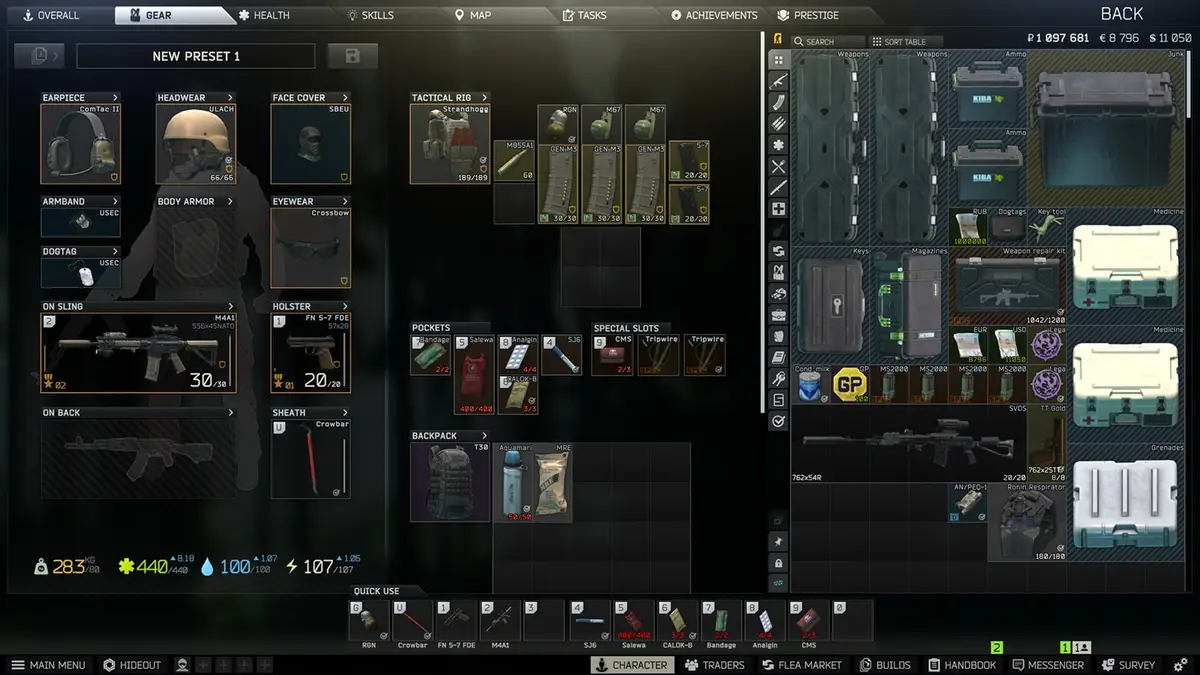
| Slot | If you die and nobody loots you | If a player kills and loots you | What to do about it |
|---|---|---|---|
| Secure container | Returns immediately, always | Returns immediately, always | Put anything you cannot replace here first |
| Weapon in hands | Insurance may return it | Gone — this is the first thing taken | Insure it, but treat it as spent |
| Armour and rig | Insurance may return it | Usually gone | Insure; expect loss in PvP-heavy raids |
| Backpack loot | Not insurable as loot | Gone | Never carry stash value you would miss |
| Headwear and comms | Insurance may return it | Frequently taken | Insure the expensive half only |
| Meds and ammo in pockets | Not returned | Gone | Budget as consumed every raid |
The pattern is blunt: the more useful an item is to the person who killed you, the less likely insurance is to give it back. Insurance is protection against the environment, against Scavs, against a fall, and against your own mistakes. It is close to useless against a player who wants your gun.
The four-line pre-raid price
Before you queue, work out one number: what this raid costs you if it goes badly. Do it in this order and stop as soon as the answer makes you uncomfortable.
- Add the value of anything not in your secure container. That is your exposed amount.
- Subtract nothing for insurance. Assume zero return. If a return arrives, it is a bonus, not a plan.
- Compare the exposed amount against what one bad day costs you. If losing this kit three times in a row would stop you playing, the kit is too expensive.
- Then decide whether the raid’s objective justifies the exposure. A task turn-in often does. “I felt like a good run” does not.
The reason step 2 is written the way it is: players who mentally deduct an expected insurance return end up running kits they cannot actually afford, because the return arrives late, arrives partial, or does not arrive. Budget on the worst case and the good cases take care of themselves.
When insuring is and is not worth it
- Cheap kit, quiet map, mostly Scav contact → insure. This is the case insurance was built for and it works well.
- Expensive kit, hot map, players everywhere → insure anyway, but assume it is gone. The premium is small relative to the kit; the expectation should still be total loss.
- Loot-run kit you deliberately made worthless → insurance barely matters either way. The point of that kit is that losing it is free.
- Anything you genuinely cannot replace → it should not be in an insurable slot at all. It belongs in the secure container, or in the stash.
The stash-side half nobody mentions
Loss is not only what leaves your body. Every item you bring out and keep occupies stash space, and stash space is the resource that quietly throttles new players. A kit that returns via insurance is only a gain if you have room to keep it and a use for it; three insured rigs you will never wear are three slots you cannot use for task items.
So the honest full accounting of a raid is: exposed value lost, minus anything returned, minus the stash space the returns now occupy. Most new players track the first term only, which is why their stash fills up while their rouble count does not move.
If you are running a seasonal character, the same logic applies to time as well as roubles — the season time planner prices your remaining schedule in raids, and a kit that takes three raids to rebuild is a kit that costs three raids of progress. Whether a rough seasonal roll makes that worse is a separate question, handled by the modifier trade-off scorer.
Figures we left out on purpose
- Insurance premium costs and return rates. These are trader-dependent and patch-dependent, and 1.1.0 moved trader pricing broadly. Check them in your own client on the day.
- Return timers. Same reason. The mechanic — return takes real time, not instant — is stable; the hours are not.
- Any claim about how likely a return actually is. We have not measured it and neither has anyone whose numbers we could verify.
Sources
- Insurance — Escape from Tarkov Wiki — the mechanic: what is eligible for return, and the condition that items must not have been taken.
- Secure container — Escape from Tarkov Wiki — the always-returns row of the matrix.
- Stash — Escape from Tarkov Wiki — stash space as the constraint behind the final section.
- Patch 1.1.0.0 — Escape from Tarkov official news — the patch that changed trader pricing, and the reason no rouble figures appear here.