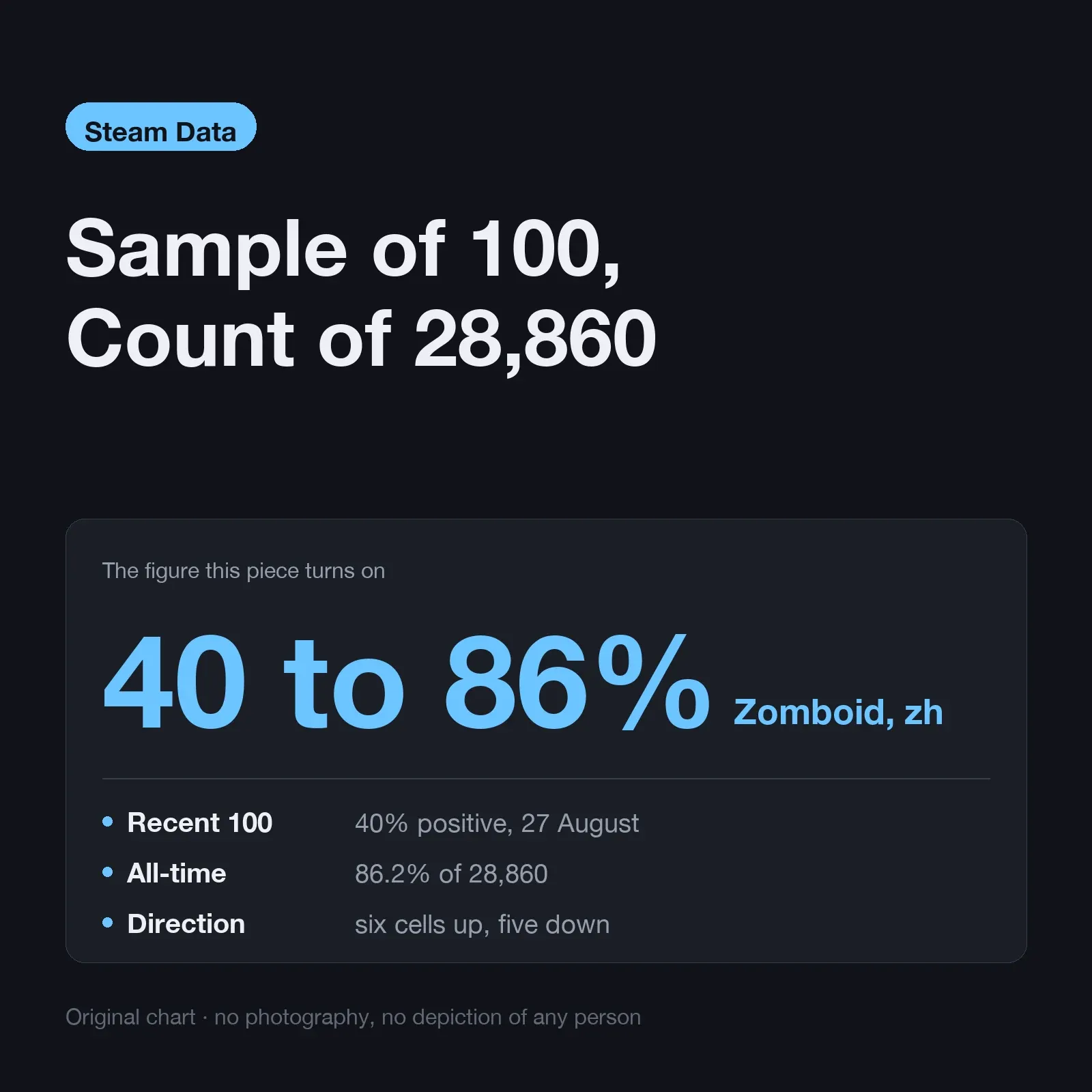
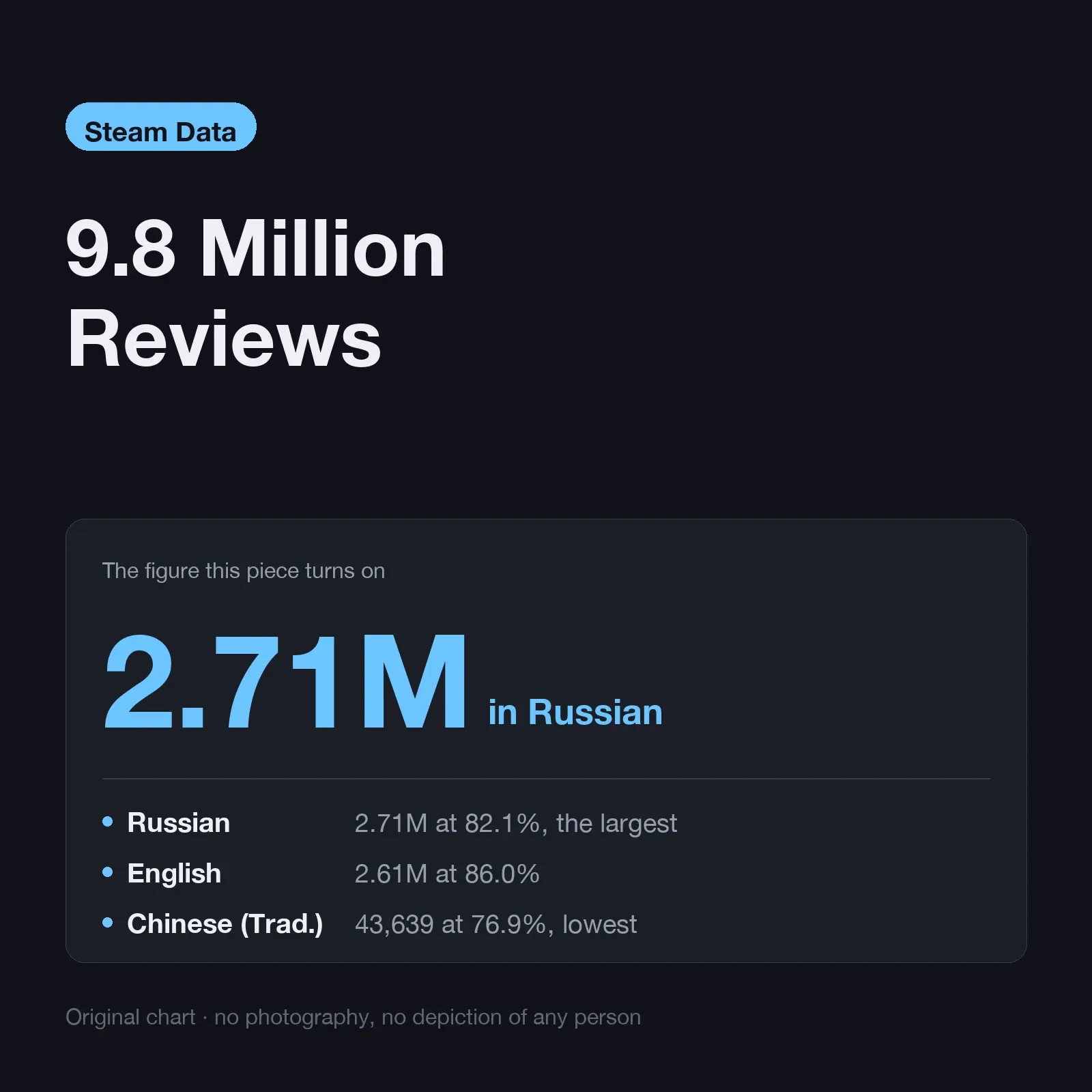
The dent below is from 1,200 English-language reviews read 2026-08-27, spanning 21 July – 26 August, close to both Tarkov’s Steam launch and Patch 1.1.0.0 (announced 22:33 UTC on 3 August, 4 August in Moscow). Playtime is the reviewer’s own recorded figure at review time, Steam client only. A fresh 1,000-review re-pull on 2026-09-13 (below, all languages) checks whether the shape and the review habits around it held up.
Every other game in this series has a curve that either rises or arches. Tarkov has a dent.
Approval falls where you would least expect it
The climb is normal at first: 19% under two hours, 40% at 2–10, 69% at 10–50, 76% at 50–200.
Then it drops. The 200–1,000 hour band comes in at 68% — eight points below the band beneath it, and the only mid-curve decline of this size in the set. Above 1,000 hours it recovers to 84%, though that band is 37 reviews and should be read loosely.
So the least satisfied experienced cohort is not the veterans. It is the people at roughly two to six weeks of serious play — deep enough to have met the systems fully, not yet deep enough to have made peace with them. The 2–10 hour band, at 40%, is the hard first evening the game’s reputation warns about; our first raids checklist targets exactly that stretch.
Cheating is named four times more often by unhappy players
22% of negative reviews mention performance, servers or crashes and 14% mention cheaters, hackers or bots. The comparison column is what matters: cheating appears in only 3% of positive reviews, and bugs in 2%. Those are four-to-one and six-to-one splits — the sharpest divides in this whole series.
That shape means something specific. Where Mistfall Hunter’s performance complaints show up in a fifth of positive reviews too — a shared condition everyone acknowledges — Tarkov’s top complaints are concentrated almost entirely on one side. Players who recommend the game largely do not raise them.
Monetisation follows the same pattern at 8% against 1%.
Method: keyword matching, not human coding. One review can match several topics, and “no cheaters this wipe” counts the same as “full of cheaters.”
Two weeks ago, 1,200 reviews took a month. Now they take eleven days
A fresh pull of the 1,000 most recent reviews, all languages, on 2026-09-13 spans just 11 days (2 September to 13 September) — the original 1,200-review English sample above needed 36 days to fill. Review volume has roughly tripled. The median review in the new pull is 33 characters, barely off the 35-character figure from the site’s language-agnostic snapshot taken the same week in August, and 59.9% of reviews still run under 50 characters. Tarkov’s Steam page is still mostly being used as a one-line vote, not a review.
Two splits inside that fresh pull echo the pattern above. Reviews from accounts that had not played in the last two weeks run 38.1% positive against 55.9% for accounts still active — a 17-point gap, the same shape as the mid-playtime dip, read a different way. And key-activated copies run 48.5% against 58.2% for store purchases, a 10-point gap in the same direction as the original English-only bands: buyers who came in through a bundle or reseller consistently score Tarkov lower than people who bought it on Steam directly.
For the seasonal clock this sample’s reviewers are playing against, see is there still time.
What the two review pulls don’t settle
- Whether Patch 1.1.0.0 caused any of this. The original window straddles it; the endpoint returns no dated slices to compare.
- Whether cheating incidence actually changed, as opposed to how often it is mentioned.
- Non-Steam playtime. Many long-term Tarkov players predate the Steam release, so recorded Steam hours understate real experience.
- Why review volume tripled. More players, a promotion, or a content update could each explain it; the endpoint does not say which.
Sources
- Steam appreviews endpoint, Escape from Tarkov (appid 3932890) — 1,200 English reviews, read 2026-08-27; 1,000 most-recent all-language reviews, re-pulled 2026-09-13
- Escape from Tarkov Steam announcements — Patch 1.1.0.0 and season one launch, posted 3 August 2026 22:33 UTC, read 2026-08-27
- Escape from Tarkov on Steam — store listing, read 2026-09-13