Version basis: written 2026-08-23, against patch 1.1.0.0 of 3 August 2026 and Season 1: KORD BREACH. There are no rouble prices, no specific weapon names, no ammo grades and no armour classes on this page. 1.1.0 changed trader pricing and market fees, so any absolute number here would be wrong within weeks. The ladder is relative, which is why it keeps working.
Take the cheapest kit that can still accomplish the raid’s purpose. Almost every gear question a new player asks — is this armour good enough, should I bring the better gun — is really the question what is this raid for, asked backwards. Answer that first and the kit picks itself.
The five rungs
Each rung is defined by what you can afford to lose repeatedly, not by an item list. Fill in your own numbers; the relationships hold regardless of what the market is doing.
| Rung | What it is | The raid it is for | Acceptable outcome | Move up when |
|---|---|---|---|---|
| 0. Naked-ish | Secure container, meds, a bag, nothing else | Map learning, extract practice | Dying costs nothing | You know the route and want loot |
| 1. Scav-tier | Whatever a Scav run gave you, unmodified | Loot runs, low-traffic maps | Losing ten in a row is survivable | Loot rooms need a fight to reach |
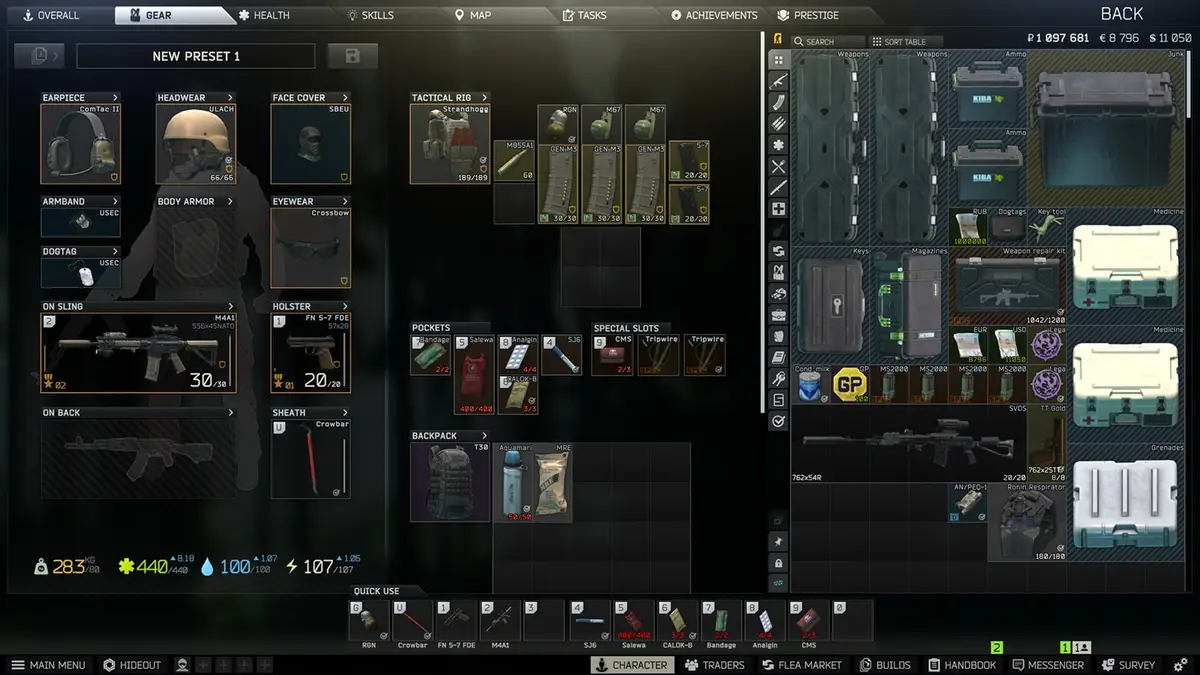
| 2. Working kit | Reliable gun, mid armour, meds you can replace | Most tasks, most raids | Losing three in a row is survivable | A task repeatedly fails on gear, not skill |
| 3. Task kit | Best gear you can rebuild within a session | A specific task you keep failing | Losing one hurts but does not stop you | Never — this is the ceiling for most players |
| 4. Hoarded kit | The gear you have been saving | Almost nothing | Losing it changes how you play for a week | Do not. Gear rots in the stash |
Rung 4 is on the table because it is where money actually disappears. Gear kept for the perfect moment is gear that either gets lost in an ordinary raid or is still in the stash at wipe. The correct amount of hoarded gear for a new player is roughly none.
The loss test
One question, applied before every queue: if I lose this kit three times in a row, what happens?
- Nothing much → the kit is correctly sized, or you could go up a rung.
- I would need a few Scav runs to recover → correct for a task raid, too expensive for a casual one.
- I would have to stop and grind money back → drop a rung. You are one bad session from playing scared, and playing scared costs more than the kit did.
- I would consider quitting for the night → drop two rungs immediately.
The test works because losses in this game arrive in clusters, not evenly. A kit you can afford to lose once is not a kit you can afford.
The three real reasons to go up a rung
Gear helps in narrower circumstances than new players assume. It is worth naming them.
- A task forces contact you cannot avoid — a location that must be reached through a contested area. Here armour and a reliable weapon convert into task progress.
- You are consistently losing fights you should be winning positionally. Not fights you were ambushed in — those are map knowledge problems and gear will not fix them.
- The raid’s loot ceiling justifies the exposure, and you have somewhere to put the loot.
Everything else — feeling behind, seeing someone else’s kit, wanting the raid to feel serious — is not a reason. Note what is absent from that list: better ammo is a real force multiplier, but its numbers moved in 1.1.0 and we are not quoting values we have not verified.
Why cheap kits actually earn more
Two effects compound. First, a cheap kit removes hesitation, and hesitation loses more raids than equipment ever does — players carrying gear they are afraid to lose take worse fights, extract later, and third-party more. Second, a cheap kit lets you play the volume game: ten low-exposure raids will out-earn three high-exposure ones for anyone still learning the maps, because most of your losses right now come from orientation and timing rather than from being outgunned.
Both of these are time questions as much as money questions. If you are running a seasonal character against a deadline, the season time planner tells you how many raids you actually have, and rebuilding a rung-3 kit is measured in raids. If your seasonal roll taxes gear recovery specifically, the modifier trade-off scorer covers whether that roll is worth keeping.
What we did not put on this page
- Rouble prices for any rung. 1.1.0 moved trader buy and sell prices and the market fee. Price your own rungs in your own client.
- Named weapons, armour classes or ammo grades. Not verified here, and the ladder does not need them to work.
- A recommended survival rate. Widely quoted figures for this exist and none of them are measured on a comparable population.
Sources
- How to Play Guide for Escape from Tarkov — Escape from Tarkov Wiki — the wiki’s own framing of loadout cost against raid purpose for new players.
- Insurance — Escape from Tarkov Wiki — why a lost kit is not the same as a refunded kit, which is what makes the loss test necessary.
- Patch 1.1.0.0 — Escape from Tarkov official news — the trader pricing and market fee changes that make absolute rouble figures unsafe to publish here.