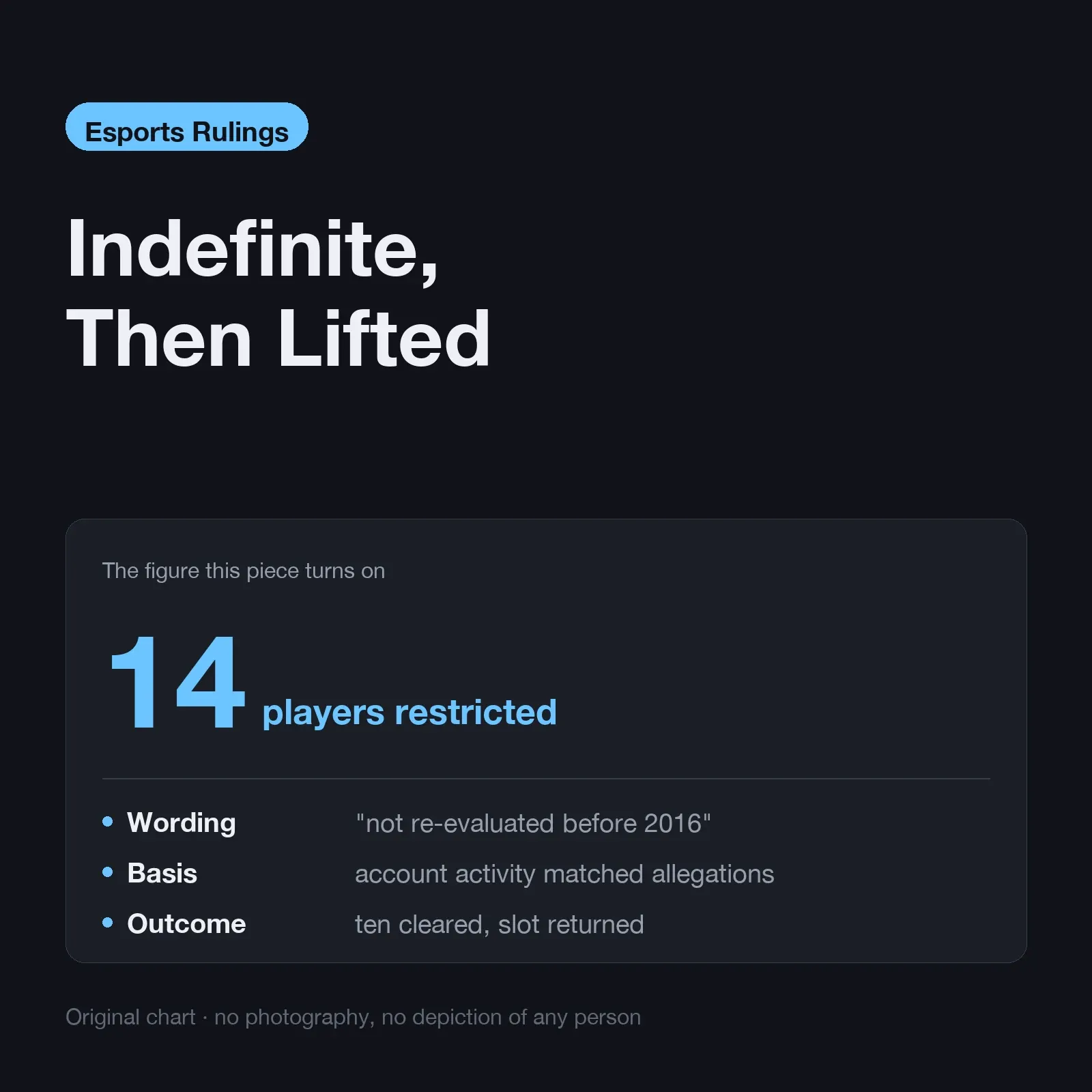
On 6 February 2015, days before the offline qualifier for ESL One Katowice, Valve restricted fourteen Counter-Strike players from its events for match-fixing. The wording left no room: “The restrictions are indefinite, and will not be re-evaluated before 2016.”
Ten of those players were competing again within weeks. Their restriction was lifted after further investigation, and the team took its qualifier slot back.
That is the whole subject of this piece. Not who cheated — what a public, indefinite ban turned out to mean when the investigation continued after the announcement.
1. What was announced, and to whom
| Group | Players | Outcome at announcement |
|---|---|---|
| Epsilon | four French players | Restricted; lost the Katowice invitation |
| ex-ESC Gaming | ten Polish players | Restricted; lost the Katowice invitation |
| Former ALSEN | roster | Restricted |
| WinneR | roster | Disqualified pending investigation, not formally banned |
| ScreaM (Epsilon) | one player | Deemed not guilty. Remained eligible |
One player on the Epsilon roster was excluded from the ruling at the moment it was made. That distinction existed on day one — which is worth holding on to when reading the rest.
2. The part that came undone
The ex-ESC players were restricted, in the organisers’ own account, because “their historical account activity matched allegations of misconduct.” That is a description of a pattern match, not of an established act.
The follow-up was published plainly: “further investigation has clarified their role in the matter, and the restriction has been lifted.” The team regained its place in the last-chance qualifier for ESL One Katowice 2015.
No equivalent statement was issued for the other two groups. Coverage at the time noted only that no further comment had been made about them.
3. What “indefinite” was doing in that sentence
Read the two announcements together and the sequence is:
- A restriction is imposed and described as indefinite, with an explicit floor of 2016.
- The stated basis is that account activity matched allegations.
- Investigation continues after the announcement.
- For ten of the fourteen, that investigation clarifies their role and the restriction ends.
The word “indefinite” described the intended duration. It did not describe the strength of the finding behind it — and the two are easy to conflate when both arrive in the same press release.
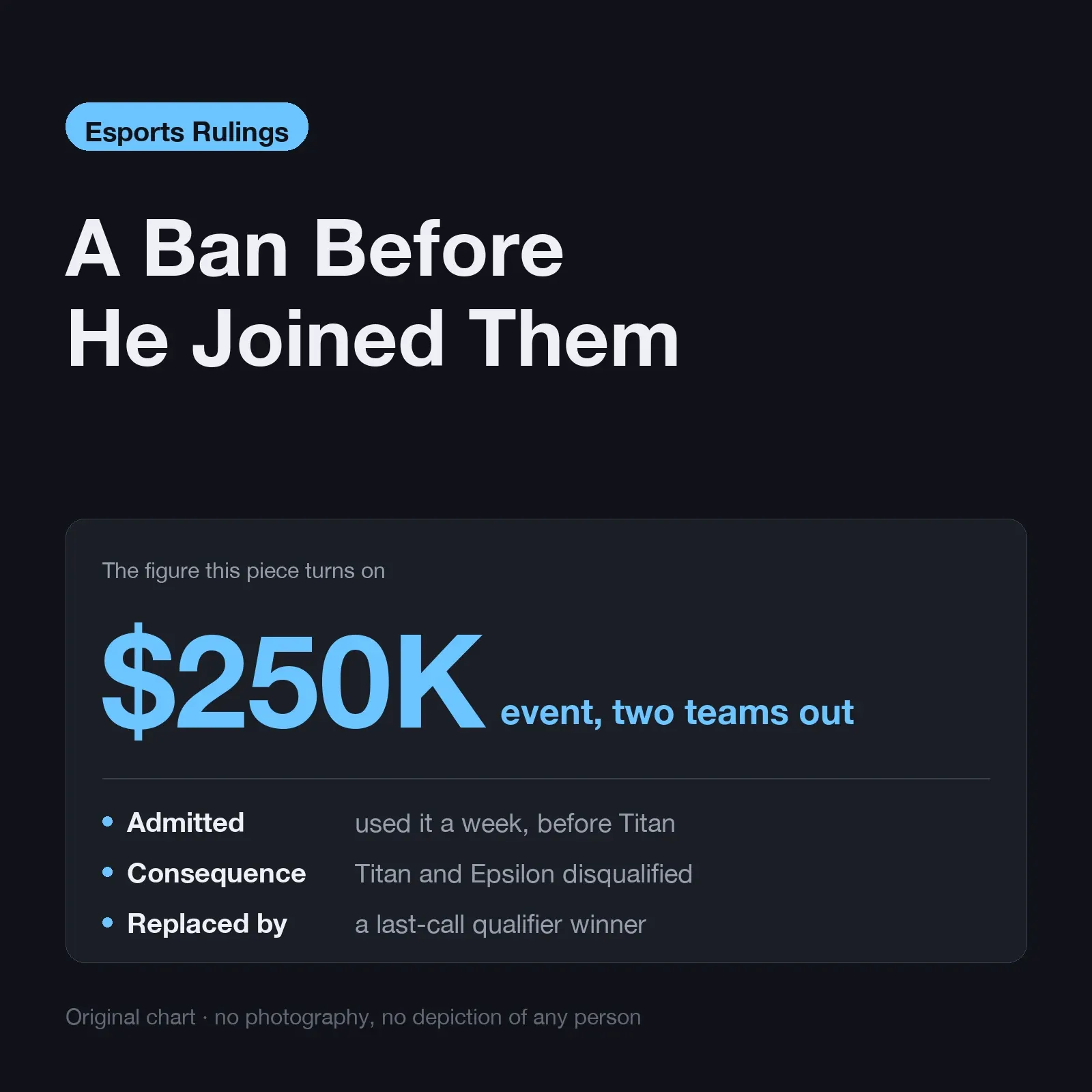
This is the same asymmetry that shows up in the iBUYPOWER case, where a publisher’s word for a penalty outlived the penalty itself, and it is the opposite of what happened to Titan and Epsilon at DreamHack three months earlier, where the finding was not in dispute and the consequence still landed on people who had not done it.
4. What it cost, and what it did not
Cost: both Epsilon and ex-ESC lost their invitations to the offline qualifier for ESL One Katowice 2015 at the point of announcement. ESL ran a last-chance tournament to fill the vacated places.
Recovered: the ex-ESC players’ restriction was lifted and the team returned to that last-chance qualifier.
Not recovered, as far as the record shows: the Epsilon players’ restrictions. We found no published reversal for them.
5. What is confirmed and what is not
Confirmed — the date, the wording of the restriction and its 2016 floor, the group composition and headcounts, ScreaM’s exclusion from the ruling, the loss of the Katowice invitations, the last-chance qualifier, and the later lifting of the ex-ESC restriction with the reason given.
Not confirmed:
- What the ex-ESC investigation actually found. The published reason is that their role was “clarified.” Nothing more specific was released, and we are not inferring what it was.
- Whether the Epsilon restrictions were ever revisited. We found no reversal; that is not the same as establishing that none happened.
- The underlying betting evidence. None of it was published, so this piece describes the rulings and their reversal, not the conduct behind them.
Because part of this ruling was undone, one thing needs saying directly: the ten players whose restriction was lifted were, on the organisers’ own published account, cleared. Any account of February 2015 that stops at the announcement leaves them where the announcement left them, and the record did not.
In one line
An indefinite ban, floored at 2016, announced against fourteen players days before a Major qualifier — and ten of them were cleared and back in the same qualifier, because the investigation that justified it was still running when it was published.
Sources
Both opened and read on 31 August 2026.
- HLTV’s report of the bans — the 6 February 2015 date, the wording “The restrictions are indefinite, and will not be re-evaluated before 2016”, the group breakdown, ScreaM being “deemed not guilty of match-fixing”, and the lost ESL One Katowice invitations.
- Destructoid on the retraction — the stated basis (“their historical account activity matched allegations of misconduct”), the lifting (“further investigation has clarified their role in the matter, and the restriction has been lifted”), the return to the last-chance qualifier, and that no further comment was made about the other two teams.