Sourcing note: the match duration and date are from Guinness World Records, which certified the game. The suspension and its stated grounds are reported from contemporary coverage of Blizzard’s ruling; Blizzard’s own 2015 WCS announcement page is no longer live, so no primary link to it is offered here. Where the sources differ, this page says so rather than picking one.
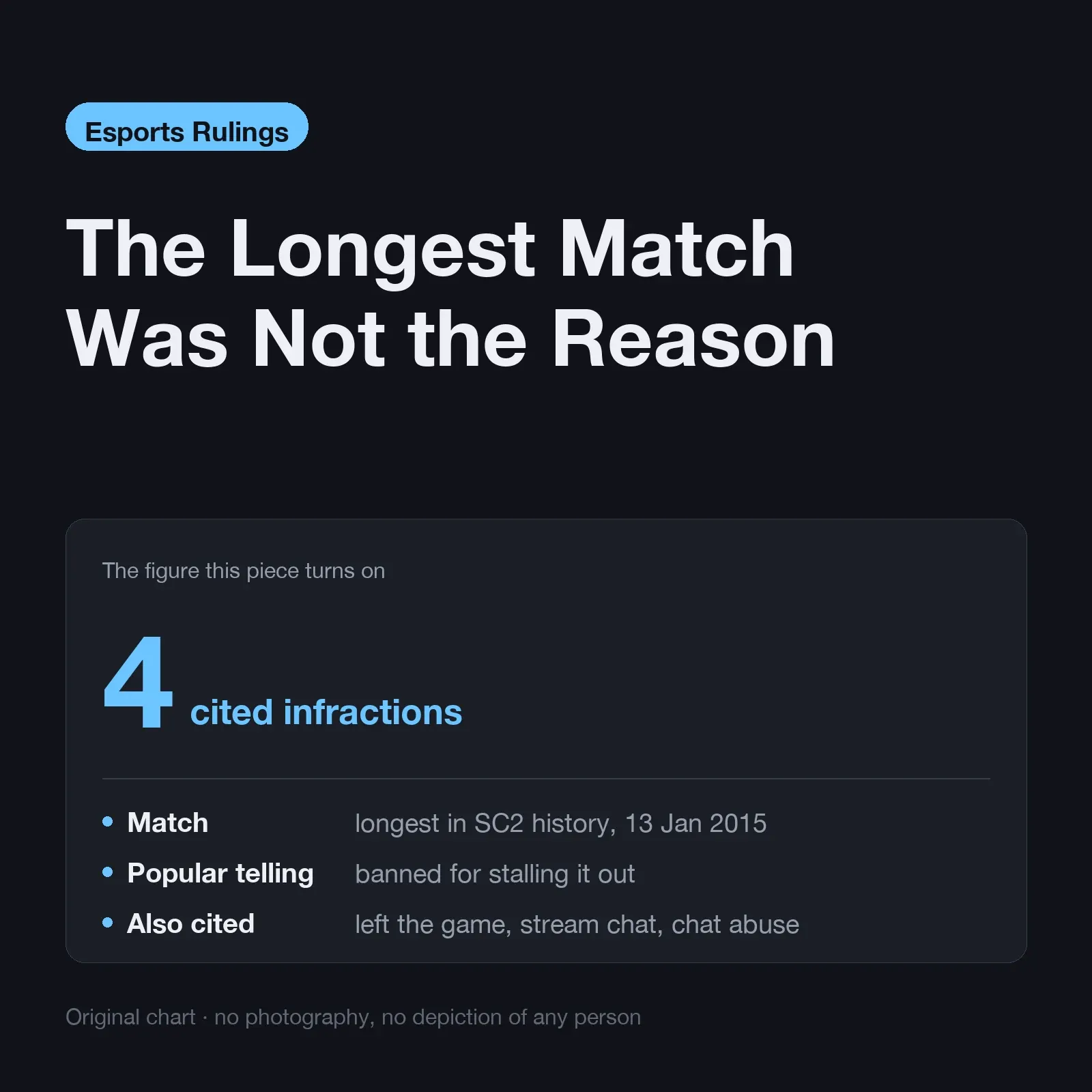
On 13 January 2015, Steffen “Lillekanin” Hovmand of Denmark played Wenlei “ZhuGeLiang” Dai of Finland in a StarCraft II match that ran 4 hours, 10 minutes and 1 second of in-game time — just under three hours of real time, because StarCraft II’s standard “Faster” speed runs the game clock ahead of the wall clock. Guinness World Records certified it as the longest professional game of StarCraft II. Hovmand was suspended for the rest of the season shortly afterwards.
Almost every retelling since has fused those two sentences into one: he was banned for taking too long. That is not what happened, and the gap between the two matters more than the record does.
The stall broke no rule
Hovmand played Terran and rushed to Ravens. Auto-Turrets backed by Point Defense Drones make a small force very hard to kill; Dai’s Zerg answered with Swarm Hosts, which throw free units at a position indefinitely. Neither composition could break the other and neither cost enough to lose by attrition. The game simply did not end.
Nothing in that is against the rules. There was no clock, no move limit, no stalling clause that a referee could point at. A player under no obligation to attack, holding a position he cannot be pushed out of, against an opponent in the same situation, is playing the game as it was built. The record stands in the Guinness database precisely because it was a legitimate match.
If the ruling had rested on the stall alone, it would have been a governing body punishing a player for the absence of a rule. It did not rest there.
The four things that were cited
Blizzard’s suspension named several distinct problems, and they belong in different categories:
| Cited | Category | Broke a written rule? |
|---|---|---|
| Match stalling tactics | Tournament conduct | No specific rule; judged as conduct |
| Leaving the game in progress | Tournament rule | Yes — a player is expected to be at the game |
| Receiving strategic information from stream chat | Competitive integrity | Yes — outside assistance |
| Typing “IM A TERRORIST” and “jihad” in in-game chat | Player code | Yes — conduct policy |
The third row is the one that should end an argument. During a match being broadcast live, Hovmand alt-tabbed away from the game and read the stream chat — where viewers watching the broadcast were discussing his opponent’s strategy, and, by one contemporary account, his supply count and resources. A player looking at the stream is looking at information his opponent does not have and cannot see.
That is not a slow game. That is the oldest form of cheating in broadcast esports, and it does not require intent to be a problem: the information arrives whether or not you went looking for it, which is exactly why the rule is written as “don’t be there,” not “don’t use what you saw.”
Why the wrong version stuck
The record is the memorable part. “Longest professional match in history” is a headline with a number in it; “left the game screen during a broadcast” is a procedural detail. Coverage at the time led with the duration because the duration was the news, and the infractions arrived as a list underneath it.
There is also a structural reason. The suspension was announced as a package — Hovmand was one of three players Blizzard suspended from WCS Europe in the same action, alongside two others sanctioned over discussing potential match fixing. In a single announcement covering multiple players and multiple grounds, the detail that survives into the retelling is whichever one is easiest to say in a sentence.
The penalty itself was not small: suspension for the remainder of WCS Europe Season 1, with disciplinary probation extending across the 2015 WCS seasons that followed.
The pattern this belongs to
Rulings in esports usually get compressed into their most quotable element, and the compression almost always loses the part that carried the weight. A ban attributed to one dramatic act turns out to rest on a quieter procedural one; a penalty everybody remembers as permanent turns out to have had a term.
The same shape appears in MarineLorD’s cancelled qualifier, where a legitimately won bracket was voided over a single ladder game played somewhere else entirely, and in Prime’s five fixed matches, where the headline number hides that the same players were paid the first time and coerced the next. For the case where a StarCraft II ban ran on two separate tracks at once — a federation’s rulebook and a criminal court — see the ban that came with a criminal record.
What we could not confirm
- Blizzard’s exact wording. The 2015 WCS announcement is no longer live. The four grounds above are as reported by contemporary coverage, which is consistent across sources on the substance but not necessarily on the phrasing. No quotation from Blizzard is presented as verbatim here.
- Whether the match and the ruling fell on the same day. Guinness dates the match 13 January 2015; at least one report gives the same date for the suspension announcement while press coverage appeared over the following days. We could not separate the two, so this page does not claim an interval.
- What Hovmand actually saw in the chat. One account describes his opponent’s strategy, supply count and resources being discussed. Whether he read any specific piece of it, and whether it changed a decision in the game, is not established anywhere we could find.
- How the strategic information reached him. Accounts differ on the mechanism — stream chat read directly, versus information arriving through chat donations. The distinction does not change the category of the infraction, but we cannot resolve it.
Sources
- Longest professional game of StarCraft 2 — Guinness World Records — both players, the 4h 10m 01s in-game duration, the sub-3-hour real time, the 13 January 2015 date, and the Raven-versus-Swarm-Host stall
- Three players suspended from StarCraft WCS Europe — Gfinity Esports — the three suspended players, the grounds cited against each, and the season-plus-probation term
- Pro StarCraft player suspended after longest match ever — Kotaku — the alt-tabbing to Twitch chat where the opponent’s strategy, supply and resources were being discussed