Seven names went up on Valve’s blog on January 26, 2015. The word used was “indefinite.” A year later Valve went back and changed the word to “permanent.” Ten years after that, one of the seven said in public that he was allowed to play again — and the confirmation came from his own Twitter account, not from Valve.
1. What happened, in order
| Step | What happened | Why it mattered |
|---|---|---|
| August 21, 2014 | iBUYPOWER loses to NetcodeGuides.com in CEVO Professional Season 5 in a way that reads as deliberate | The underlying act everything else is built on |
| January 2015 | Richard Lewis reports the loss was tied to skin bets against their own team | Brings the match under public and Valve scrutiny |
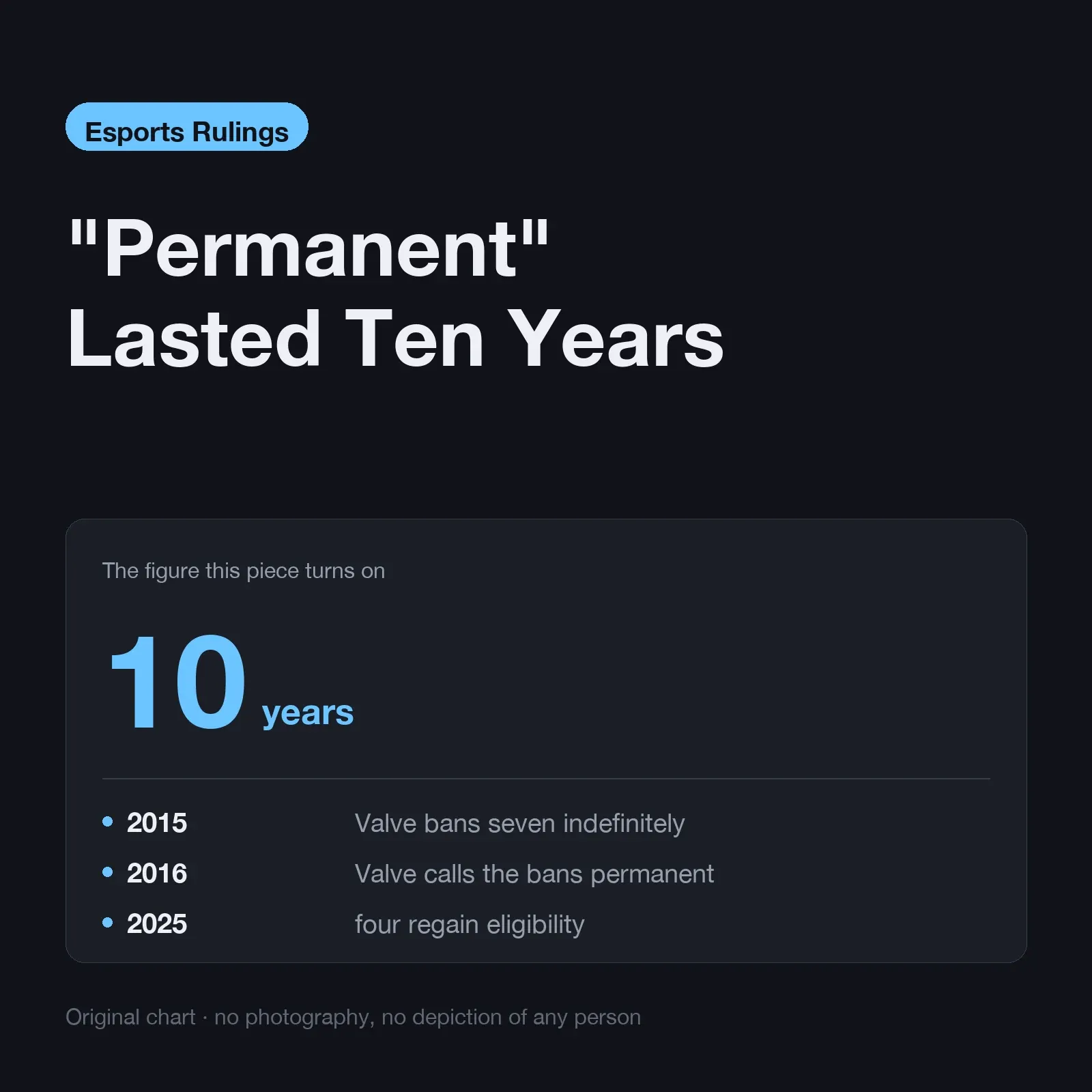
| January 26, 2015 | Valve bans seven people — players Sam “DaZeD” Marine, Braxton “swag” Pierce, Keven “AZK” Larivière, Joshua “steel” Nissan, plus Derek “dboorn” Boorn, Duc “cud” Pham, and Casey Foster — from Valve-sponsored events, calling it indefinite | Tyler “Skadoodle” Latham, who declined his share of the winnings, is not banned |
| January 2016 | Valve states on the Counter-Strike blog that the bans are permanent | Removes the ambiguity in “indefinite” — publicly, this is now framed as never being lifted |
| August 1, 2017 | ESL lifts its own ban on the players (not Valve’s) | The first crack, from a different organizer entirely |
| September 6, 2017 | DreamHack follows ESL’s lead | Non-Valve events are now open again |
| January 26, 2025 | Steel posts that he is clear to play at Valve-partnered events, exactly ten years after the original ban | The first public claim that “permanent” had an end date |
2. The permanent ban was never a single decision
The part that gets flattened in the retelling is that “banned by Valve” and “banned everywhere” stopped being the same thing in 2017. ESL and DreamHack are separate organizers; they run their own events and can set their own eligibility rules. When they lifted their bans, the players could compete again at ESL and DreamHack events — just not at Valve Majors or other Valve-sponsored tournaments, where the original ban still applied.
So by 2017 there were already two different bans running on two different clocks, even though the public conversation kept referring to “the ban” as one thing. The Valve ban — the one Valve itself had called permanent in writing — is the one that took until 2025 to move at all.
3. What actually changed in 2025, and who said so
This is the detail that matters most: there is no public Valve statement announcing the 2025 change. What exists is Joshua “steel” Nissan posting that he would be eligible to attend Valve-partnered events starting January 26, 2025 — the ten-year mark from the original ban — and Braxton “swag” Pierce engaging with that post without issuing his own statement about his eligibility.
No public statement from Valve confirms this, sets out its scope, or explains why ten years specifically. What is confirmed is limited to what the players themselves have said. The other three named in the original 2015 ban — dboorn, cud, and Foster, none of whom were players — have not been reported on in connection with any 2025 change, and their status is not addressed in the sources we reviewed.
4. What it cost, and for how long
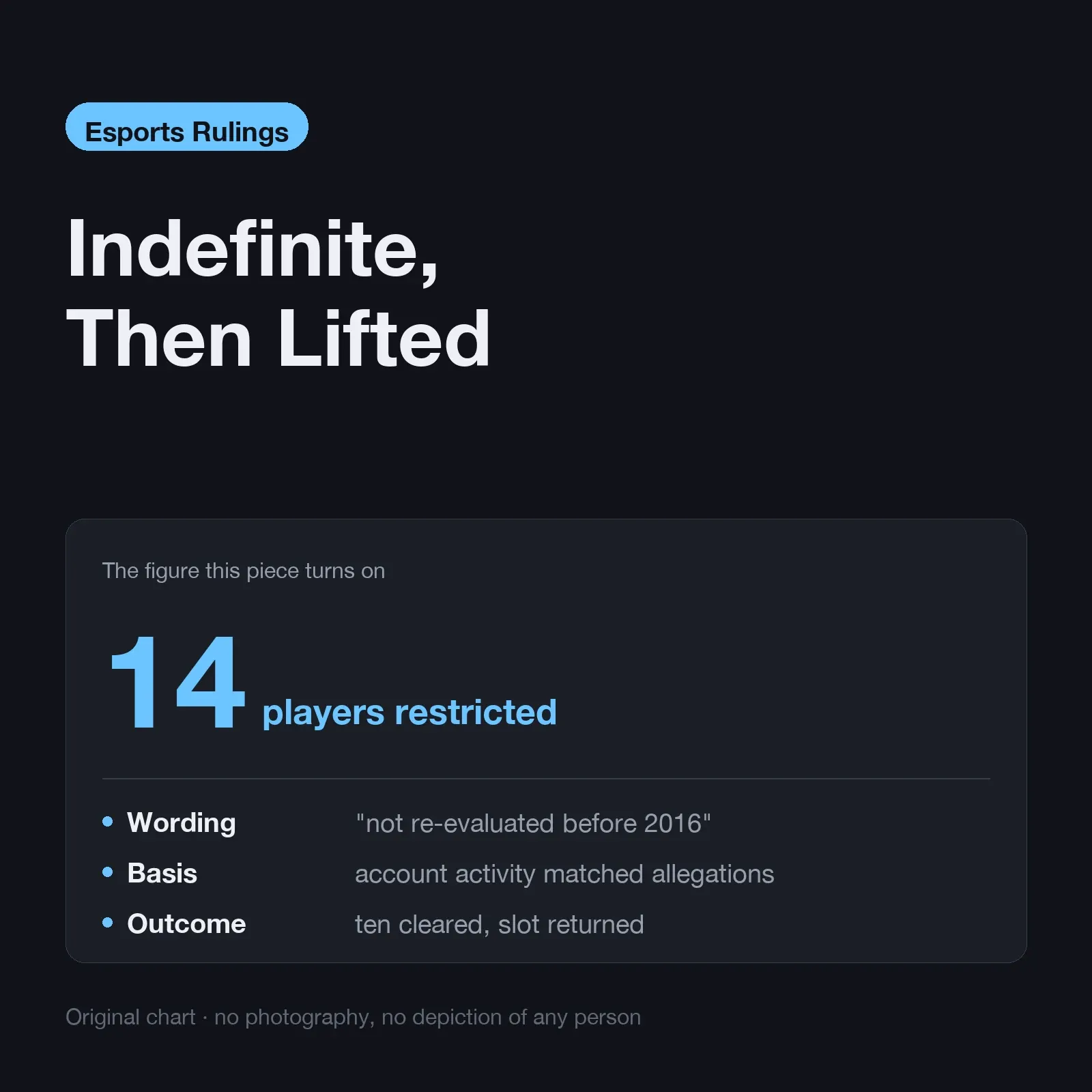
- DaZeD, swag, AZK, steel (players): banned from Valve-sponsored events from January 2015; ESL and DreamHack eligibility restored in 2017; Valve-event eligibility reported by steel as restored January 26, 2025 — ten years, if the ten-year framing is accurate.
- dboorn, cud, Foster (non-players who arranged or profited from the bets): banned in the same January 2015 announcement; no reported change in status found.
- Skadoodle: no ban, on the record of having declined the payout.
The contrast with forsaken’s case three years later is instructive: there the proof was sitting on the machine and the ruling took hours. Here it took months of argument about what a thrown match looks like from the outside. A third variety appears in the StarCraft II case, where the question left the federation entirely and went to a court.
5. What is confirmed and what is not
Confirmed — the August 2014 match, Richard Lewis’s reporting, the January 26, 2015 ban and its seven names, Valve’s January 2016 statement that the bans were permanent, the 2017 ESL and DreamHack reinstatements and their dates, and steel’s own January 2025 public statement about his Valve-event eligibility.
Not confirmed here — any official Valve announcement, statement, or policy document setting out the 2025 change, its scope, or its reasoning. We also did not find confirmation, beyond steel’s statement and swag’s public engagement with it, that swag’s ban was lifted on the same terms. The status of DaZeD and AZK following the 2025 reports, and the status of dboorn, cud, and Foster at any point after 2015, is not established in what we reviewed.
We did not attempt to establish why ten years was the figure Valve is reported to have used, or whether it reflects a documented internal policy rather than a coincidence of timing that steel identified himself.
In one line
Valve put “permanent” on a Counter-Strike blog in 2016 — and ten years later, the only public word that it had ended came from one of the banned players, not from Valve.
Sources
- Wikipedia’s article on the Counter-Strike match-fixing scandal — sets out the August 2014 match, the January 26, 2015 ban list of seven names, the 2017 ESL and DreamHack reinstatement dates, and the January 26, 2025 restoration of Valve-event eligibility for the four named players.
- GosuGamers’ report on Valve’s permanent-ban clarification — quotes Valve’s 2016 statement that “the bans for these players are permanent.”
- HLTV’s report on steel’s ban elapsing — confirms steel’s own January 2025 statement about his eligibility and notes the absence of confirmation for other named players.
- GGRecon’s report on the 2025 development — confirms no other banned player besides steel had made a public statement on eligibility, and that swag engaged with steel’s post without confirming his own status.
All four pages were opened and read on 30 August 2026.