Most of the rulings in this series turn on something the player did not intend. A towel on wet ground. A ball that moved a fraction of an inch. A local rule nobody read.
This one is different. Lee Seung-hyun, who played as Life, agreed to lose matches he was paid to lose. What makes the case worth writing down is not that he was punished — it is that he was punished twice, by two systems that do not answer to each other, and only one of them was about esports.
1. What he was before
By the end of 2015 Life had, by Wikipedia’s count, the second-highest number of premier StarCraft II tournament wins of any player and the second-largest prize earnings, around US$475,000. The record includes the 2014 WCS Global Finals, GSL titles in 2012 Season 4 and 2015 Season 1, two DreamHack events, two MLG events and an IEM title.
That matters here for one reason: it sets the size of what the ruling took away. A marginal player losing a ban loses a job. He lost a career at its peak.
2. The two tracks
| Track | Who decided | What it did |
|---|---|---|
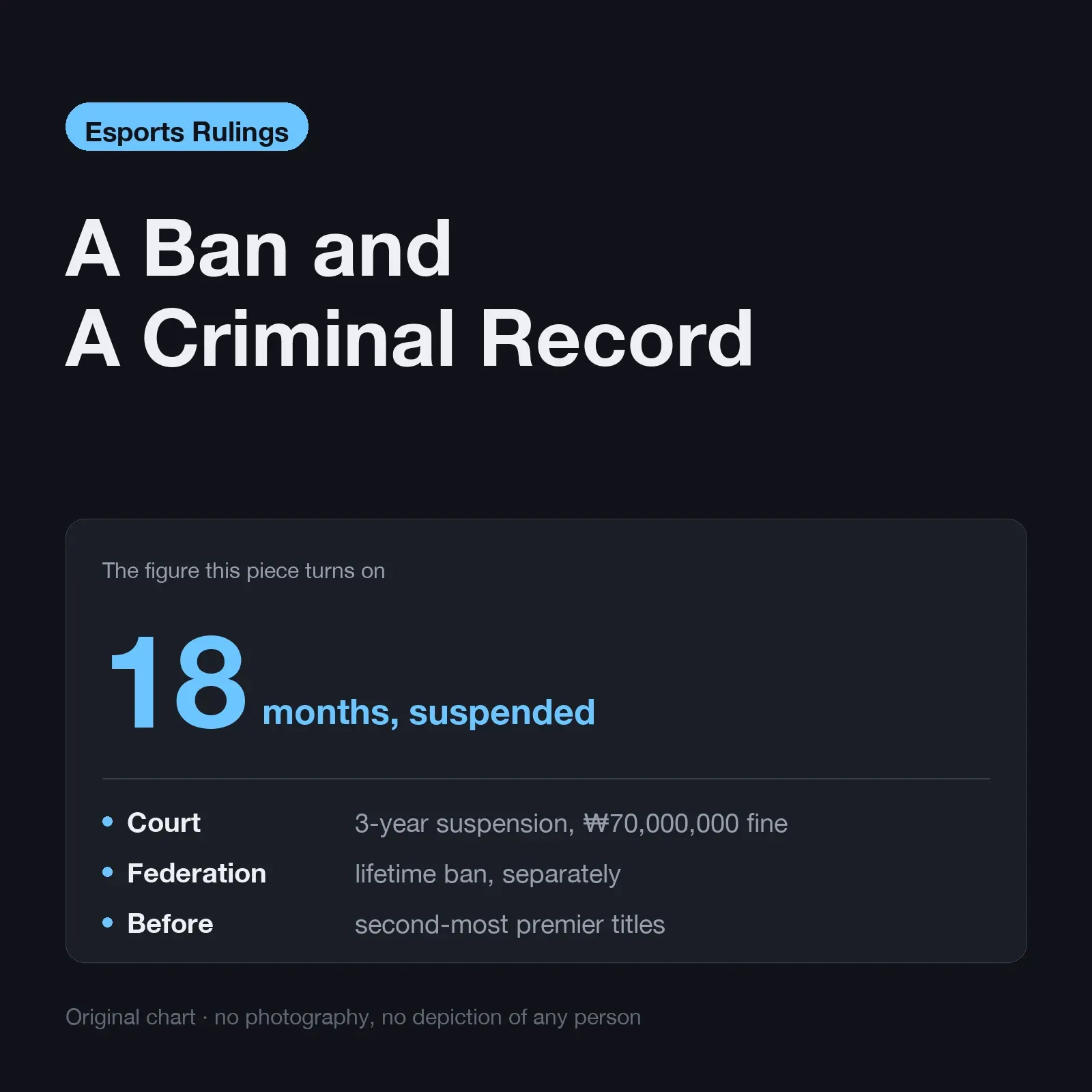
| Criminal | A South Korean court | 18 months’ imprisonment, suspended for three years, plus a fine of ₩70,000,000 |
| Federation | KeSPA (Korea e-Sports Association) | A lifetime ban from Korean esports events |
Two separate processes on the same conduct. Neither is an appeal of the other, and neither depends on the other’s outcome.
This is the structural point. In golf, a rules body can take your prize money and your place in the field, and that is the end of its reach — the R&A cannot fine you or put you on probation. Match-fixing crosses out of the rulebook and into a criminal code, and at that point a second authority applies its own penalties on its own schedule.
3. The sequence
| When | What happened |
|---|---|
| 2015 | The matches at issue — KeSPA Cup games he was paid to lose |
| 29 January 2016 | Arrested as part of the prosecution’s investigation |
| 21 April 2016 | Prosecutors announce the finding that the losses were deliberate |
| 2016 | Sentenced: 18 months suspended for three years, ₩70,000,000 fine |
| — | KeSPA imposes a lifetime ban |
Reported accounts describe the payment as around ₩70,000,000 — the same figure as the fine — and note it was several times the prize money on offer in the event itself. That detail is what the two-track structure ends up answering: the federation can take the prize; only a court can take the payment.
The other match-fixing case in this series, iBUYPOWER in 2015, stayed inside the industry — a publisher barred players from its own events, and that was the extent of it. Compare that with what happened here, and with forsaken’s case, where the evidence was immediate but the authority was still only a federation.
4. What is confirmed and what is not
Confirmed across three independent sources — the sentence (18 months, suspended three years), the fine (₩70,000,000), the separate KeSPA lifetime ban, the arrest date, the April 2016 prosecution announcement, and the career record above.
Not confirmed, and stated as such:
- The 2014 WCS title. Several accounts say the championship was revoked. Wikipedia’s own article on the 2014 WCS Global Finals still lists him as the winner, and we could not find the revocation recorded anywhere primary. Both readings are in circulation; we are not choosing between them.
- The co-defendant’s name. English sources spell it two different ways. Because that is a named living person and we could not reach a court document, this piece uses only the handle Bbyong and notes the discrepancy rather than picking a spelling.
- The final judgment date. One source describes an appeal dismissed in July 2016; the others do not mention an appeal at all. We could not settle when the sentence became final.
- The statute. Korean criminal law was applied, but we did not reach the judgment or the statute text, so no provision is named here.
- Korean-language reporting. The original Korean coverage is likely the most precise record. Our attempts to open it were blocked, so everything above rests on three English-language sources read directly.
In one line
Two thrown matches cost him a career, a fine equal to what he was paid, a suspended prison sentence, and a lifetime ban — the ban from the sport, the sentence from the state, neither one waiting on the other.
Sources
All opened and read on 30 August 2026.
- Wikipedia’s article on Life — the sentence and fine (“18 months of imprisonment with a suspended sentence for three years… fined ₩70,000,000”), the KeSPA lifetime ban, and the career record including the second-highest premier title count and roughly US$475,000 in earnings.
- ESPN’s account of his rise and fall — the January 2016 arrest, the April 2016 prosecution announcement, and the payment figure.
- Esports Legal News on the StarCraft II match-fixing case — corroborates the sentence and arrest date, and is the only source of the three to mention an appeal.
- Wikipedia’s article on the 2014 WCS — checked specifically for a revocation of the title, which it does not record.