Team Prime’s head coach was in debt. His players were not being paid. Somewhere in that gap, two of them agreed to lose matches for cash — and one of them kept losing matches after the cash stopped, because someone threatened to expose what he had already done.
That second part is the one worth sitting with. It does not make the match-fixing anything other than match-fixing. It does change who was pulling the strings by the end.
1. What happened, in order
| Step | What happened | Why it mattered |
|---|---|---|
| January–June 2015 | Team Prime, in financial trouble, stops paying its players on time | Sets the condition the rest of the case grows out of |
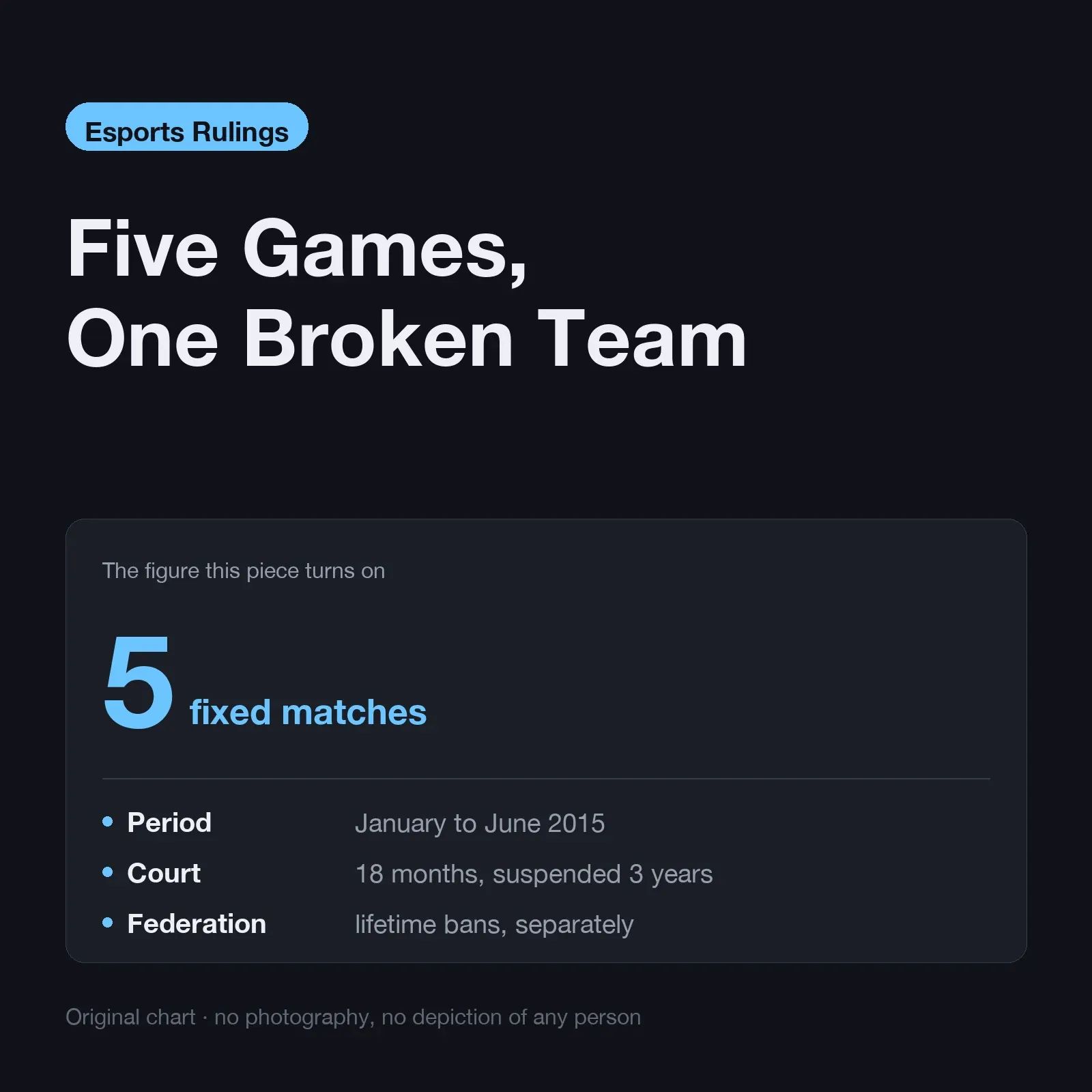
| Jan–Jun 2015 | Five matches across Proleague and GSL (Code A and Code S) are fixed | The scope of the scheme — not one game, five |
| Undated, within that window | Player BBoongBBoong takes payment to lose one Proleague match | First documented instance |
| Undated, within that window | Player YoDa takes payment to lose two matches | Second player, two matches, for cash |
| Undated, within that window | YoDa is blackmailed into fixing two further matches for no payment | The threat: expose what he had already done unless he did it again |
| 19 October 2015 | Arrests and indictments begin; 12 people identified across the scheme | Coach, players, and a ring of brokers and betting-site contacts |
| 31 March 2016 | Sentencing | 18 months’ imprisonment, suspended for three years, with fines |
| — | KeSPA bans coach Gerrard, BBoongBBoong, and YoDa for life | The federation’s own track, separate from the court |
2. The real starting point was not the players
The instinct is to read this as two players who decided to cheat. The record reads differently: the team was already in trouble before either of them fixed anything.
Head coach Park “Gerrard” Oi Shik was, by the reporting, heavily in debt, and Team Prime’s players were going unpaid. That is the condition the fixing grew out of — not a sudden decision to cheat a game that was otherwise healthy, but a team already breaking financially, with match-fixing as one of the ways that showed up on the ladder.
This is the same shape as Life’s case in one respect and the opposite in another. Both are StarCraft II, both end in a criminal sentence plus a KeSPA lifetime ban, and both involve losing matches on purpose for cash. But Life fixed two matches as one of the sport’s top individual earners, acting alone. Here, the fixing starts from a team already in financial collapse, and the person with the most control over the outcome — the coach — was the one in debt, not the players on stage.
3. The people, and what they did
- Park “Gerrard” Oi Shik, head coach. Reported as heavily in debt, with the team’s finances cited as the backdrop to the scheme. Received a lifetime KeSPA ban.
- Choi “BBoongBBoong” Jong Hyuk, player. Took roughly ₩5,000,000 (about $4,500) to lose one Proleague match. Lifetime KeSPA ban.
- Choi “YoDa” Byung Hyun (sources also render this Byeong Heon), player. Took a total of roughly ₩30,000,000 (about $26,600) to fix two matches. He was then blackmailed into fixing two further matches for no payment, under threat that what he had already done would otherwise be exposed. Lifetime KeSPA ban and, per one source, a suspended progaming license.
That sequence — paid twice, then pressured into two more games for nothing — is why YoDa’s five-match total sits differently from BBoongBBoong’s single one. He is not less responsible for the first two. But the last two were not a decision made freely the same way the first two were.
Six more people, described as brokers and financial backers connected to illegal betting, were arrested and indicted alongside the three Team Prime members, for twelve people identified in total.
4. What was lost
- Careers. All three Team Prime figures received lifetime bans from KeSPA events.
- A license. At least Gerrard and YoDa had their progaming licenses suspended, per one source.
- Money going the other way. Beyond the fines from the court, KeSPA’s ban ends any further income from KeSPA-run competition.
- Liberty, suspended. Eighteen months’ imprisonment, suspended for three years — a sentence that does not put anyone behind bars unless the terms are broken, but stays on the record as a criminal conviction.
5. What KeSPA said about the future, not just this case
| When | What KeSPA said or did |
|---|---|
| October 2015 | Announces the lifetime bans for Gerrard, BBoongBBoong, and YoDa |
| October 2015 | States that anyone else later found to be involved “will be banned for life regardless of the result of a trial” |
Read plainly, that second line separates KeSPA’s own penalty from the court’s. The federation was not waiting on a verdict to decide who could keep playing in its events — it set the ban ahead of the trial outcome for anyone it later identified. We have not found a record of the sentencing outcome changing any of the three bans already issued; the two tracks ran on their own schedules, the same structural point as Life’s case.
6. What is confirmed and what is not
Confirmed across at least two independent sources — the three names and roles (Gerrard, BBoongBBoong, YoDa), the arrest/indictment date of 19 October 2015, the sentencing date of 31 March 2016, the sentence (18 months, suspended three years), the five fixed matches across Proleague and GSL Code A/Code S in the January–June 2015 window, the lifetime KeSPA bans for all three, BBoongBBoong’s payment of roughly ₩5,000,000, and YoDa’s payment of roughly ₩30,000,000 for two matches.
Reported in one source, at one remove — the blackmail detail: that YoDa was pressured into fixing two additional matches for no payment under threat of exposure. It appears in GosuGamers’ report and not in the other two we read, and that report itself hedges it: “According to reports, YoDa was also blackmailed into fixing two more games with no compensation under the threat that his deed would be otherwise exposed.” So this is a single outlet relaying someone else’s reporting, and we could not reach the account underneath it. It is in this piece because it changes what the case is, but it is the least-supported thing here — read the rest of the page as established and this line as reported.
Not confirmed here:
- The exact fine amounts. One source describes “varying fines” for the group without a breakdown; we did not find per-person figures.
- Whether all 12 people were arrested, or only indicted. Accounts differ on how many of the twelve were physically arrested versus charged; at least one describes some individuals as indicted but not arrested, and one as still at large at the time of reporting. We did not find a later account resolving this.
- YoDa’s given name spelling. Sources render it both “Byung Hyun” and “Byeong Heon.” We use the former, from the source with the fuller account of the case, and note the discrepancy rather than picking silently.
- Whether progaming license suspension applied to BBoongBBoong as well. One source names it only for Gerrard and YoDa.
- Appeal outcomes. We found no record of an appeal in either direction.
In one line
A coach in debt, players going unpaid, five matches fixed for cash — and one of the two players who took that cash was then blackmailed into fixing two more games for nothing.
Sources
All opened and read on 31 August 2026.
- Esports Legal News on the StarCraft II match-fixing scandal — names Park “Gerrard” Oi Shik, Choi “YoDa” Byung Hyun, and Choi “BBoongBBoong” Jong Hyuk; the arrest date of 19 October 2015; the sentencing date of 31 March 2016; the sentence of 18 months suspended for three years “along with varying fines.”
- Blizzard Watch’s report on the arrests — 12 people indicted, the team name PRIME, five matches across January–June 2015, the line “the team was apparently in dire financial straits, with Gerrard heavily in debt and team members not getting paid,” and KeSPA’s lifetime ban of Gerrard, BBoongBBoong, and YoDa.
- GosuGamers’ account of the arrests and bans — the payment figures (₩5,000,000 for BBoongBBoong, ₩30,000,000 for YoDa’s two matches), the sentence quoted as “18 months in prison, suspended for three years,” the line “YoDa was also blackmailed into fixing two more games with no compensation under the threat that his deed would be otherwise exposed,” the license suspensions for Gerrard and YoDa, and KeSPA’s statement that future participants found involved “will be banned for life regardless of the result of a trial.”
Where the three accounts differ — on exact arrest-versus-indictment counts, and on the spelling of YoDa’s given name — this piece states the disagreement rather than resolving it by guess.