True Temper’s Dynamic Gold is one of the longest-running names in steel iron shafts. Checking the official spec table on truetemper.com, we confirmed five flexes: R300, S200, S300, S400, and X100.
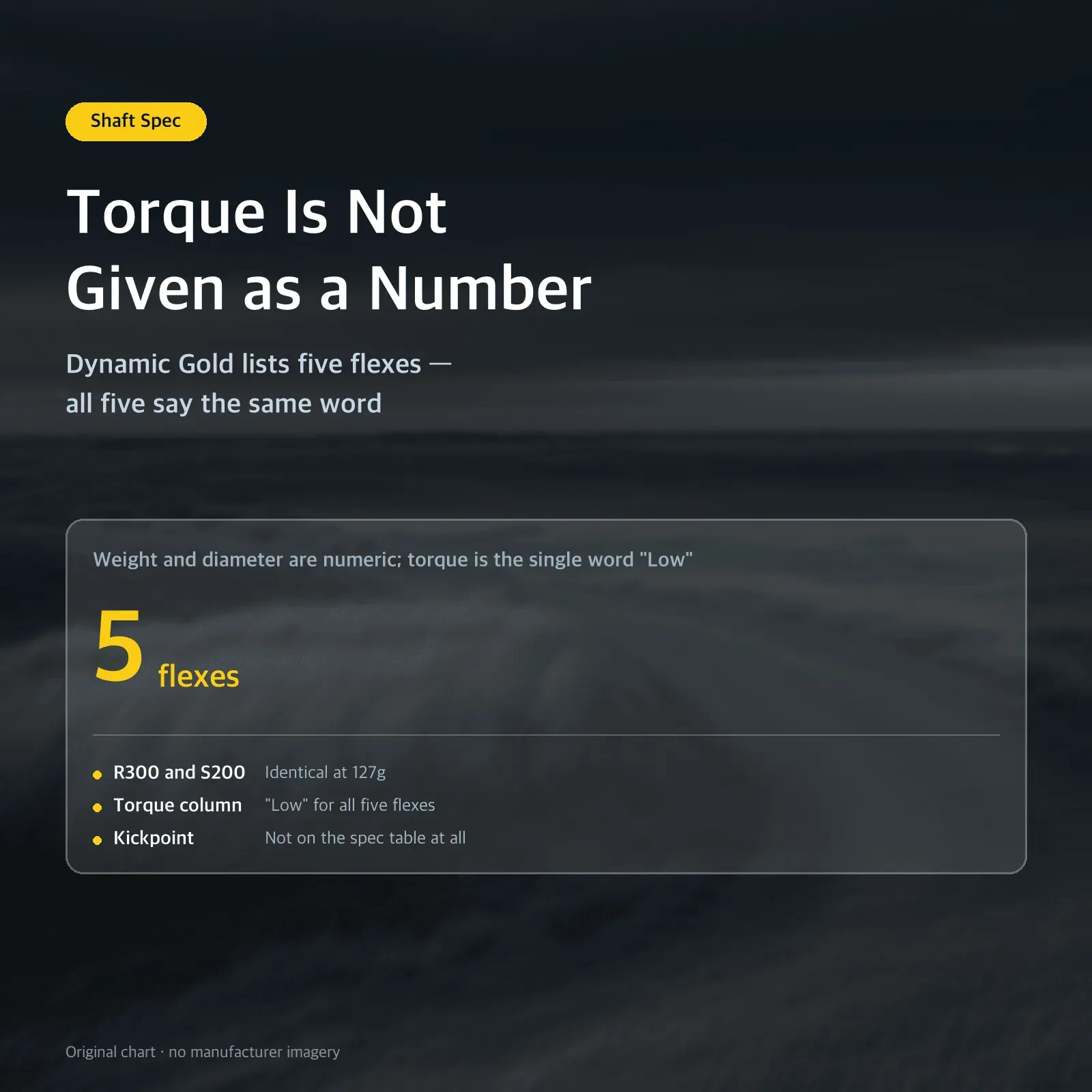
The first thing that stood out working through the table wasn’t weight — it was the torque column. All five flexes show a single word, “Low,” instead of a number.
1. Five flexes, weight ranging 127–132 grams
| Flex | Weight | Tip diameter | Butt diameter | Torque |
|---|---|---|---|---|
| R300 | 127 g | 0.355 in | 0.580 in | Low |
| S200 | 127 g | 0.355 in | 0.600 in | Low |
| S300 | 130 g | 0.355 in | 0.600 in | Low |
| S400 | 132 g | 0.355 in | 0.600 in | Low |
| X100 | 130 g | 0.355-0.370 in | 0.600 in | Low |
Dynamic Gold — Five Flexes as Published — every value taken from the official spec table on truetemper.com. Kickpoint does not appear on the table for any of the five flexes.
R300 and S200 sit side by side at 127 grams. S300 climbs to 130 grams, S400 to 132 grams, and X100 comes in at 130 grams. Tip diameter is 0.355 inches across the board, except X100, listed as 0.355–0.370 inches. Butt diameter is 0.580 inches for R300 and 0.600 inches for the other four.
| Weight | Flexes at that weight | What it means |
|---|---|---|
| 127 g | R300 and S200 | An “R” and an “S” at the same weight |
| 130 g | S300 and X100 | An “S” and an “X” at the same weight |
| 132 g | S400 only | The one weight unique to a single flex |
Weight Does Not Track the Flex Label — two pairs share a weight; only one flex has a weight of its own. Within the S flexes alone the order does hold: S200 127 g, S300 130 g, S400 132 g.
One thing worth flagging: R300 and S200 share the same 127-gram weight. “R” and “S” are typically used to distinguish softer from stiffer flex, but by weight alone, the two are identical here. Weight and flex label don’t move together in lockstep on this table — weight alone won’t distinguish R from S in this line.
Moving from S300 to S400, weight separates again — a 3-gram jump from S200 to S300, then a further 2-gram jump to S400. Within the “S” flexes alone, S200/S300/S400 climb in order (127/130/132 grams), with R300 sitting alongside S200 at the same weight. X100 shares its 130-gram weight with S300. Of the five flexes, two pairs share an identical weight (R300–S200, S300–X100), and only S400 has a weight unique to itself.
2. Torque is one word — “Low” — and kickpoint isn’t listed at all
None of the five flexes carries a decimal-point torque figure. R300 and S400 alike are listed simply as “Low.” Whether torque changes meaningfully as flex increases, and by how much, can’t be determined from a word alone.
Kickpoint doesn’t appear on the spec table at all. Some competing shaft lines at least offer a qualitative kickpoint label; Dynamic Gold’s official table leaves that field out entirely. This piece covers only the core R300–X100 lineup and doesn’t extend to derivative lines like AMT.
Tip and butt diameter show relatively little variation across the five flexes. Tip diameter has a range only for X100 (0.355–0.370 inches); the rest are fixed at 0.355 inches. Butt diameter is 0.580 inches for R300 alone, with the other four sharing 0.600 inches. In practice, the physical numbers that actually distinguish the five flexes come down mostly to weight, plus R300’s butt diameter and X100’s tip range — everything else is largely shared.
3. What a qualitative label obscures
The word “Low” tells you all five flexes fall into the low-torque category as a general direction. It doesn’t tell you how much torque actually differs between R300 and X100. A number would let you calculate that gap directly; a qualitative label forecloses that calculation.
The contrast sharpens against other current steel shafts. Nippon’s N.S.PRO 950GH publishes a 0.3° torque range from R (2.0°) to X (1.7°), and MODUS³ TOUR 120 publishes the same 0.3° range from R (1.8°) to TX (1.5°) — both as numbers. Whether that same kind of range exists in Dynamic Gold, and how wide it might be, simply isn’t answerable from the official spec table alone. There’s no way to tell from the table whether all five “Low” entries are the same value or five different ones.
None of this is to call it a flaw. Dynamic Gold is a long-running line that appears to have kept this disclosure style for a long time. Set alongside Nippon’s shafts, which publish torque down to a decimal point, it does show that the same spec-table field can carry very different amounts of information depending on the brand.
What you can practically ask about in a fitting session also depends on this disclosure gap. “What’s the torque on this flex, in degrees” isn’t something the official material can answer. “Is this flex in the low-torque category” is about as far as the published spec supports. Anyone who wants an actual number needs to look past the official spec sheet, to independent shaft measurement data or in-store equipment.
Among current steel shaft options, Dynamic Gold’s S200 (127 grams) sits at the heavier end of the S-flex range. It’s heavier than average and, at the same time, discloses less torque information than average — two separate facts that happen to sit on the same shaft.
4. Who this fits
Based on the confirmed specs. This does not substitute for an actual fitting.
- Golfers choosing between R300 and S200 on a basis other than weight — the two flexes are identical at 127 grams, so weight alone won’t separate them.
- Golfers looking for a long-established, well-proven steel shaft — Dynamic Gold is among the longest-running names in this category.
May not fit:
- Golfers who want to compute the torque gap between flexes from published numbers — all five flexes are listed only as “Low,” with no decimal value to compare.
- Golfers who want even a qualitative kickpoint label — the field isn’t on the spec table at all.
5. What we could not confirm
| Item | Status |
|---|---|
| Numeric torque, in degrees, per flex | Official table lists “Low” only |
| Kickpoint | Field is not on the spec table |
| Derivative lines such as AMT | Not covered in this piece |
| CPM (frequency) | Not confirmed |
| Manufacturer distance and feel claims | Not independently verifiable, not cited |
What Could Not Be Confirmed — left blank rather than filled in. Recorded as “not confirmed,” not as “does not exist.”
- Numeric torque values (in degrees) for the five flexes — the official table lists “Low” only.
- Kickpoint figures — the field isn’t on the spec table.
- Specs for derivative lines such as AMT — not covered in this piece.
- CPM (frequency) — not confirmed.
- Manufacturer distance/feel claims — not independently verifiable, so not cited here.
Summary
Dynamic Gold has a spot where the flex label and the actual weight don’t track together — R300 and S200 sit at the same 127 grams. And torque, across all five flexes, is disclosed only as the single word “Low.”
For a golfer who wants numeric comparison, this qualitative labeling may be frustrating — but it isn’t unique to Dynamic Gold. It’s one example of a broader pattern: torque-disclosure practices differ sharply from brand to brand, with fully numeric disclosure (as in Nippon’s N.S.PRO 950GH and MODUS³ lines) sitting at the opposite end from Dynamic Gold’s single-word approach.
Every figure in this piece came from True Temper’s official spec sheet. Where we couldn’t confirm a value, we left it blank rather than guess.
Sources
- Dynamic Gold — True Temper — official spec table confirmed live: R300 127g, S200 127g, S300 130g, S400 132g, X100 130g, all five flexes listed with torque “Low.” Tip/butt diameters match the body’s table exactly.
🔴 Unpublished by the manufacturer: kickpoint. Dynamic Gold’s official table leaves the field out entirely, where some competing lines give at least a qualitative label.
One archived URL is recorded above, and it confirms every figure cited in this piece’s spec table. Items the source does not publish are named as unconfirmed rather than estimated.