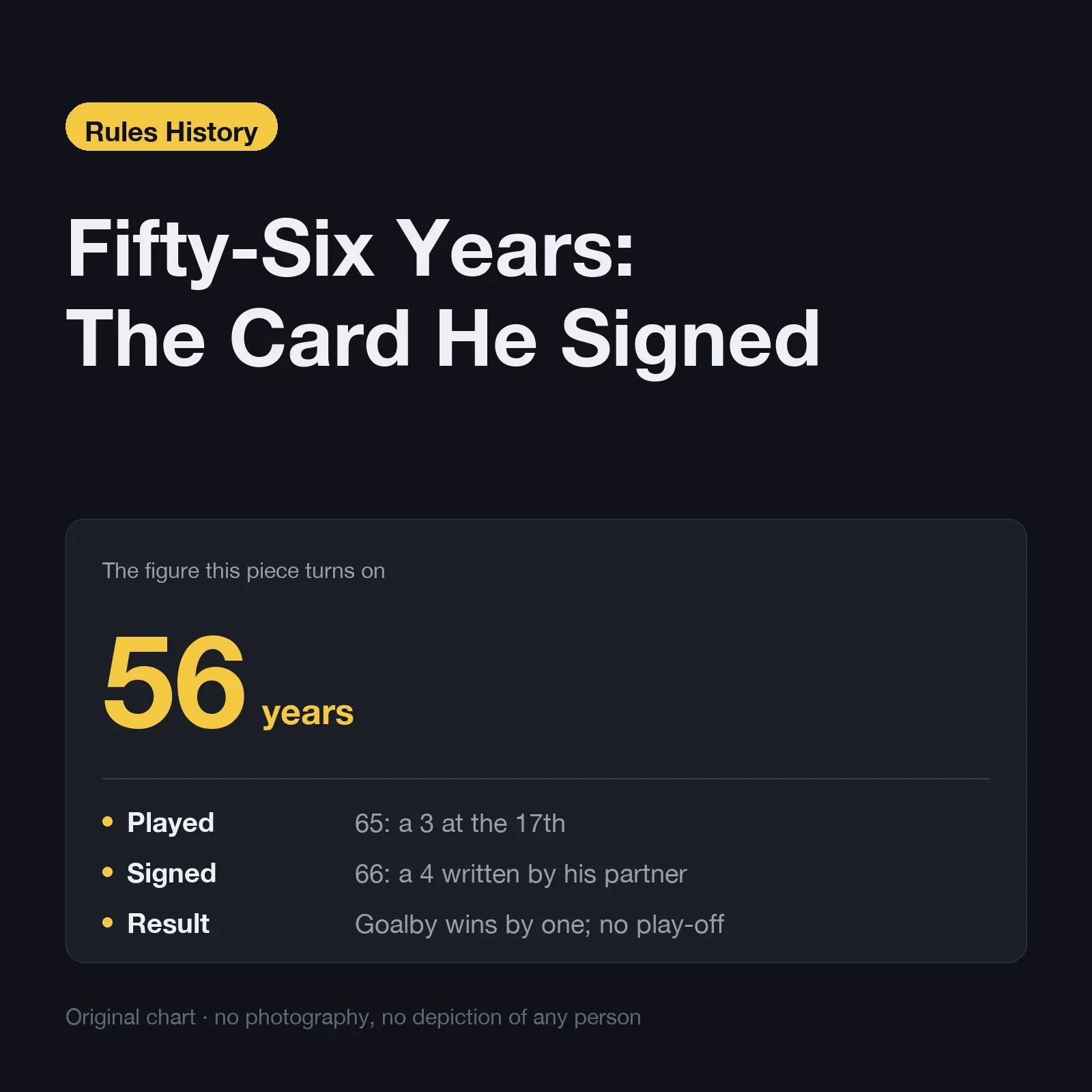
A television viewer sent an email about something that had happened the day before. By the time Lexi Thompson reached the 13th tee of the final round of a major, it had cost her four strokes. Nobody in the story broke a rule, and she lost the tournament.
1. What happened
| Step | What happened | Why it mattered |
|---|---|---|
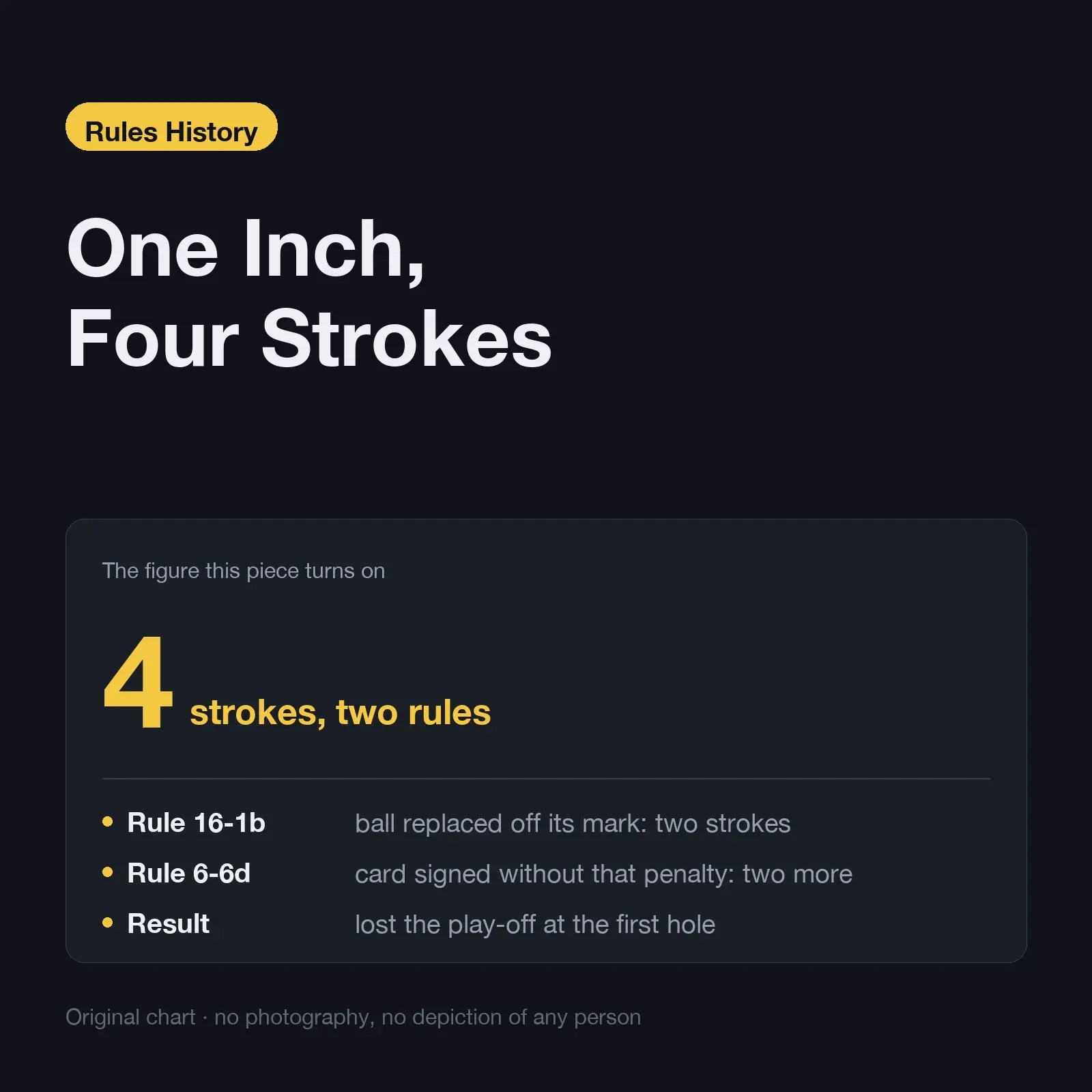
| Third round, 17th green | Thompson marks her ball, lifts it, and in the USGA’s words replaces it “in a slightly different position” | A ball played from the wrong spot breaches Rule 16-1b — two strokes |
| That evening | She signs a card that does not include a penalty nobody has noticed | Under Rule 6-6d that is a further breach — two more strokes |
| Final round, after 12 holes | An LPGA Tour referee walks out to tell her, with a two-stroke lead | Four strokes are applied mid-round, to a round already in progress |
| The finish | She birdies the 13th and plays the last six in three birdies and a bogey | She reaches a play-off and loses it at the first hole to So Yeon Ryu |
2. The email is not the interesting part
The retelling always leads with the viewer. The harder fact is that the penalty was two penalties, and only one of them is about the ball.
The first, under Rule 16-1b, is for the replacement itself. The second, under Rule 6-6d, is for signing a card that omitted a penalty she did not know she had incurred. It is a penalty for an administrative consequence of the first penalty, applied a day later, to a player who could not have avoided it.
Two strokes for the inch. Two more for not having known about the inch.
That second one is what made the number four, and it is the one that the governing bodies removed within the year.
3. What the rule did not ask
It did not ask whether the mismark was intentional — nobody has ever suggested it was. It did not ask whether it helped: replacing a ball fractionally off its mark on a putt of that length changes nothing anybody can measure.
And crucially, the second penalty did not ask whether she could have known. Under the rules as they stood, a card signed without a penalty you were unaware of was still an incorrect card. The state of your knowledge was not an input.
4. What it cost
- Four strokes, applied during the final round of a major.
- A two-stroke lead, which became a two-stroke deficit in the time it took to walk to a tee.
- The 2017 ANA Inspiration, lost at the first play-off hole.
- Her only major remains the 2014 edition of the same tournament. She announced her retirement from full-time golf in 2024, at twenty-nine. We put those facts next to each other and claim no causal link between them.
The most damning assessment came from the commissioner of the tour that imposed it. Mike Whan: “The penalty in this case doesn’t fit the crime and it drives me crazy.” He put the structural problem more precisely still — “It’s a great example of something that’s 100 percent right by the rules and feels 100 percent wrong on all functions.” That sentence is the premise of this entire series.
Sue Witters, the official who had to walk out and deliver it, gave the only defence available, and it is a real one: “I can’t go to bed tonight knowing I let a rule slide. It’s a hard thing to do, and it made me sick, to be honest with you.”
5. Did the rule change?
Yes — both routes were closed, and quickly.
On 11 December 2017, the R&A and the USGA, with a working group including the PGA Tour, the LPGA, the PGA European Tour, the Ladies European Tour and the PGA of America, announced two measures effective 1 January 2018:
- Tournaments would “assign one or more officials to monitor the video broadcast of a competition to help identify and resolve Rules issues as they arise”; and
- golf would “discontinue any steps to facilitate or consider viewer call-ins as part of the Rules decision process.”
- A Local Rule was approved “to eliminate the additional two-stroke penalty for failing to include a penalty on the score card when the player was unaware of the penalty.”
Read those together and both halves of Thompson’s four strokes are addressed: the channel that delivered the report, and the second penalty that doubled it.
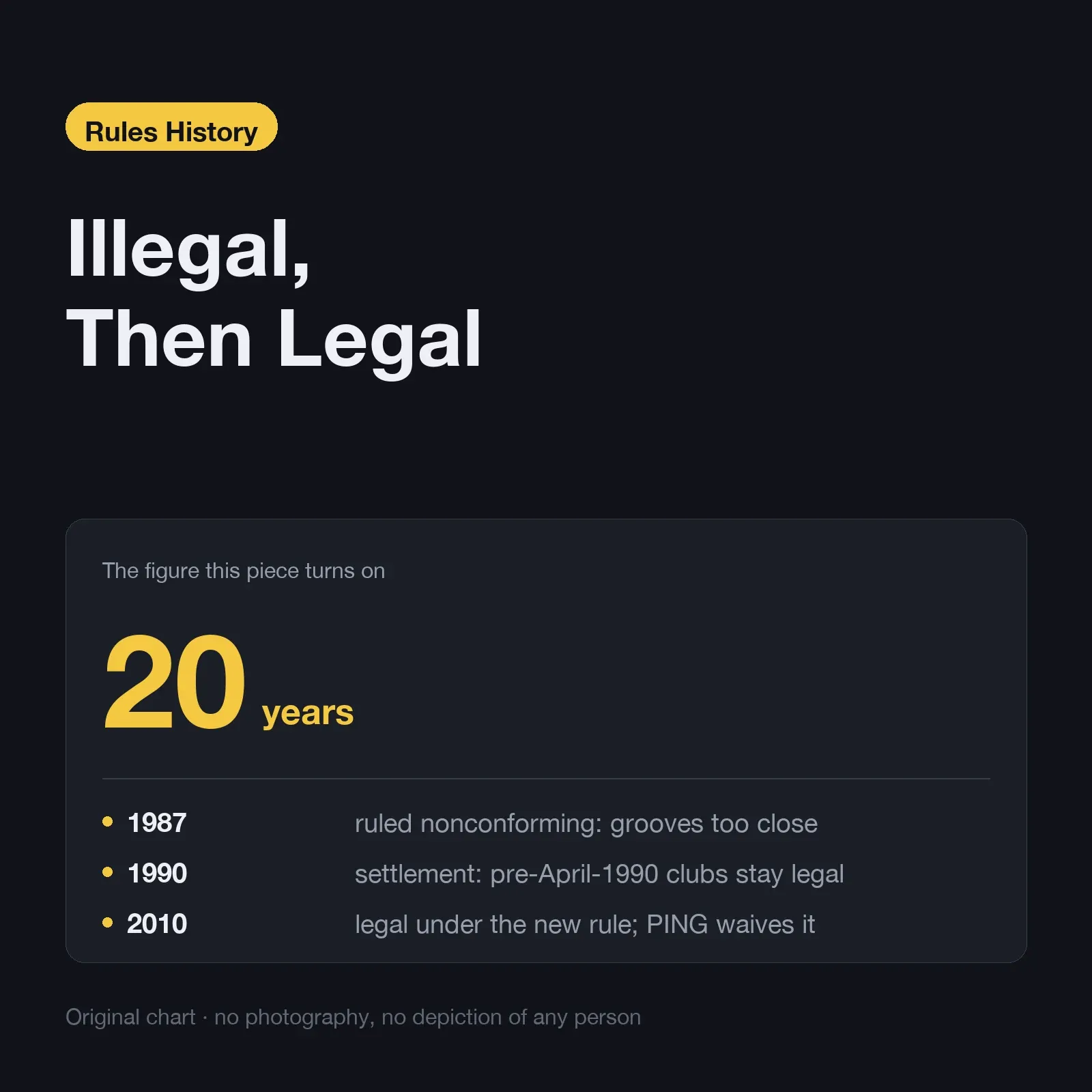
There is a longer arc here. This series opened with a man disqualified in 1987 because a viewer picked up a telephone, and it ran through a viewer’s email in 2011. For roughly thirty years, anybody with a television was effectively an official. That ended on 1 January 2018, and this is the case that ended it.
6. What is confirmed and what is not
Confirmed — the round and hole, the two rules and their penalties, the timing “through 12 holes,” the referee’s approach and the two-stroke lead all come from the USGA’s own account of the ruling. The December 2017 announcement is quoted from the joint statement.
Not confirmed here — the measurements. The widely repeated figures of a one-inch replacement error on a fifteen-inch putt do not appear in the USGA’s account, which says only that the ball was replaced “in a slightly different position.” Those numbers come from press coverage. We report them as circulating figures and do not present them as established.
Sources disagree on the lead. ESPN’s contemporaneous report gives a three-shot advantage before the penalty was announced. The USGA says a two-stroke lead through 12 holes. We follow the USGA and note the disagreement rather than picking silently.
One reporter, not several. Coverage consistently describes a single emailed report from one viewer, and the sender’s identity was never made public. That is a contrast worth noting against the 1987 case, where accounts describe “viewers” in the plural and we could not establish how many calls there were.
Rule numbering. Some coverage cites Rule 20-7c for the wrong-place play. The USGA’s own explanation gives 16-1b, and that is what is used here.
In one line
A one-day-old, unmeasurable ball-marking error produced two separate penalties totalling four strokes, was reported by an anonymous email, was applied correctly under every rule in force, and cost a major — after which golf changed both rules that allowed it.
Sources
- Inside the Lexi Thompson Penalty — USGA — the third-round 17th green, “replaced it in a slightly different position,” Rule 16-1b at two strokes, the further breach under Rule 6-6d, the four-stroke total, and the “two-stroke lead through 12 holes”
- Video Review Protocols Introduced for Broadcast Golf Events — Golf Business News — the 11 December 2017 joint announcement, the monitoring-official and viewer-call-in wording quoted above, the Local Rule on the additional two-stroke penalty, and the 1 January 2018 effective date
- Lexi Thompson gets 4-shot penalty, loses major after viewer tip — ESPN — the contemporaneous account, the Sue Witters quote reproduced above, the three-shot figure for the lead, and the play-off loss to So Yeon Ryu
- LPGA head says Lexi penalty left him in tears — Yahoo Sports, 6 April 2017 — both Mike Whan quotes reproduced above
The USGA article was read on 4 September 2026 through a browser; it refuses automated requests. Where it and press coverage disagree — on the size of the lead, and on the rule number for the wrong-place play — this piece follows the USGA and says so above.