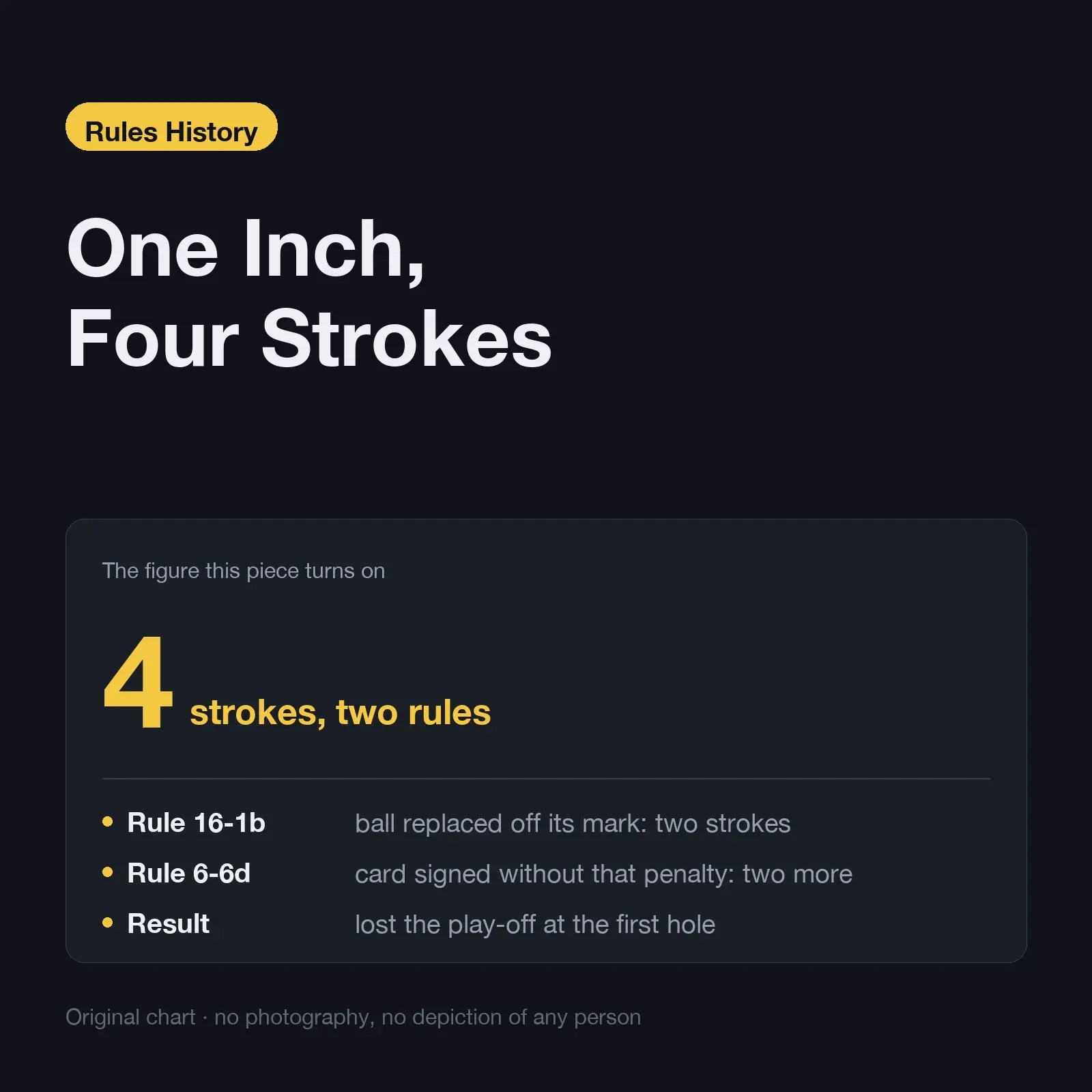
Roberto De Vicenzo shot the round of his life at the 1968 Masters, on his forty-fifth birthday, and lost the tournament to a number he never took. Nobody cheated. The committee applied the rule exactly as written.
1. What happened
| Step | What happened | Why it mattered |
|---|---|---|
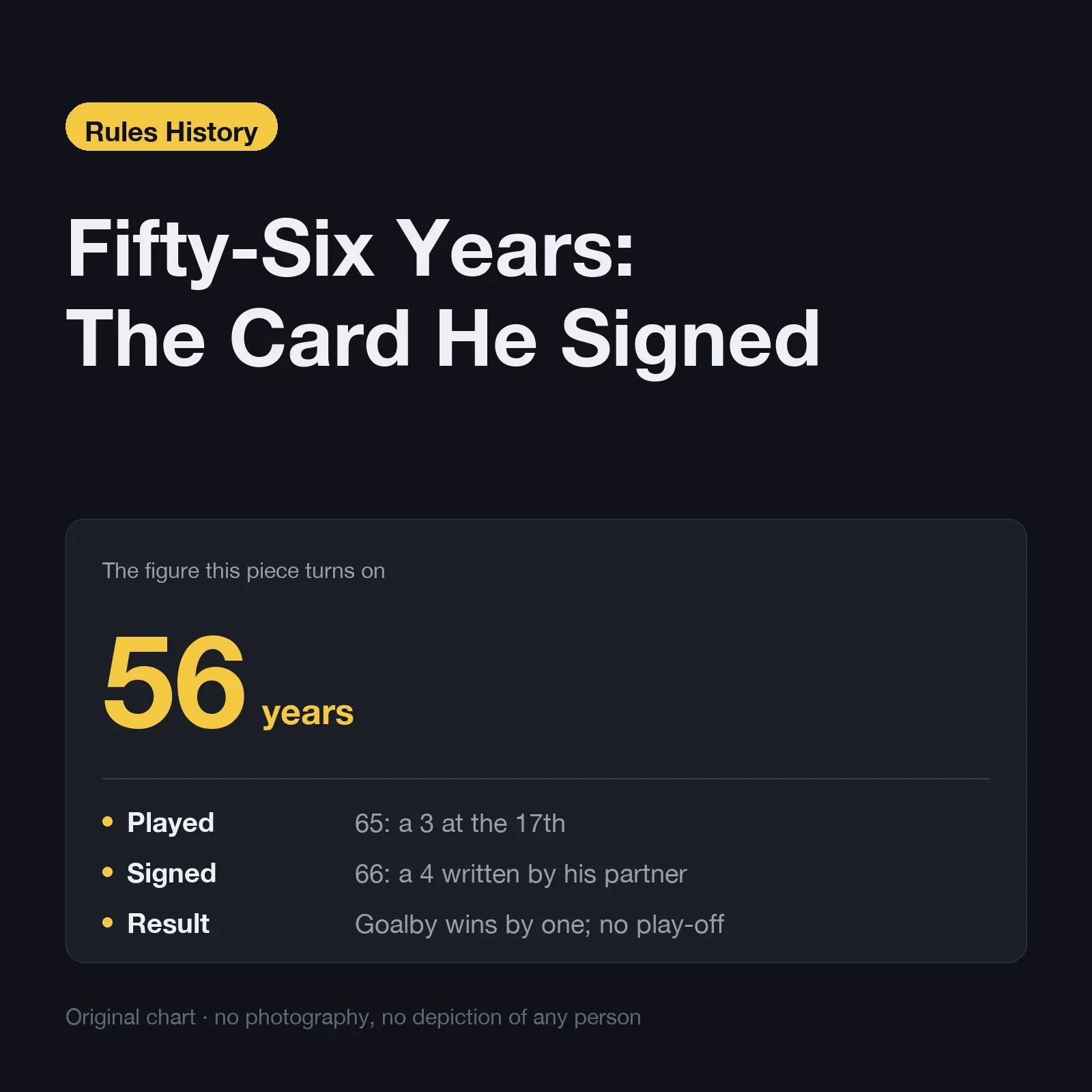
| Final round | De Vicenzo shoots 65 — birdie at the 1st, eagle at the 2nd, birdie at the 17th | Ties Bob Goalby at 277; an 18-hole play-off is set for Monday |
| At the scoring table | Playing partner Tommy Aaron records a 4 at the 17th, where De Vicenzo made a 3 | In golf your partner keeps your card; you check it and sign it |
| The signature | De Vicenzo signs without checking the card | The signed card, not the play, becomes the record |
| The ruling | The higher signed score stands. His round becomes 66, his total 278 | Goalby wins by one. There is no play-off |
2. The mistake everyone remembers is the wrong one
The story is usually told as Tommy Aaron cost De Vicenzo the Masters. That is not what the rule says happened.
Aaron’s error was an error, and it was corrected the moment anyone looked. What was not correctable was the signature. Golf does not treat the card as a report of the round; it treats the signed card as the round. The moment De Vicenzo’s pen left the paper, a 4 at the 17th was the true and only fact about that hole, and it stayed true for the rest of his life.
So the operative mistake is not the one made by the man holding the pencil. It is the one made by the man holding the pen — and the rule is designed to put it there.
3. What the rule does not ask
It does not ask whether the error was yours. It does not ask whether you benefited. It does not ask whether the correct score is knowable — De Vicenzo’s 3 at the 17th was watched by thousands of people and recorded by television, and none of that is admissible against a signature.
It asks one question: is the signed score lower than the score actually made? If yes, disqualification. If no — if the card is higher than the truth — the higher number stands.
That asymmetry is the whole of it. Sign for less than you took and you are gone; sign for more and you simply own it. De Vicenzo signed for more.
4. What it cost
- One stroke, taken by nobody, on a hole he had birdied in front of a gallery.
- A play-off place. Goalby won the 1968 Masters by that stroke; no play-off was ever played.
- A green jacket he would never get another chance at. He was forty-five that day.
- Fifty-six years before the governing bodies conceded any ground on the point.
He is reported to have said, in his third language, twenty minutes after it happened: “What a stupid I am.”
5. Did the rule change?
Eventually, and only slightly.
On 18 June 2024 — fifty-six years later — the PGA Tour, working with the USGA, the R&A and the DP World Tour, amended the definition of when a scorecard is “returned.” Players now have a 15-minute window to correct a scorecard error, per the memo, “even if they have left the scoring area,” and whether or not the card has been validated. It took effect that same week, at the Travelers Championship.
The change lists its own limits: “Exceptions may apply when constraints within the competition limit a player’s correction time to less than 15 minutes, such as releasing tee times following the cut, starting a playoff, or the close of the competition.”
Note what was not conceded. The signature is still binding. You are still responsible for arithmetic somebody else did. All that moved is when “final” begins — fifteen minutes after the pen, instead of the instant of it.
The immediate catalyst was not De Vicenzo. It was Jordan Spieth, disqualified from the 2024 Genesis Invitational for signing for a 72 when he had made 73. Under the new window, that card could have been fixed.
De Vicenzo died in 2017. The fix arrived seven years after he did.
6. What is confirmed and what is not
Confirmed — the 15-minute window, its effective date, its exceptions and the Spieth case are as reported from the June 2024 announcement. The 1968 sequence — Aaron’s 4 at the 17th, the signature, the one-stroke margin, Goalby’s win without a play-off — is consistent across the accounts we read.
Not confirmed here — the exact wording of De Vicenzo’s remark. “What a stupid I am” is the form most widely reproduced, but it appears in circulation with variations in phrasing and punctuation, and we did not find a contemporaneous transcript settling it. We reproduce the common form and flag it rather than presenting it as verbatim.
Also not established — whether anyone at the scoring table read the card aloud, or how long the signing took. Accounts describe an open table rather than a sealed scoring room, which is not in dispute; the procedure at it is not documented in anything we could read.
In one line
Tommy Aaron wrote the wrong number, Roberto De Vicenzo signed it, and the rule did exactly what it was written to do — on his forty-fifth birthday, after the best round he ever played.
Sources
- Rule adjustment now gives players 15-minute window to correct scorecard mistakes — NBC Sports — the 18 June 2024 announcement, the memo’s “even if they have left the scoring area” wording, the stated exceptions, and the Spieth disqualification that prompted it
- A new golf rule has been introduced – and it would have changed who won the Masters — Today’s Golfer — the 1968 date, Aaron’s marking of the birdie at the 17th as a par, and “De Vicenzo finished second by one shot – a shot he never took”
- Roberto De Vicenzo — Wikipedia — biography and date of death
All three pages were opened and read on 4 September 2026. Where coverage of the 2024 change refers to the incident, at least one account in circulation misdates it to 1967; the sources cited above give 1968, and that is the date used here.