A match doesn’t usually stop for ten minutes on its own map two. At eXTREMESLAND 2018 in Shanghai, OpTic India’s second map against Revolution did — because the tournament’s anti-cheat software flagged something before any admin laid eyes on a screen.
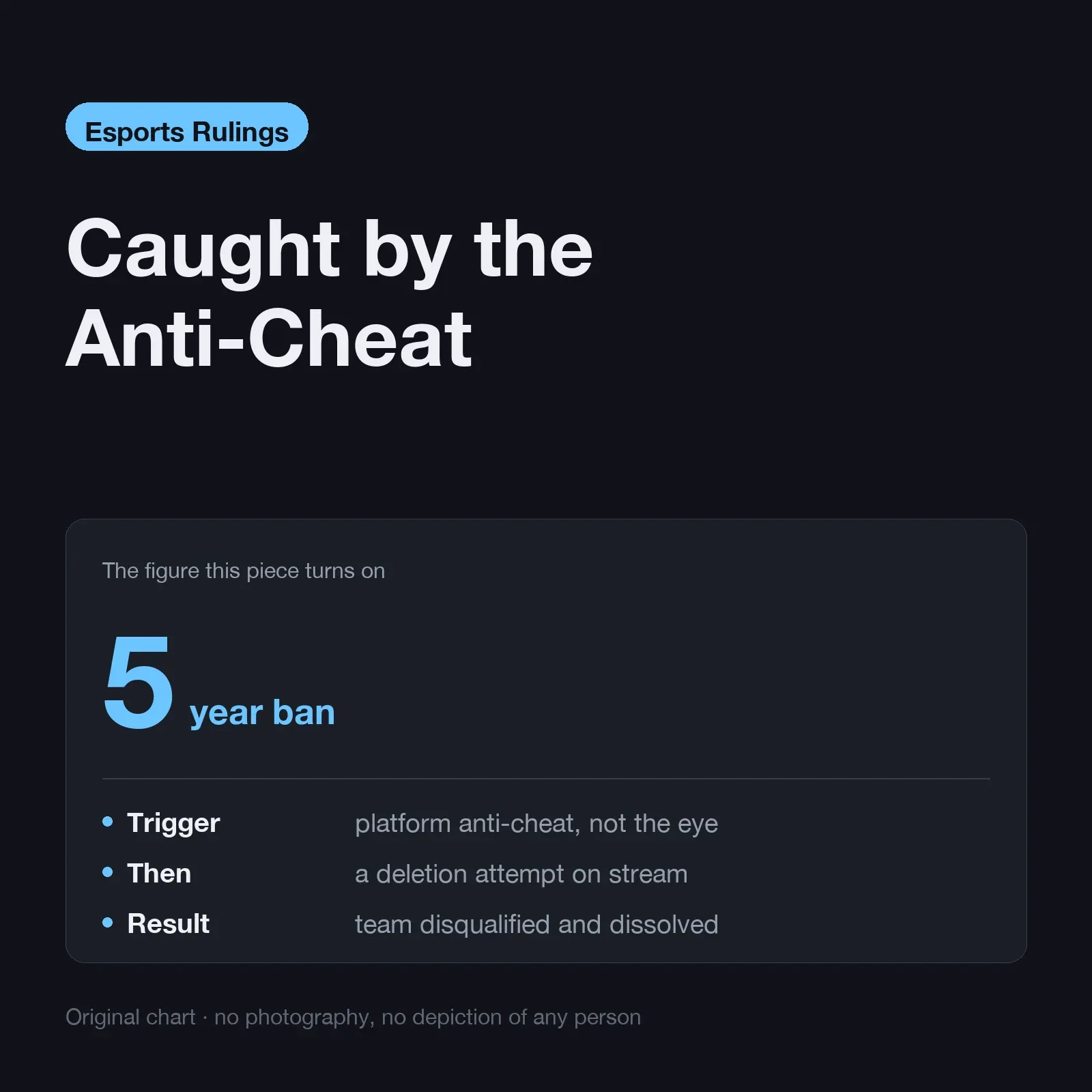
By the time a human looked, Nikhil “forsaken” Kumawat was already trying to close the program down.
1. What happened on map two
| Step | What happened | Why it mattered |
|---|---|---|
| Map 1 (Inferno) | OpTic India wins 16-7 | No flag raised yet |
| Map 2, midway | B5 platform anti-cheat triggers a pause | The system, not a viewer, made the first call |
| Admin check | Admin alt-tabs on forsaken’s PC, sees a program running in the background | Direct visual confirmation of what the anti-cheat flagged |
| Same moment | forsaken closes and deletes the program | Admins recover the file anyway; it can’t be run again to reproduce, but the file survives |
| Ruling | OpTic India disqualified on the spot | Team, not just player, removed from the event |
The anti-cheat trigger came first. The deletion attempt happened in front of the admin who was already there to look.
2. The single match was never the whole case
Getting caught mid-map at one LAN is, on its own, a one-event problem: disqualify the team, ban the player, move on. That is not what determined the length of the punishment.
ESL India was a member of ESIC, and after OpTic India had won the ESL India Premiership the week before Shanghai, ESIC went back and checked forsaken’s hardware and match data from that earlier event too. They found the same cheat software on his SSD, with match analysis showing it had been used there as well.
So the real weight of the case wasn’t the Shanghai disqualification. It was that ESIC could now show cheating across two separate events, which is what moved the case from “removed from one tournament” to a multi-year ban ESIC applies across every member organizer at once.
3. What forsaken intended, as far as the record shows
The deletion attempt is the clearest documented signal of intent: when confronted, he moved to remove the evidence rather than let the PC be inspected as it stood. ESIC’s ban announcement also references a prior 2017 offense, which it describes as “only very indirectly related” to the 2018 case — the ban board’s own words for why it treated this as an aggravated second offense without going all the way to a lifetime ban.
OpTic Gaming’s statement afterward said the rest of the roster had no knowledge of what forsaken had done, and released him from the organization immediately.
4. What it cost
- The team: OpTic India disqualified from eXTREMESLAND 2018 on the spot; the org released forsaken from the roster within days.
- The player: a five-year ban from ESIC, covering all esports-related activity for or with any ESIC member organization, issued October 25, 2018.
- The scope: because ESIC bans apply across its full membership rather than one tournament operator, this closed off ESL, DreamHack, and other member events at once — not just a single organizer’s future events.
5. What happened to the ban since
| When | What happened |
|---|---|
| October 25, 2018 | ESIC issues the five-year ban |
| October 24, 2023 | The five-year ESIC ban period elapses |
| After September 21, 2024 | Valve’s separate 2021 RMR eligibility rules, which are not part of the ESIC ban, stop applying to him |
| As of the ban-ends reporting | forsaken has not returned to competitive CS2; he had been in retirement since the ban |
This is a timeline, not a causal chain. We did not find documentation tying this specific case to any later, named change in LAN anti-cheat procedure — see the section below.
Set this next to the iBUYPOWER case and the difference is in what each ruling had to prove. Match-fixing needs an investigation to establish intent; a cheat found on the machine needs only the machine. Both ended careers, but only one of them took years to decide. In golf, the equivalent is a camera — the evidence arrives before anyone has argued about it.
6. What is confirmed and what is not
Confirmed — the eXTREMESLAND 2018 disqualification, the anti-cheat trigger preceding the admin’s visual check, the deletion attempt, the file’s recovery, OpTic India’s immediate release of forsaken, the cross-referencing of ESIC’s ESL India Premiership data, the five-year ban dated October 25, 2018, its expiry on October 24, 2023, and the separate Valve RMR restriction running to September 21, 2024.
Not confirmed here — the exact nature of forsaken’s 2017 prior offense beyond ESIC’s own description of it as “only very indirectly related.” We also did not find a documented, named rule change (e.g., a specific ban on external storage devices at LAN events) that cites this case as its cause. General LAN security has tightened industry-wide since 2018, but we did not verify a direct line from this incident to any specific procedural change.
In one line
An anti-cheat trigger caught the match; a second event’s stored data is what turned it into a five-year ban.
Sources
- ESPN’s account of the incident — confirms the disqualification, forsaken’s attempt to delete the software when confronted, his removal from OpTic India, and Jesal Parekh’s statement that the organization does not tolerate cheating.
- HLTV’s report from the event — details the map-by-map sequence, the B5 platform anti-cheat trigger, the admin’s alt-tab discovery, the deletion and file recovery, and the immediate disqualification.
- ESIC’s press release announcing the ban — states the five-year ban dated October 25, 2018, its scope across ESIC member organizations, the reference to forsaken’s 2017 prior offense as “only very indirectly related,” and the reasoning for not imposing a lifetime ban.
- Dexerto’s report on the ban’s expiry — confirms the ESIC ban ended October 24, 2023, notes the separate Valve RMR restriction running to September 21, 2024, and reports he had not returned to competitive play as of that writing.
All four pages were opened and read on 30 August 2026.