A towel on wet ground is not equipment. It is not a swing aid. Nobody argued that it made the shot easier to hit. It still cost Craig Stadler a runner-up cheque, because of where the rulebook draws one particular line.
The line is Rule 13-3 as it then stood: a player is entitled to place their feet firmly in taking a stance, but may not build a stance. Kneeling on a towel is building one.
1. What happened on the 14th
At the 1987 Andy Williams San Diego Open at Torrey Pines, Stadler and George Burns went into the third round tied for the lead at 13 under. On the 14th, Stadler’s ball finished under low tree limbs. The only way to play it was from his knees, and overnight rain had left the ground wet. He put a towel down and knelt on it.
He played on, signed for his round, and came back the next day.
| Step | What happened | Why it mattered |
|---|---|---|
| Saturday, 14th hole | Kneels on a towel to play from under a tree | Rule 13-3 — building a stance — two-stroke penalty |
| Saturday evening | Signs a scorecard that does not include the two strokes | The card is now signed for a score lower than actual |
| Sunday, 17th hole | A phone call reaches the PGA Tour office | Officials check the replay |
| Sunday, after the round | Disqualified | Not for the towel — for the card |
The penalty itself was two strokes. The disqualification came from the signature, one day later.
2. The two-stroke penalty was never the problem
This is the part that gets lost in the retelling. Kneeling on the towel carried a two-stroke penalty, and two strokes would not have ended his week. He finished four shots behind Burns; two more would have left him well inside the money.
What ended his week was signing a scorecard for a score lower than the one he had actually made. Under the rules of the time that was disqualification, full stop, whether or not the player knew about the penalty when he signed.
So the towel cost two strokes. The signature cost the tournament.
3. The caller thought he was watching live
The call did not come from an anonymous armchair viewer, which is how the story is usually told. It came from Robert “Skee” Riegel, a Philadelphia club professional, and his intent was the opposite of what happened.
Riegel was watching Sunday’s broadcast when he saw the towel. He believed he was watching it happen live — that Stadler was on the course at that moment and could still be assessed the two strokes before signing. That is why he picked up the phone while Stadler was on the 17th.
The footage was a replay from Saturday. The card had been signed the evening before. By calling to prevent a scoring error, Riegel triggered the disqualification instead.
He said afterwards that if he had known what he was watching had happened the day before, he would never have made the call.
4. What it cost
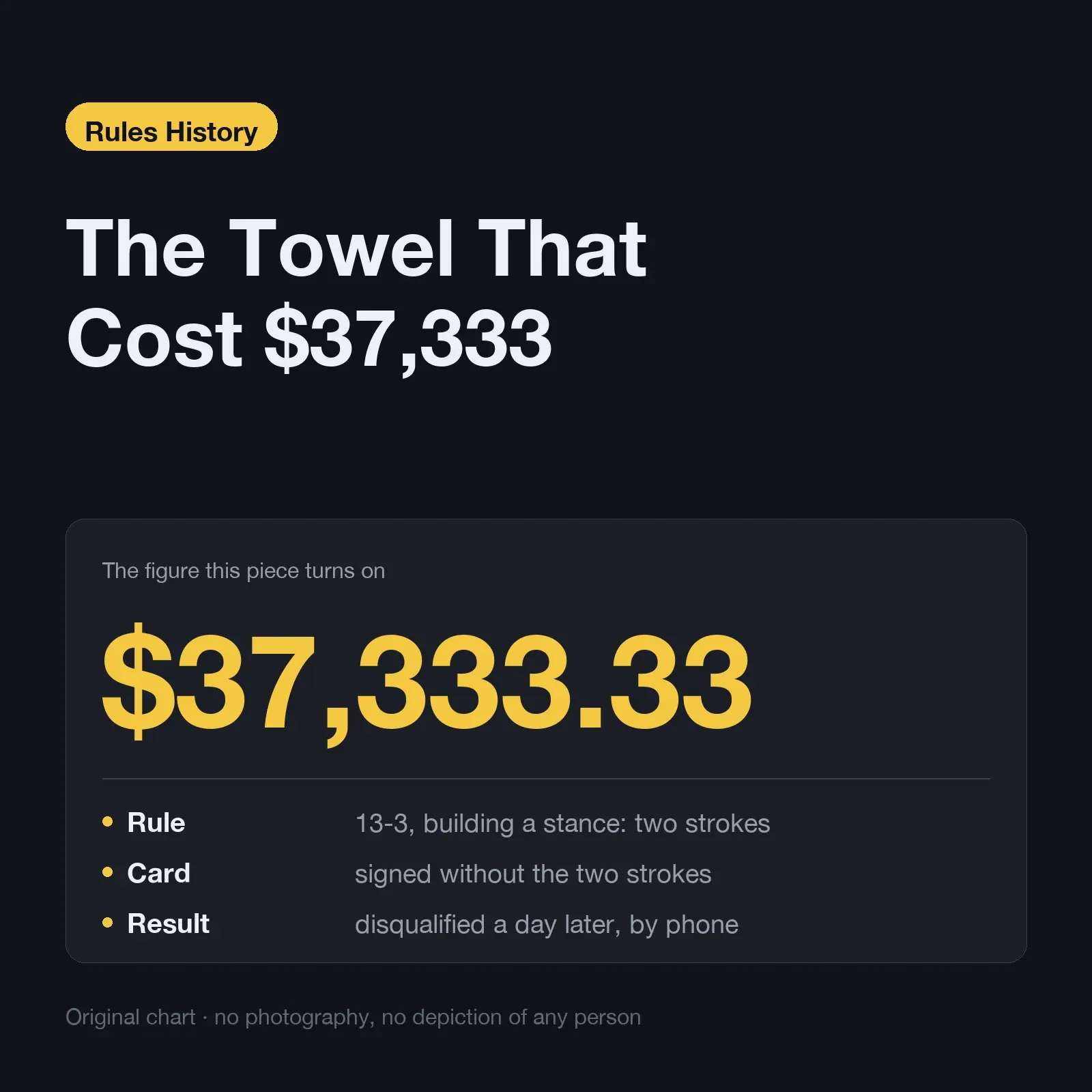
$37,333.33. That is the second-place money he did not receive. Burns won the tournament; Stadler, on the number, went from a share of second to nothing.
Eight years later, in 1995, Torrey Pines had the tree removed — it had become diseased — and invited Stadler to take the first cut with a chainsaw. He did.
5. The rules did change, but not quickly
Stadler’s case is the one people point to as the start of golf’s call-in era. The changes that closed the gap he fell into arrived over the following three decades:
| When | What changed |
|---|---|
| April 2011 | Decision 33-7/4.5 — a player who signs an incorrect card because of a penalty they did not know about is penalised rather than disqualified |
| 2017 | A penalty is not applied where the breach is only visible with the precision of video technology |
| From 1 January 2018 | A local rule that sharply limits penalties arising from television reports |
Read the first row against Stadler’s week and the shape is exact: he did not know about the penalty when he signed. Under the 2011 decision he takes the two strokes and keeps his cheque. He was 24 years early.
6. What is confirmed and what is not
Confirmed — the hole, the towel, the rule number, the mechanism (penalty → unsigned strokes → DQ), the caller’s identity and profession, his belief that the broadcast was live, the amount, and the 1995 chainsaw.
Not confirmed here — whether Riegel’s call was the only one that reached the Tour office that day. Accounts that describe “viewers” in the plural are common, and we did not find a record settling how many calls there were. The one call that is documented by name is his.
We also did not attempt to establish that Stadler’s case caused the 2011 decision. The sequence is a matter of record; the causation is an argument other people make, and we have not verified it.
In one line
A two-stroke penalty he never knew about, on a card he had already signed, reported by a man who thought he was helping — $37,333.33 and a share of second place.
Sources
- Golf.com’s account of the disqualification — the 14th hole, the towel, the stance-building rule, the disqualification for an incorrect card, and the 1995 removal of the tree.
- Trenham Golf History’s account of the phone call — names Robert “Skee” Riegel, records that he called while Stadler played the 17th on Sunday believing the broadcast was live, cites USGA Rule 13-3, and gives the figure of $37,333.33.
- Wikipedia’s article on trial by television in golf — dates the incident to 7 February 1987 and sets out the later changes: Decision 33-7/4.5 in April 2011, the 2017 video-precision rule, and the local rule effective 1 January 2018.
All three pages were opened and read on 30 August 2026. Where they disagree — the prize figure appears as both $37,000 and $37,333.33 in circulation — this piece uses the more precise figure and names the page it came from.