Fujikura’s official name for this shaft is “VENTUS TR with VeloCore+.” We checked spec tables for three color lines — Blue+, Red+, and Black+ — on the manufacturer’s official page, and this piece covers the R/S/X/TX flexes of the Blue+ 6 weight group specifically.
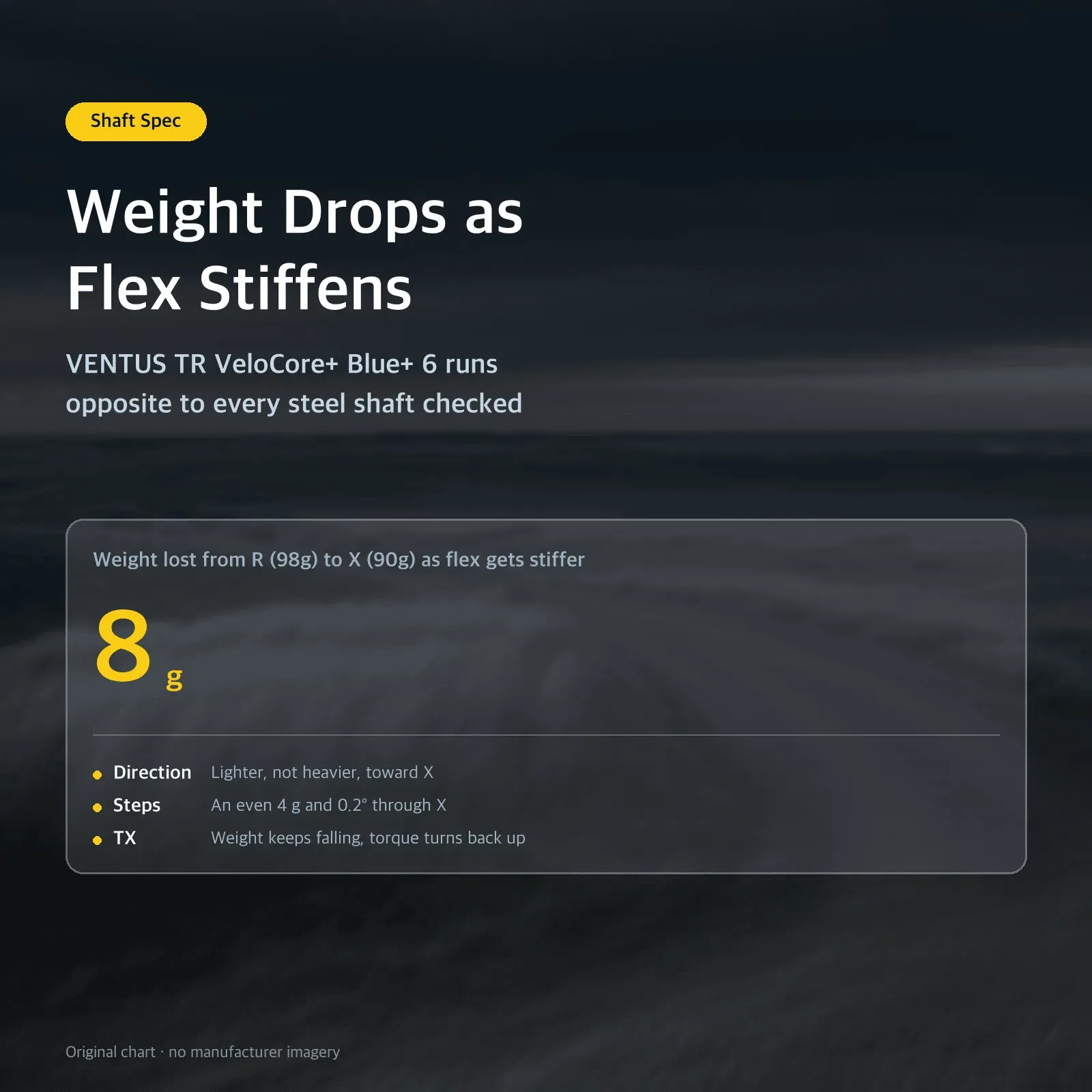
Working through the numbers surfaced a pattern running opposite to what we found across a set of current steel shafts. Steel shafts generally get heavier, or stay the same, as flex stiffens. VENTUS TR VeloCore+ runs the other way — it gets lighter as flex stiffens.
Across the steel shafts checked in this comparison — from four different makers — every one ran flat or heavier from R toward X. Seeing that direction flip within a single graphite shaft was enough to prompt a second check of the table.
1. R at 98g to X at 90g — weight runs backward
| Flex | Weight | Weight step | Torque | Torque step |
|---|---|---|---|---|
| R | 98 g | — | 3.3° | — |
| S | 94 g | -4 g | 3.1° | -0.2° |
| X | 90 g | -4 g | 2.9° | -0.2° |
| TX | 88 g | -2 g | 3.0° | +0.1° |
Blue+ 6 — Four Flexes as Published — Confirmed on Fujikura’s official page for VENTUS TR with VeloCore+. Every steel shaft in this comparison ran flat or heavier from R toward X. This one runs the other way.
The Blue+ 6 group: R is 98 grams at 3.3° torque, S is 94 grams at 3.1° torque, X is 90 grams at 2.9° torque. Weight drops 8 grams from R to X. Every steel shaft checked in this comparison ran flat or heavier moving from R toward X; VENTUS TR VeloCore+ runs the opposite direction.
Torque also drops, from 3.3° at R to 2.9° at X. Weight and torque moving in the same direction is consistent with what we saw on Nippon’s 950GH and MODUS³ lines — but here the actual direction (lighter vs. heavier as flex stiffens) flips depending on the shaft material category (steel vs. graphite), which is the more notable finding from this table.
Step sizes: R to S is −4g, S to X is another −4g — an even step. Torque drops 0.2° at each of the same two steps. Unlike the uneven steps we saw on Nippon’s two lines, Blue+ 6 decreases in perfectly even 4-gram, 0.2°-torque steps through X.
2. TX is lighter still, but torque climbs back up
| Step | What weight does | What torque does |
|---|---|---|
| R to S | Falls 4 g | Falls 0.2° |
| S to X | Falls 4 g | Falls 0.2° |
| X to TX | Falls only 2 g | Rises 0.1°, reversing direction |
The TX Step Does Two Things at Once — R, S and X form one trend; TX sits outside it. No official explanation was found for why torque specifically reverses at TX.
There’s a detail easy to miss without reading the table all the way to the end. TX comes in at 88 grams — 2 grams lighter than X (90 grams). By weight alone, the downward trend continues cleanly from R through TX.
Torque doesn’t follow, though. It climbs back up 0.1° from X (2.9°) to TX (3.0°). Weight and torque fall together from R through X, then at TX, torque alone reverses. Stopping at R/S/X and concluding “both weight and torque keep falling” would miss this reversal entirely. We found no official explanation for why torque specifically reverses at TX.
The weight step also narrows at this point — only 2 grams from X to TX, versus 4 grams at the two prior steps. So the TX step is doing two different things at once: the weight decrease slows down, and torque changes direction. R, S, and X form one consistent trend; TX sits outside it. That’s an observation drawn from the numbers on the table, though, not something Fujikura explained in any text we found.
3. Red+ and Black+ are published in the same format
Beyond Blue+, the Red+ and Black+ lines are also published in the same format — weight and torque by flex — on the official page. This piece worked through the actual figures for Blue+ 6 only; we didn’t complete reading the Red+ and Black+ tables in this pass.
We confirmed the three color lines exist and that each carries R/S/X/TX flexes. Weight and torque differences between the color lines at a matched flex are outside what this piece covers.
Graphite shaft brands in general, based on what we’ve seen elsewhere, tend to structure their pages around multiple named color lines, each with its own spec table — a page structure that differs from the single, simpler table format we saw across the steel shafts in this comparison.
The three color names — Blue+, Red+, Black+ — likely each signal a different trajectory or spin profile, but we found no official text explaining which color targets which characteristic. What we obtained in this piece is limited to Blue+ 6’s weight and torque figures; design intent behind the colors isn’t covered.
Reading the Red+ and Black+ tables directly on fujikuragolf.com filled in the numbers this piece had left blank. Both lines publish more weight groups than Blue+ does (5 through 9 for Red+, 5 through 9 for Black+, versus Blue+‘s 6-only coverage in this piece), and neither reverses direction the way Blue+ does — weight still falls somewhat as flex stiffens within a weight group, but nowhere near as sharply, and torque in both lines falls in step with weight across every flex with no TX reversal:
- Red+ 5: R2 114g/3.8°, R 108g/3.6°, S 102g/3.4°
- Red+ 6: R 102g/3.4°, S 96g/3.2°, X 90g/3.0°
- Red+ 7: S 94g/3.0°, X 90g/2.8°
- Red+ 8: X 88g/2.7°
- Red+ 9: X 85g/2.5°
- Black+ 5: S 94g/3.5°, X 90g/3.3°
- Black+ 6: S 87g/3.1°, X 81g/2.9°
- Black+ 7: S 84g/2.9°, X 79g/2.7°
- Black+ 8: X 78g/2.6°
- Black+ 9: X 75g/2.5°
That confirms the Blue+ 6 pattern doesn’t generalize across the whole product family — the TX-torque reversal documented above is specific to Blue+ 6, not a Ventus TR VeloCore+ house characteristic. Black+ also runs lighter than Red+ at a matched weight group and flex. The official page does label spin/launch for these two: Red+ is listed as mid spin / mid-to-high launch across its weight groups, while Black+ is listed as low spin / low launch, with a higher bend point than Red+‘s mid-to-low. That’s a documented difference between the two lines, though it still doesn’t explain why Fujikura chose the specific color names.
One more detail worth flagging: the “6” in “Blue+ 6” designates a specific weight group. The manufacturer’s page appears to list additional weight groups beyond this one. This research covered only the R/S/X/TX row of group 6; other weight groups aren’t covered here.
4. Who this fits
Based on the confirmed specs. This does not substitute for an actual fitting.
- Golfers who want a stiffer flex paired with a lighter weight suited to faster swing speeds — in Blue+ 6, X (90g) and TX (88g) are both lighter than R (98g), so both preferences are satisfied together on this line.
- Golfers who want to understand how the weight trend flips moving from steel to graphite — this table shows weight decreasing from R to TX, which is confirmable directly.
- Golfers who assumed flex and torque always move in the same direction — the TX step, where torque climbs back above X, is a confirmed exception on this table.
May not fit:
- Golfers who expect torque to keep dropping as flex stiffens, as with steel shafts — torque rises 0.1° from X to TX here.
- Golfers who need specific figures for the Red+ or Black+ lines from this piece — this research covered Blue+ 6 numbers only.
5. What we could not confirm
| Item | Status |
|---|---|
| Why torque reverses direction at TX | No official explanation text found |
| Weight groups other than Blue+ 6 | Not confirmed |
| CPM (frequency) | Not confirmed |
| Manufacturer distance and spin claims | Not independently verifiable, not cited |
What Could Not Be Confirmed — Left blank rather than filled in. Recorded as “not confirmed,” not as “does not exist.”
- The reason torque reverses direction at TX — no official explanation text found.
- Specs for weight groups other than Blue+ 6, if any exist — not confirmed.
- CPM (frequency) — not confirmed.
- Manufacturer distance/spin claims — not independently verifiable, so not cited here.
Summary
VENTUS TR VeloCore+ Blue+ 6 runs from 98 grams at R to 90 grams at X and 88 grams at TX — weight falling as flex stiffens, the reverse of the pattern seen across a set of current steel shafts. Torque falls in step through X, then climbs back 0.1° at TX.
This reversal only shows up if you read all four rows of the table, not just the first three. A comparable graphite-category disclosure pattern — published to the decimal point — is covered separately for other graphite shaft makers, though the weight-progression detail confirmed here is specific to Fujikura’s table.
Every figure in this piece came from Fujikura’s official page. Where we couldn’t confirm a value, we left it blank rather than guess.
Sources
- VENTUS TR with VeloCore+ — Fujikura Golf — official spec table confirmed live for Blue+, Red+, and Black+ across all published weight groups; Blue+ 6 (R 98g/3.3°, S 94g/3.1°, X 90g/2.9°, TX 88g/3.0°) and every Red+/Black+ figure quoted in this piece matched the page exactly.
🔴 Unconfirmed: no official explanation was found for why torque reverses specifically at TX.
One archived URL is recorded above, and it confirms every weight and torque figure cited in this piece. Items the source does not publish are named as unconfirmed rather than estimated.