Moving to graphite shafts for drivers and fairway woods, we opened three brands’ official pages in turn: Fujikura Ventus TR with VeloCore+, Mitsubishi TENSEI 1K Pro Blue, and Graphite Design TOUR AD GC. All three publish torque to a decimal place — a different impression than the steel shaft comparison covered separately.
One naming correction first. Fujikura’s full name isn’t just “Ventus TR” — it’s precisely “Ventus TR with VeloCore+.” And Mitsubishi’s isn’t “2K Pro” — it’s “1K Pro.” No “2K” label appeared on screen anywhere.
Both corrections are cases where an assumption going into this research turned out to be wrong, confirmed directly on screen. The “VeloCore+” suffix and the “1K” (not “2K”) designation are both easy to miss from search results or older information alone, so they’re flagged upfront here.
1. All three publish S-flex torque to a decimal point
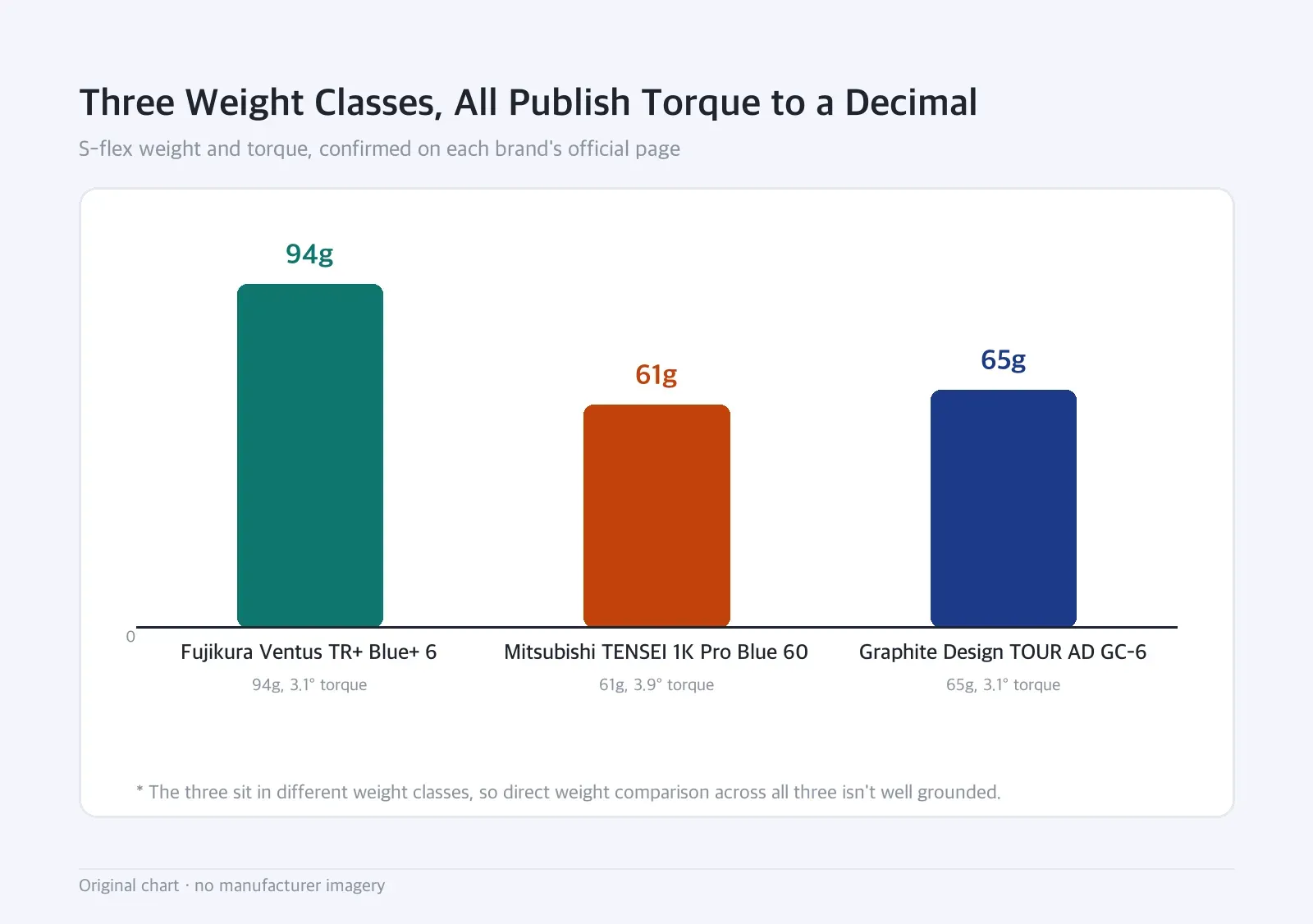
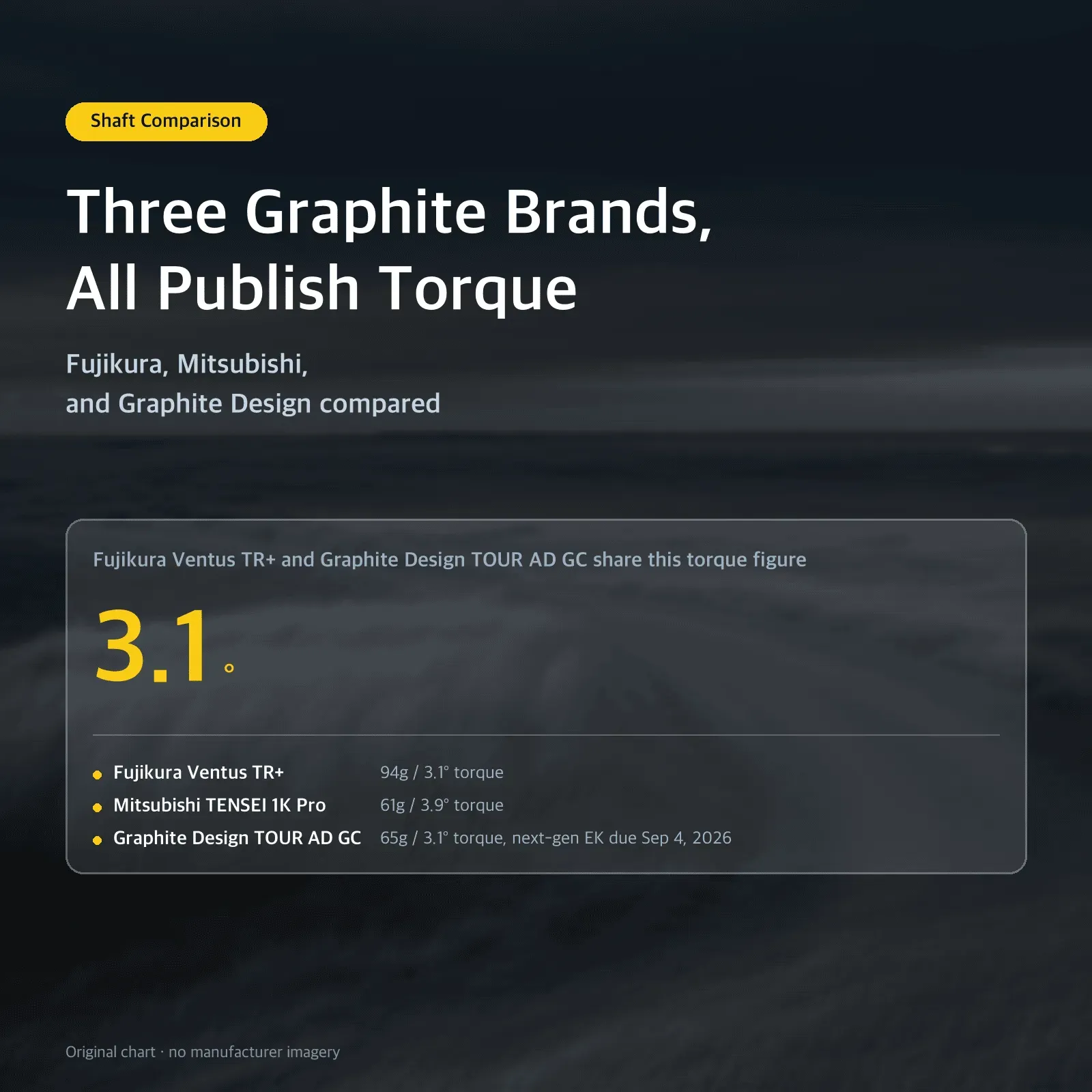
Fujikura Ventus TR+ Blue+ 6’s S is 94 grams with 3.1° of torque. Mitsubishi TENSEI 1K Pro Blue 60S is 61 grams with 3.9° of torque. Graphite Design TOUR AD GC-6’s S is 65 grams with 3.1° of torque. All three values were confirmed directly on each brand’s official page.
The three brands sit in different weight classes, so direct weight comparison is difficult. But all three share one thing: publishing torque as a number to one decimal place. That’s the contrast point with the steel shaft side, where True Temper and KBS used qualitative labels or no field at all.
| Shaft | Torque |
|---|---|
| Fujikura Ventus TR+ | 3.1° |
| Mitsubishi TENSEI 1K Pro | 3.9° |
| Graphite Design TOUR AD GC | 3.1° |
Torque Can Match While Weight Differs Sharply — Fujikura and Graphite Design share 3.1° torque despite a 29g weight gap. Torque and weight don’t always move in proportion — this only became visible by placing all three tables side by side.
Listed again: Fujikura 3.1°, Mitsubishi 3.9°, Graphite Design 3.1°. Fujikura and Graphite Design happen to share the same 3.1° torque figure, even though the two products differ sharply in weight (94g vs. 65g). That torque can match while weight differs sharply is something that only became visible by placing all three tables side by side — torque and weight don’t always move in proportion to each other.
2. Mitsubishi publishes all four weight classes
Mitsubishi TENSEI 1K Pro Blue publishes R, S, X, and TX flex across four weight classes — 50, 60, 70, and 80 — all directly on its official page. The value confirmed on screen here is the 60-weight S (61 grams, 3.9° torque), but the other weight classes appear in the same format across the full table.
Of the three brands, Mitsubishi published the widest weight-class range in one place most clearly. Fujikura and Graphite Design are each split by color line (Blue+, Red+, Black+ / GC, etc.), so their page structures differ slightly.
That structural difference affects how a buyer reaches the spec. On Mitsubishi’s page, scrolling one table shows every weight class and flex at once; Fujikura and Graphite Design require choosing a color line first before that line’s table appears. The total amount of information looked similar across the three brands, but the number of steps to reach it was shortest with Mitsubishi.
The three steel shaft brands covered in the shaft comparison — True Temper, KBS, Nippon Shaft — had a structure that ended with one flex table, no color line involved. Moving to the three graphite brands adds a color axis on top — another structural difference that surfaced only by researching steel and graphite together. More color options also means more tables to check.
3. Graphite Design is about to change generation
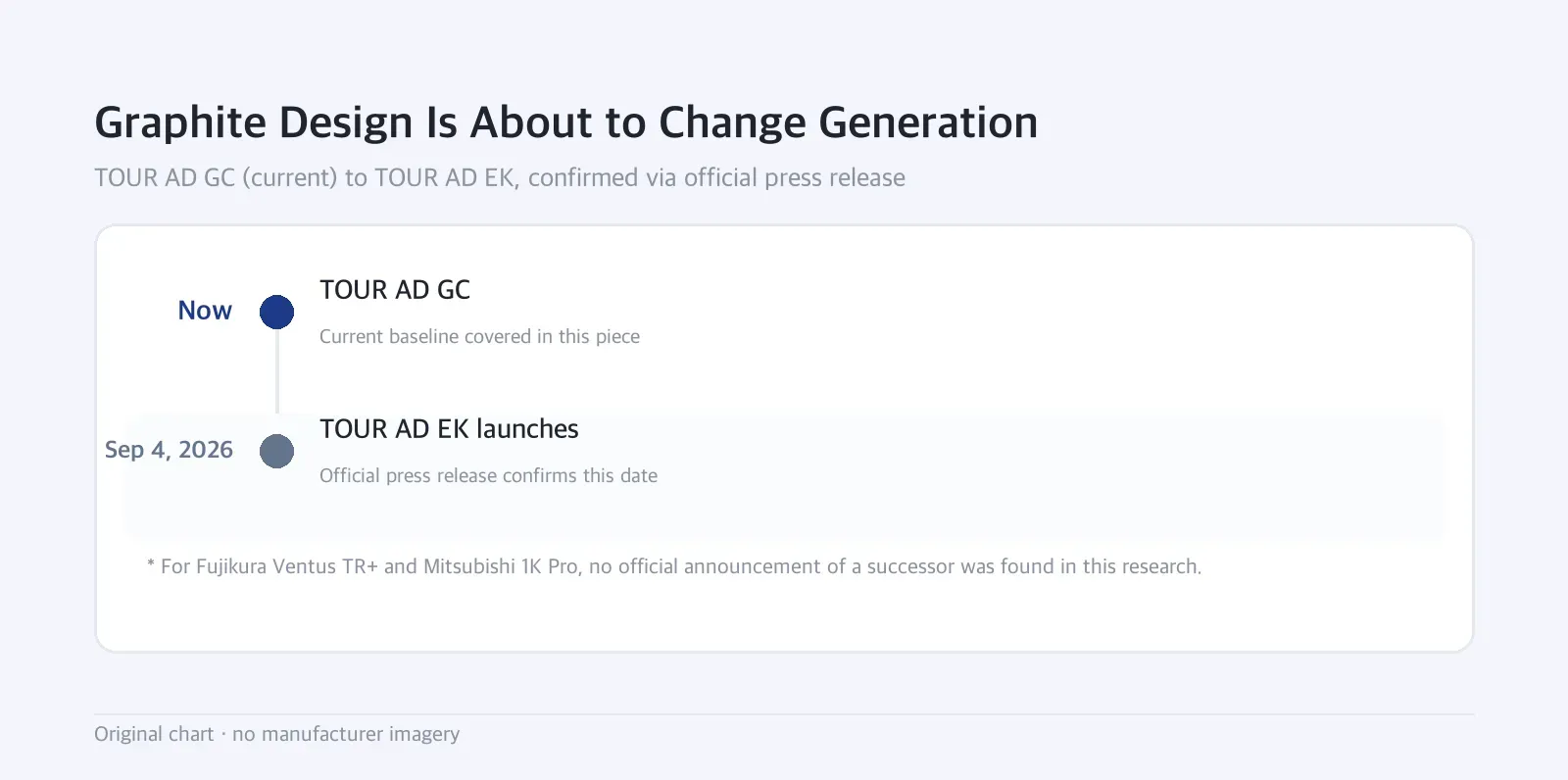
Graphite Design’s current model is TOUR AD GC, but its successor, TOUR AD EK, is confirmed via official press release to launch on September 4, 2026. The GC specs covered here are the current baseline up until EK’s release.
Depending on when this is read, what’s on the shelf may be GC or EK. For the other two brands (Fujikura Ventus TR+, Mitsubishi 1K Pro), no official announcement of an upcoming successor was found in this research.
On the Mitsubishi side, a separate “1K” line (with a 2026 label) exists alongside “1K Pro.” How the two differ on spec, and whether they’re a tiered or parallel relationship, wasn’t confirmed in this research. This piece covers only the 1K Pro Blue 60S line; the 1K line’s specific numbers aren’t covered here.
4. Who this comparison is useful for
A judgment framework drawn from confirmed specs.
- Golfers who want to compare torque numbers across graphite brands — all three publish to a decimal place, so this axis is directly comparable.
- Golfers who want to see Mitsubishi’s whole product family across multiple weight classes at once — all four weight classes (50/60/70/80) are laid out in one official table.
This may not fit:
- Golfers trying to compare weight across the three brands on the same basis — 94g, 61g, and 65g come from different product lines and weight classes, so lining the numbers up directly isn’t well grounded.
- Golfers planning a Graphite Design purchase without checking the EK release (2026-09-04) — relying on GC specs alone means the generation is about to change.
5. What we could not confirm
| Item | Status |
|---|---|
| Fujikura and Mitsubishi next-gen plans | Not confirmed |
| A directly comparable weight basis, all three | Different weight classes/lines — no common basis found |
| Manufacturer distance/spin claims | Unverifiable, not cited |
What Could Not Be Confirmed — Left blank rather than filled in. Mitsubishi 1K Pro Blue publishes all four weight classes (50/60/70/80) directly on one official page.
- Fujikura and Mitsubishi’s plans for their next generation — not confirmed.
- A directly comparable basis for weight and torque across all three brands — different weight classes and product lines meant this research couldn’t establish one.
- Manufacturer distance/spin claims — unverifiable, so not cited.
In one line
Fujikura, Mitsubishi, and Graphite Design all publish torque to a decimal place — that much is consistent across the three. Graphite Design, though, is about to change generation, with TOUR AD EK launching September 4, 2026.
Set against the steel shaft comparison covered separately, this piece sharpens a divide: numeric disclosure on one side (graphite brands and Nippon Shaft), qualitative or absent disclosure on the other (True Temper, KBS). Fujikura’s weight progression from R through X is covered separately.
Every chart here was built directly, and every number comes from each brand’s official page. Anything we could not confirm was left blank.
Sources
- VENTUS TR with VeloCore+ — Fujikura Golf — official page confirmed live: Blue+ 6 S is 94g at 3.1° torque, matching the body exactly.
- TENSEI™ 1K Pro Blue — Mitsubishi Chemical Golf — official spec table confirmed live: 60-weight S is 61g at 3.9° torque, and all four weight classes (50/60/70/80) are confirmed present.
- TOUR AD GC — Graphite Design — official spec table confirmed live: GC-6 S is 65g at 3.1° torque, matching the body exactly.
Three archived URLs are recorded above; all torque and weight values cited in this piece were confirmed directly on each brand’s own live page. Items the source does not publish are named as unconfirmed rather than estimated.