We checked KBS’s official spec tables for two of its steel iron shafts, Tour and C-Taper. Both are presented as distinct, separately named products.
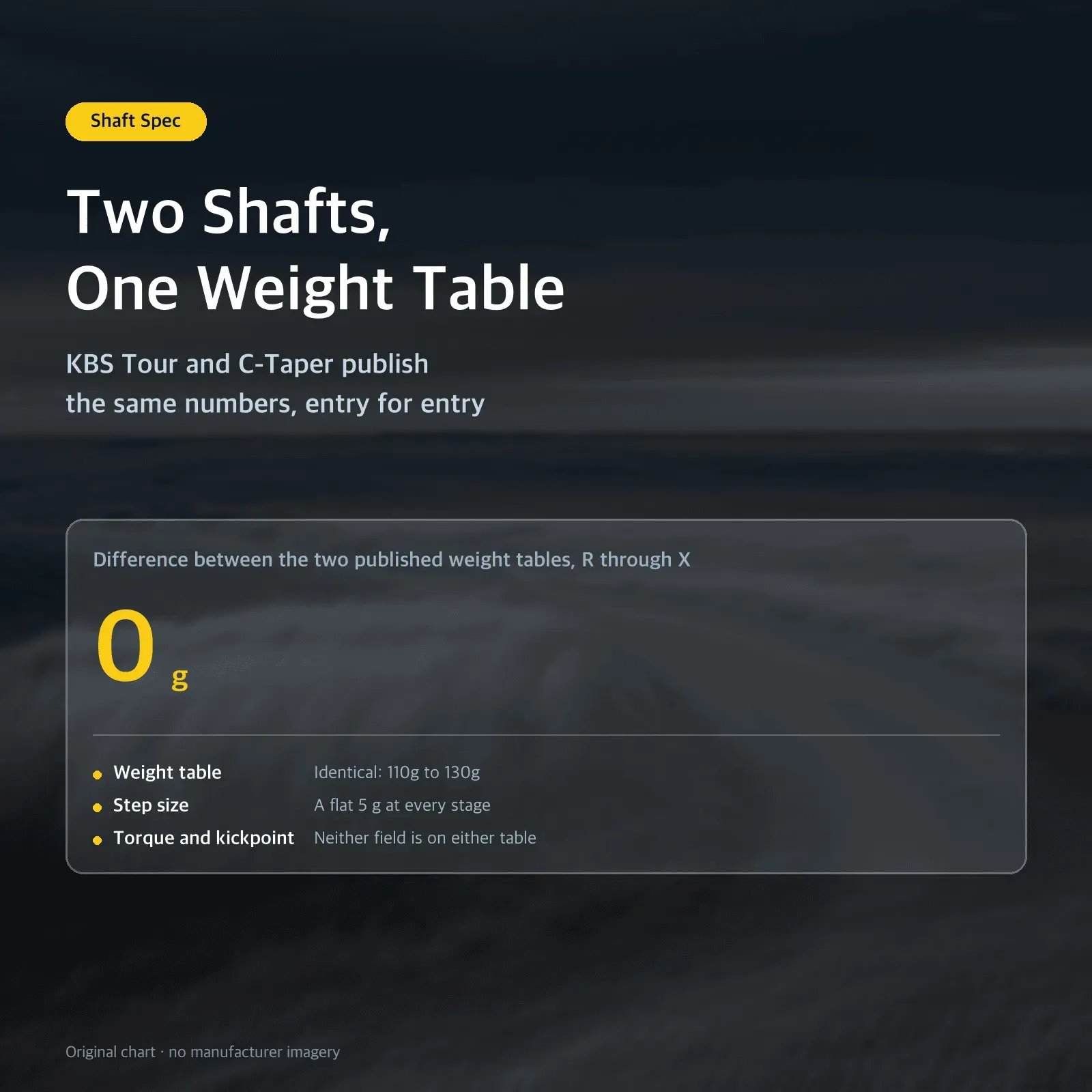
Copying the weight tables over, though, we noticed something odd. Tour and C-Taper’s per-flex weights — R 110g, R+ 115g, S 120g, S+ 125g, X 130g — were identical, entry for entry.
1. Identical weight tables, R through X
| Flex | KBS Tour | KBS C-Taper | Step from previous |
|---|---|---|---|
| R | 110 g | 110 g | — |
| R+ | 115 g | 115 g | +5 g |
| S | 120 g | 120 g | +5 g |
| S+ | 125 g | 125 g | +5 g |
| X | 130 g | 130 g | +5 g |
The Two Tables, Side by Side — copied from KBS official spec sheets for Tour and C-Taper. Not a single figure differs between the two lines, and the spacing is perfectly even.
Tour: R 110g, R+ 115g, S 120g, S+ 125g, X 130g. C-Taper: R 110g, R+ 115g, S 120g, S+ 125g, X 130g. Not a single figure differs. The S flex, at 120 grams, is among the heavier values in the current steel-shaft comparison we’ve assembled.
Going in, the assumption was that two differently named products would carry at least a different weight range. Copying out the actual tables, that assumption didn’t hold.
Based on the weight table alone, there’s no way to distinguish Tour from C-Taper. The two are sold as separate products under separate names, but within the spec fields we were able to obtain, weight isn’t a distinguishing factor between them.
The step size between flexes is identical too: R to R+ is +5g, R+ to S is +5g, S to S+ is +5g, S+ to X is +5g — a flat 5-gram step at every stage. Compared with other current steel shafts, where step sizes vary unevenly between flexes, KBS’s two lines stand out for their perfectly even spacing: five steps from 110 to 130 grams, exactly 5 grams apart.
2. Torque and kickpoint fields aren’t on the table at all
We expected some other field to distinguish the two shafts if weight didn’t. That wasn’t the case either. Neither Tour nor C-Taper’s official spec table includes a torque or kickpoint field at all. Even a qualitative label — the kind True Temper uses for torque (“Low”) — would have given some directional information. KBS’s table omits the field entirely.
Among the current steel shafts in this comparison, KBS is the only one missing the torque/kickpoint fields entirely. True Temper’s Dynamic Gold has the field but fills it qualitatively; Nippon Shaft’s two lines have the field filled numerically. KBS represents a third category: no field at all.
Three patterns emerge across this comparison: no field (KBS), field present but qualitative (True Temper), and field present and numeric (Nippon’s 950GH and MODUS³). That the four current steel shafts we reviewed split cleanly into these three categories is a more specific finding than simply saying “torque disclosure varies by brand.”
3. So what actually distinguishes the two models?
| Disclosure level | Brand | What the table shows |
|---|---|---|
| No field at all | KBS Tour, C-Taper | Torque and kickpoint are absent |
| Field present, qualitative | True Temper Dynamic Gold | Torque reads “Low” for every flex |
| Field present, numeric | Nippon 950GH, MODUS³ TOUR 120 | Torque to one decimal, per flex |
Three Ways a Brand Fills the Torque Field — the four steel shafts reviewed split cleanly into three categories. KBS is the only line in this comparison missing the fields entirely.
Based on the spec fields we were able to obtain (weight, flex), there’s no basis to distinguish Tour from C-Taper. What actually separates the two — taper profile, material composition, actual kickpoint position — isn’t stated in any official text we found.
This isn’t a claim that KBS is withholding information. Whether the fields we obtained happen not to distinguish the two products, and whether KBS has published the distinguishing information somewhere else, are two separate questions. This piece reports what’s confirmed (identical weight tables) and what isn’t (the actual basis for distinguishing them) separately.
The names themselves offer a hint. “C-Taper” plausibly points to a taper-profile characteristic (the shaft’s diameter narrowing along its length); “Tour” plausibly signals a tour-oriented positioning in the name. But that’s an inference from the names, not a confirmed manufacturer statement about how the two differ. We’re keeping the inference and the confirmed fact separate rather than blending them.
We revisited KBS’s page a second time in this research, checking for any distinguishing detail below the weight table or on a separate tab. Within what we accessed, we didn’t find one. That doesn’t rule out the possibility that more detail exists deeper in the site — only that it wasn’t reached in this pass.
Checking other models in the KBS lineup might have surfaced a clue to what separates Tour and C-Taper. This piece’s scope was limited to these two models specifically, and a full survey of the KBS lineup is outside what we set out to do here.
Laying the two tables side by side, the fact that weight doesn’t distinguish them becomes itself a piece of information. For anyone choosing between the two in a fitting session, weight at least isn’t something to weigh in the decision. That the distinguishing factor lies elsewhere is clear; what that factor actually is wasn’t something this research could fill in.
4. Who this fits
Based on the confirmed specs. This does not substitute for an actual fitting.
- Golfers picking a KBS shaft primarily by weight — since Tour and C-Taper share an identical weight table, weight alone won’t decide between them.
- Golfers new to the KBS brand generally — the R (110g) to X (130g) five-flex structure is confirmed.
- Golfers who prefer a predictable, evenly stepped weight progression — every step from R to X is a flat 5 grams.
May not fit:
- Golfers who want a torque number to judge workability — KBS is the only shaft in this comparison with no torque or kickpoint field at all.
- Golfers who want to distinguish Tour from C-Taper by spec (e.g., taper profile) — within the fields we obtained, the two aren’t distinguishable.
5. What we could not confirm
| Item | Status |
|---|---|
| The official basis for distinguishing Tour from C-Taper | Not found in this pass |
| Torque and kickpoint values | Neither field appears on either table |
| Other KBS models beyond these two | Outside the scope of this piece |
| CPM (frequency) | Not confirmed |
| Manufacturer distance and feel claims | Not independently verifiable, not cited |
What Could Not Be Confirmed — left blank rather than filled in. Not reached in this pass is not the same as does not exist — deeper pages were not ruled out.
- The official basis for distinguishing Tour from C-Taper — the weight tables are identical, and this research didn’t turn up a distinguishing figure.
- Torque and kickpoint values — neither field appears on either shaft’s spec table.
- Other KBS models beyond Tour and C-Taper — not covered in this research.
- CPM (frequency) — not confirmed.
- Manufacturer distance/feel claims — not independently verifiable, so not cited here.
Summary
KBS’s Tour and C-Taper carry an identical weight table, R (110g) through X (130g), and neither includes a torque or kickpoint field on its spec sheet. We could not find a confirmed basis for distinguishing the two models.
This is the clearest case, among the current steel shafts we reviewed, of the pattern where torque disclosure practice differs sharply by brand — KBS sits at the end of that spectrum with no field at all. Nippon Shaft’s two lines, at the opposite end, are covered separately.
Every figure in this piece came from KBS’s official spec sheet. Where we couldn’t confirm a value, we left it blank rather than guess.
Sources
- KBS TOUR — KBS Golf Shafts — official spec table confirmed live: R 110g, R+ 115g, S 120g, S+ 125g, X 130g. No torque or kickpoint field present.
- C-TAPER — KBS Golf Shafts — official spec table confirmed live: identical weight table to Tour (110g–130g). No torque or kickpoint field present.
🔴 Neither table includes a torque or kickpoint field at all, so no comparison on those axes is possible.
Two archived URLs are recorded above; both confirm the identical weight tables and the absence of torque/kickpoint fields this piece turns on. Items the source does not publish are named as unconfirmed rather than estimated.