Nippon Shaft’s N.S.PRO 950GH is the lightest of the current steel shafts we reviewed. The official spec table on the manufacturer’s site is built as a JavaScript grid; we opened it directly in a browser to recover the values.
The light weight wasn’t the only thing that stood out. Among the steel shafts we checked, 950GH was the only one to publish torque and kickpoint together, in full — one as a number, one as a descriptive label.
1. R through X, weight 94.5–104.0 grams
| Flex | Weight | Step from previous | Torque |
|---|---|---|---|
| R | 94.5 g | — | 2.0° |
| SR | 97.0 g | +2.5 g | 1.9° |
| S | 98.0 g | +1.0 g | 1.8° |
| X | 104.0 g | +6.0 g | 1.7° |
N.S.PRO 950GH — Four Flexes as Published — values recovered from the JavaScript spec grid on the maker’s official page. Torque narrows by a fixed 0.1° per step while the weight steps vary in size.
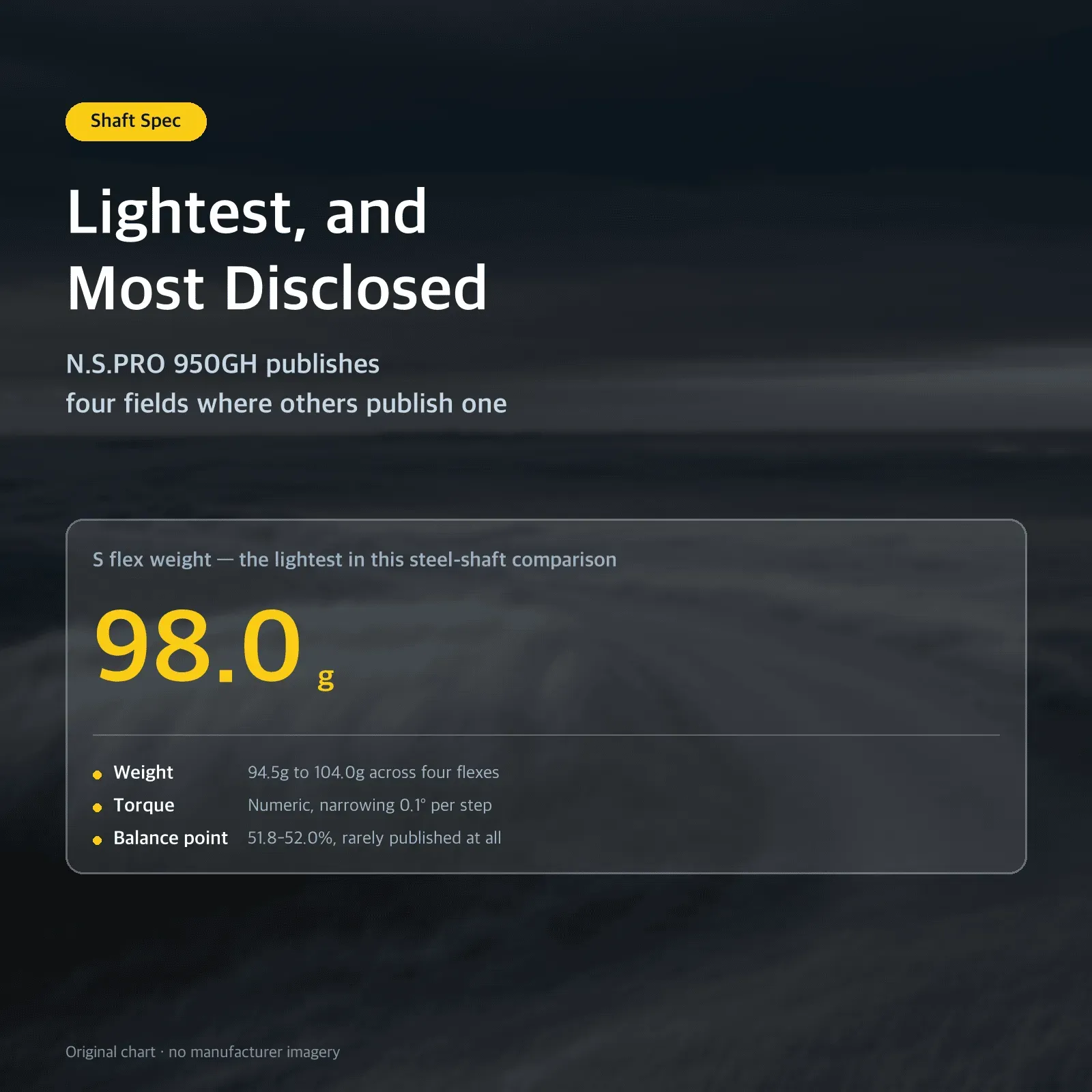
R is 94.5 grams, SR is 97.0 grams, S is 98.0 grams, X is 104.0 grams. The four flexes are spaced closely together, climbing in a stepped progression from R to X. Against other current steel shafts, 950GH’s S flex at 98.0 grams reads as the lightest weight we found in that comparison — a fact that traces back directly to this tightly spaced weight progression.
Torque also differs by flex: R is 2.0°, SR is 1.9°, S is 1.8°, X is 1.7°. Torque drops by exactly 0.1° per step, consistently across all four flexes.
Weight steps hold order too, but not evenly: R (94.5g) to SR (97.0g) is +2.5g, SR to S (98.0g) is +1.0g, and S to X (104.0g) is +6.0g. The last step is by far the largest. The first two steps are tightly packed, and then the jump to the stiffest flex opens up sharply. Torque narrows by a fixed 0.1° each step while weight steps vary in size — a distinction only visible when the two columns are laid side by side.
2. Kickpoint: middle. Balance point: 51.8-52.0%
| Field | N.S.PRO 950GH | Dynamic Gold |
|---|---|---|
| Weight | Numeric, per flex | Numeric, per flex |
| Torque | Numeric, 2.0° to 1.7° | One word: “Low” |
| Kickpoint | Label: “Middle” | Field not on the table |
| Balance point | 51.8% to 52.0%, per flex | Field not on the table |
Four Fields Published, Not One — how the same spec categories are filled across these steel shafts. Balance point is the shaft’s center of gravity as a percentage of total length.
950GH lists kickpoint as “Middle” and publishes a balance point for every flex — 51.8% at R, 51.9% at SR and S, and 52.0% at X. True Temper’s Dynamic Gold, by contrast, doesn’t include a kickpoint field on its spec table at all. 950GH publishes both a qualitative field (kickpoint) and a quantitative one (balance point).
Balance point expresses where the shaft’s center of gravity sits, as a percentage of total shaft length. A figure like 51.9% doesn’t by itself determine how a shaft feels — but publishing it at all is uncommon among the shafts in this comparison.
The “Middle” kickpoint label is also worth noting on its own. In format, it’s the same kind of qualitative label as Dynamic Gold’s “Low” — but Dynamic Gold’s qualitative label sits on the torque field itself, while 950GH pairs a qualitative label (kickpoint) with quantitative fields (torque, balance point) elsewhere on the same table. Whether a word-only label represents the entire spec table or sits alongside numeric fields turns out to be a meaningfully different situation.
Kickpoint itself is generally understood as describing where along the shaft’s length it bends most — closer to the grip or closer to the head. 950GH’s “Middle” label means the exact position (say, as a percentage of shaft length) isn’t disclosed, only the general category. Publishing balance point as a precise percentage while keeping kickpoint at a category label (low/mid/high) isn’t dramatically more informative overall than Dynamic Gold’s single “Low,” worth noting for context.
3. Among current steel shafts, this discloses the most fields
Weight, torque, kickpoint, and balance point — all four published as numbers or labels together — is something we found on 950GH and not on the other steel shafts we checked. Some lines publish torque only as a qualitative word; others leave torque and kickpoint off the table entirely. 950GH sits at the opposite end from both.
Three disclosure levels emerge across the shafts we reviewed: no field at all, a field present but only qualitative, and a field present with numeric values. Whether torque-disclosure practice differs by brand turns out to be a three-way split, not just a binary one — something that only became clear looking closely at 950GH’s table.
Nippon’s own MODUS³ TOUR 120, another shaft in the same maker’s lineup, publishes the same four fields — and its balance point runs 50.1% at R and S, 50.2% at X, and 50.4% at TX. The two lines differ by roughly 1.5 to 1.8 percentage points, with 950GH’s centre of gravity sitting further toward the butt end.
Among current steel shafts, 950GH’s S flex (98.0g) sits at the light end of the weight range while also being the shaft that discloses the most spec fields. There’s no inherent reason weight and disclosure completeness should move together, but in this comparison, they happened to coincide in the same shaft.
That combination — light weight plus thorough disclosure — is part of what makes 950GH stand out here. For a golfer prioritizing a lighter steel shaft, the weight alone is reason enough; for one who wants to check every field before buying, the disclosure completeness adds a second reason. Having both reasons line up in the same shaft was, among the steel shafts we reviewed, unique to 950GH.
4. Who this fits
Based on the confirmed specs. This does not substitute for an actual fitting.
- Golfers who want to check as much spec information as possible before a fitting — weight, torque, kickpoint, and balance point are all published.
- Golfers looking for a lighter steel shaft — the S flex at 98.0 grams is the lightest value we found among current steel shafts in this comparison.
May not fit:
- Golfers who need a heavier steel shaft — even X flex, at 104.0 grams, is lighter than Dynamic Gold’s X100 (130 grams) by 26 grams.
- Golfers who want kickpoint expressed as a specific number (e.g., percentage of shaft length) — 950GH publishes only the category label “Middle.”
- Golfers who prefer to judge purely by feel over detailed spec figures — more published numbers doesn’t mean this piece is vouching for the feel of the shaft.
5. What we could not confirm
| Item | Status |
|---|---|
| Kickpoint as a specific number | Published only as the category “Middle” |
| CPM (frequency) | Not confirmed |
| Manufacturer distance and feel claims | Not independently verifiable, not cited |
What Could Not Be Confirmed — left blank rather than filled in. Recorded as “not confirmed,” not as “does not exist.”
- CPM (frequency) — not confirmed.
- Manufacturer distance/feel claims — not independently verifiable, so not cited here.
Summary
N.S.PRO 950GH runs 94.5–104.0 grams across four flexes, with torque, kickpoint, and balance point all published as numbers or labels. Among the current steel shafts we checked, it disclosed the most fields.
Nippon’s other shaft in this comparison, MODUS³ TOUR 120, sits in a heavier weight range than 950GH — a related question, covered separately.
Every figure in this piece came from Nippon Shaft’s official page. Where we couldn’t confirm a value, we left it blank rather than guess.
Sources
- N.S.PRO 950GH — Nippon Shaft — official spec table confirmed live: R 94.5g/2.0°, SR 97.0g/1.9°, S 98.0g/1.8°, X 104.0g/1.7°; kickpoint “Middle”; balance point 51.8%–52.0%.
Among current steel shafts this line discloses the most: weight, torque, kickpoint and balance point are all published.
One archived URL is recorded above, and it confirms every figure cited in this piece’s spec table. Items the source does not publish are named as unconfirmed rather than estimated.