🔴 Correction, 30 August 2026. This piece described Odyssey’s zero-torque line as “Ai-ONE Square-to-Square” with a three-model roster (Double Wide, #7, Jailbird). Odyssey’s current official lineup calls this line “Square 2 Square,” and Double Wide is not part of it — Double Wide is a separate, non-center-shafted Ai-ONE model. The current Square 2 Square center-shafted roster is #7, Max Stripe, Jailbird, and Max 1. The center-shaft, coplanar-center-of-gravity construction described below is still accurate; the model names have been corrected.
Putter inserts are usually a story about material — what it’s made of decides how it feels.
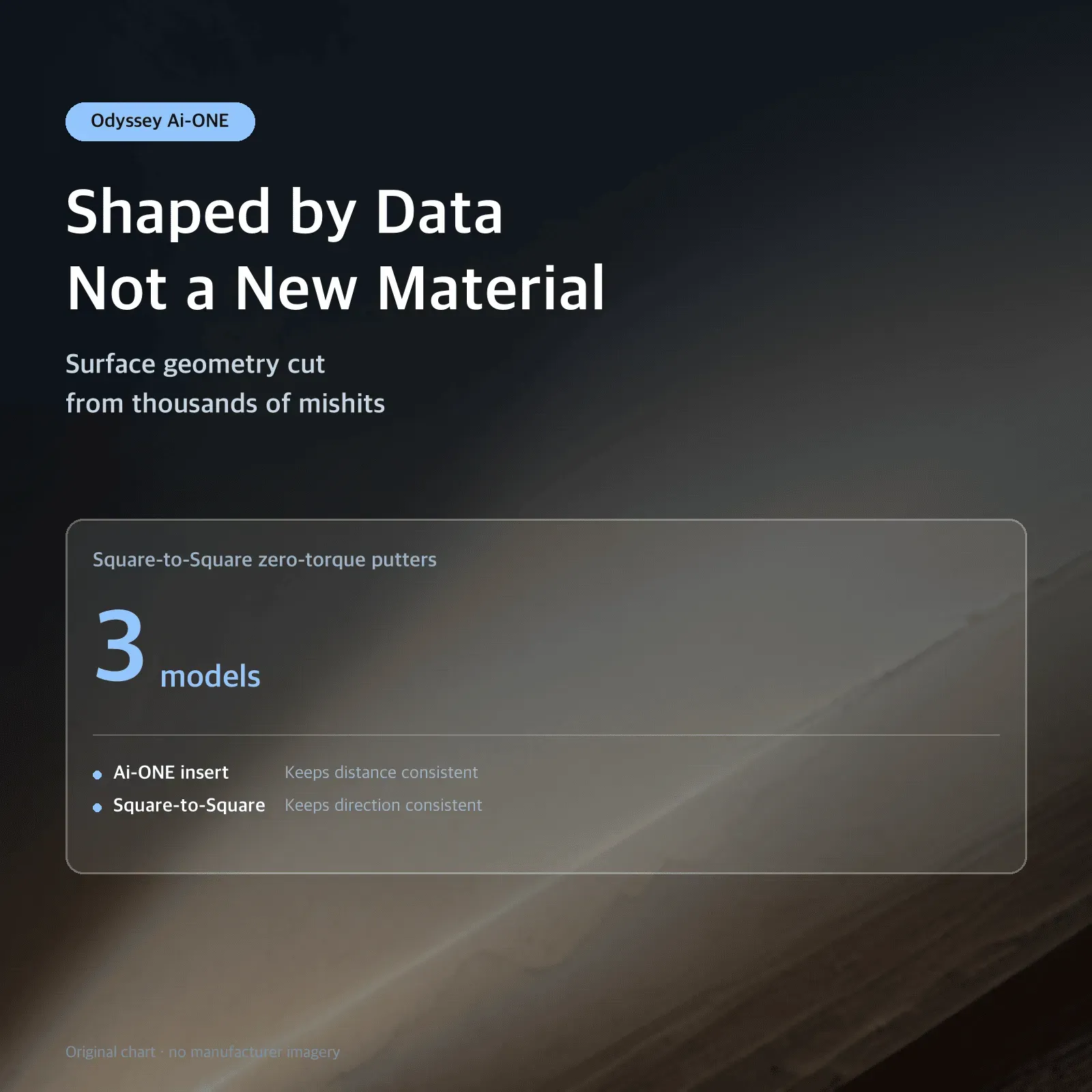
Odyssey’s Ai-ONE takes a different approach. Instead of the material, it changed the surface geometry — and not a geometry designed by a person, but one shaped, Odyssey says, by analyzing a large volume of mishit patterns.
The line also gained a zero-torque branch. Here’s how the two pieces fit together.
1. Ai-ONE — a face surface cut from data
| Step | What Odyssey did |
|---|---|
| Problem | Off-center contact costs ball speed, and distance |
| Method | Analyzed thousands of mishit patterns using AI |
| Result | Surface topography built from that analysis |
| Goal | Similar distance no matter where contact happens |
Ai-ONE - A Face Cut From Mishit Data — material targets feel, this targets outcome. Scotty Cameron and PING answer “what is it made of” - Odyssey answers “what shape is it cut into.”
The core of the Ai-ONE insert is the topography of the face surface.
Center-face contact is rarer than it seems on a putt — most strikes land slightly toward the toe or heel. Off-center contact costs ball speed, which costs distance.
Odyssey addressed this through surface shape. The company says it analyzed thousands of mishit patterns using AI to determine how each area of the face should be treated, then built the surface topography from that analysis.
The intent is clear: produce similar distance no matter where contact happens. Distance matters as much as direction on the green, and this approach targets the distance loss that comes from off-center hits by shaping the surface itself.
That’s a different layer of solution than changing material. Material targets feel; surface topography targets outcome.
The contrast with other brands is instructive. Scotty Cameron relies on the damping properties of carbon steel as a material. PING uses PEBAX, an elastic polymer, for softness. Both are answers to “what is it made of.”
Odyssey answered “what shape is it cut into” instead — a different axis on the same problem.
2. A zero-torque branch arrived in 2026
| Line | Models |
|---|---|
| Square 2 Square (center-shaft) | #7 · Max Stripe · Jailbird · Max 1 |
| Mallet variant | Square 2 Square Ai-DUAL |
A Zero-Torque Branch — Square 2 Square, the face stays square, not opening and closing. “Square to square” means the face stays square back and returns square.
As the Ai-ONE line expanded, a zero-torque branch appeared: the Ai-ONE Square 2 Square series.
Current center-shafted models:
- #7
- Max Stripe
- Jailbird
- Max 1
Double Wide is a separate Ai-ONE model, not part of the Square 2 Square center-shafted line.
The name describes the intent directly. “Square to square” means the face stays square going back and returns square, rather than opening and closing through the stroke.
3. The toe tilts up
The Square 2 Square line’s construction is distinctive.
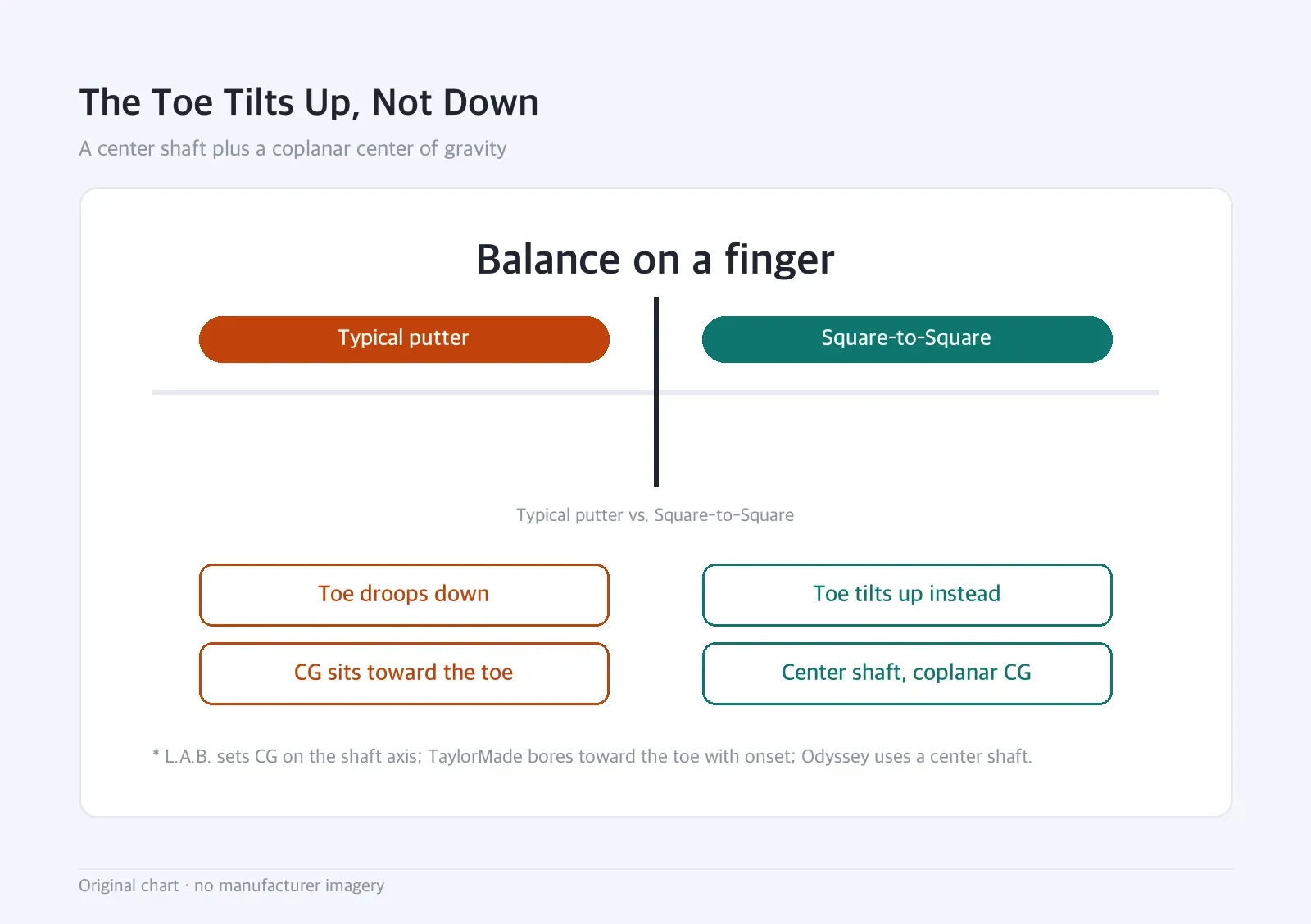
Balanced on a finger, a typical putter droops toe-down, because the center of gravity sits closer to the toe than the shaft axis.
Square 2 Square is the opposite. The toe tilts up instead.
The method is a center shaft. The shaft is set into the middle of the head, and the center of gravity is placed on the same plane as the shaft. That removes the direction gravity would otherwise rotate the head toward.
Different brands reach zero torque through different means. L.A.B. sets the center of gravity precisely on the shaft axis at playing lie angle; TaylorMade bores the shaft toward the toe and adds a large onset. Odyssey solves it with a center shaft and a coplanar center of gravity.
4. Where the two technologies overlap
Here’s how the line’s structure resolves:
- Ai-ONE insert — keeps distance consistent even on off-center hits
- Square 2 Square — keeps direction consistent through the stroke
Putts miss for two broad reasons: bad direction or bad distance. This line targets each with a different technology, and the Square 2 Square models combine both.
The logic holds together. What’s missing is published measurement of the effect — the process (analyzing thousands of mishits) is disclosed, but not a resulting percentage improvement in distance consistency.
5. How to choose
| If putts scatter… | Look at |
|---|---|
| Short and long (distance) | Ai-ONE insert |
| Left and right (direction) | Square 2 Square |
| Both | A Square 2 Square model (combines both) |
How to Choose — work out whether distance or direction is your problem. Hit about ten putts of the same length on a practice green to see which way you scatter.
First, work out whether distance or direction is your problem.
Hit about ten putts of the same length on a practice green. If they scatter left and right of the hole, that’s a direction problem. If they scatter short and long, that’s a distance problem.
- Distance scatters → the Ai-ONE insert targets this
- Direction scatters → Square 2 Square targets this
- Both → the Square 2 Square models combine both technologies
Check the address look. Center-shaft putters divide opinion — the shaft rising from the middle of the head can look unfamiliar.
Know the toe-up feel in advance. It feels different in hand from a conventional putter — not worse, just different.
Choose among the four models by shape. #7, Max Stripe, Jailbird, and Max 1 have different head shapes. All four share the zero-torque property, so the next filter is whichever suits your eye.
6. Who this putter is for
Judgment calls based on confirmed specs.
- Golfers who frequently lose distance on mishits — the Ai-ONE insert targets exactly that
- Golfers whose direction wavers on short putts — Square 2 Square targets that
- Golfers who want to try zero torque — four shapes give room to find one that suits the eye
- Golfers who value data-driven design — the design process is disclosed in more detail than most
It may be less suited for:
- Golfers unfamiliar with center-shaft putters — every Square 2 Square model is center-shafted
- Golfers who use an opening-and-closing face motion — this design is built to remove that motion
- Golfers who want numeric confirmation — the process is disclosed, but not the resulting figures
7. What we could not confirm
- The measured distance-correction effect of the Ai-ONE insert — not publicly disclosed
- The specific shape of the surface topography — only “optimized” was confirmed
- Head weight, length, and loft for the current models
- Shaft lean and onset figures — not publicly disclosed
- The source and scale of the mishit data used in the analysis — only “thousands” was confirmed
In one line
Ai-ONE is an insert that tries to correct mishits through surface shape rather than material, and Square 2 Square adds center-shaft zero torque on top of it.
Distance and direction are each targeted by a separate technology, which makes choosing easier once you know which one is your problem. Neither technology publishes a number for its effect, though — the final check is still hitting it yourself.
Structure and technology details here are drawn only from official Odyssey materials. What we couldn’t confirm is left blank.
Sources
- Odyssey official Ai-ONE page — structure and technology details come from no other source. The disclosed process is the analysis of thousands of mishits. Live check (30 August 2026) confirms the current Square 2 Square center-shaft roster as #7, Max Stripe, Jailbird, and Max 1 — Double Wide is a separate, non-center-shafted Ai-ONE model, not part of Square 2 Square.
🔴 Unconfirmed: no published measurement of the resulting effect. The process is disclosed, a percentage is not.
Confirmed live on Odyssey’s official Ai-ONE page: the insert is described as “Ai-designed,” built to deliver consistent ball speed across the face including on off-center strikes, consistent with this piece’s account. The exact “thousands of mishit patterns” phrasing could not be located verbatim on the official pages checked. The center-shaft, coplanar-center-of-gravity construction this piece describes is confirmed. Items the source does not publish remain named as unconfirmed rather than estimated.