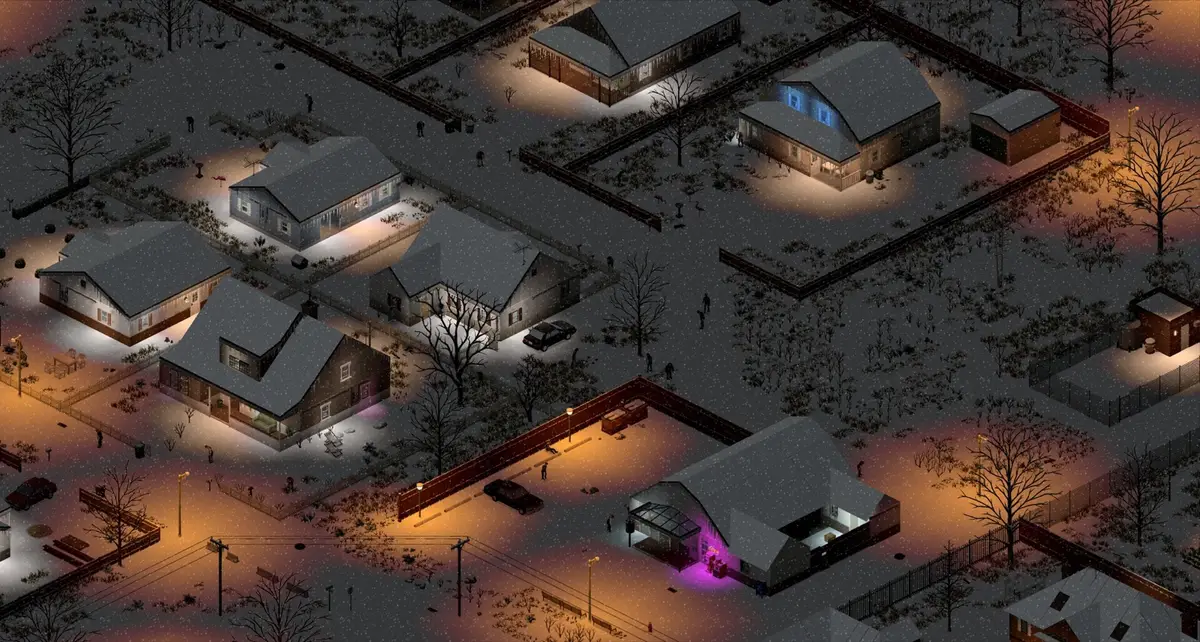
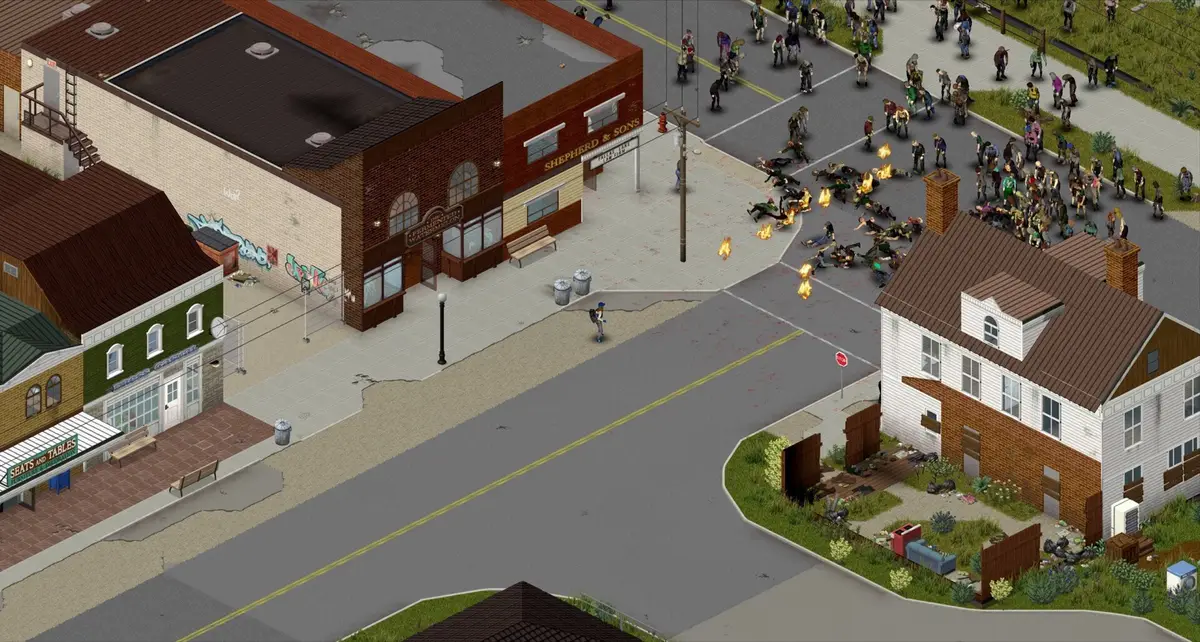
Most base advice starts with walls. It should start with a calendar. Two of the five things that decide whether a base works have dated deadlines already running when you spawn — the water shuts off on a random day from day 0 to day 30, and the power on a random day from day 14 to day 30 on Apocalypse defaults. A building that is beautiful to defend and has nowhere to put a rain collector will fail on a date you cannot see.
So score candidates in this order. Anything with a deadline outranks anything without one. This is written for Build 42, checked against 42.20.3 stable; deliberately, it contains no map coordinates, because the Build 42 map remake invalidated that entire class of advice.
The five criteria, in priority order
1. Outdoor space you control (deadline: day 0–30). You need somewhere to put water containers and rain collectors that you do not have to walk into open ground to reach. A fenced yard, a flat roof you can access, an enclosed courtyard. Buildings with no such space are not candidates regardless of anything else, because water can stop on day 0 and there is no warning — the shutoff is not announced on the emergency broadcast.
2. Generator viability (deadline: day 14–30). Power failure is announced up to two days ahead on the radio, which sounds generous until you realise the fix has three prerequisites: find a generator, fuel it, and be allowed to connect it. That last one needs the How to Use Generators magazine, the Electrician occupation, or Electrical 3. Score a building on whether a generator can sit somewhere its noise does not sit in your bedroom, and whether you can reach a fuel source. Finding the generator in the first place is a search problem the remake reset — the building-type search order is the version of that advice that survives map changes.
3. Corpse disposal (no deadline, but it compounds). Every fight near your base leaves bodies, and bodies near where you live are a health problem, not just an aesthetic one. What you are scoring is whether there is somewhere to put them — burnable ground away from your structures, or diggable soil. A base with a perfect interior and nowhere to dump a pile is a base that slowly poisons you. Ranking your own corpse load and clearing it is the follow-up once you have already moved in.
4. Approach and noise geometry. Not “is it defensible” but “what draws zombies past it”. Main roads, gas stations, sirens and anything that generates recurring noise are the concern. The helicopter event occurs once per game on default settings and pulls zombies toward you from far away, so a base you cannot quietly leave is a base with one scheduled catastrophe built in.
5. Actual defensibility. Last. It matters, but it is the criterion that is easiest to fix after you move in and the only one you can build your way out of.
Scoring a candidate in two minutes
Walk the building once and answer these in order. Stop at the first hard no.
- Is there enclosed or roof outdoor space? If no → reject, whatever else it has.
- Can a generator sit at least a room away from where you sleep, with fuel reachable? If no → keep it as a temporary camp only, not a long-term base.
- Is there ground you can burn or dig within a short walk? If no → viable, but budget time for hauling bodies further than you want to.
- Does a main road, gas station or large parking area run past it? If yes → subtract heavily; this is the criterion most beginners underweight.
- Are there more than two ground-floor entrances? If yes → fine, but this is now your first week’s carpentry project rather than a reason to reject.
- Can you leave in a direction that is not the direction you arrived from? If no → reject. A single exit is how good bases become the place you died.
A candidate that passes the first two and fails the last two is still better than one that fails the first two and passes everything else. That ordering is the entire point of the framework.
The three arguments people have about base type
Isolated rural house versus in-town. Rural wins on criteria 1, 3 and 4 almost automatically — yard space, burnable ground, no traffic. It loses on the thing this framework does not score: distance to loot. That is a real cost, but it is a cost in time, not a cost with a deadline, which is why it sorts below the shutoff criteria here.
Warehouse or commercial building. Usually strong on interior space and weak on criterion 1, because the outdoor space attached to a commercial building tends to be an open lot rather than an enclosed yard. Score the lot honestly: a car park you cannot fence is not controlled space.
Second floor with the stairs removed. A popular answer that scores badly here, because it optimises criterion 5 at the direct expense of criteria 1 and 3 — you have made it harder for zombies to reach you and harder for you to reach your water and your corpse pile. It is a fine panic room. It is a poor base.
What changes once you are settled
The criteria above are for choosing. Once you are in, the failure modes shift to maintenance ones, and they are mostly systems that break quietly. Animals are the clearest example — a hutch in the yard looks like solved food until it stops producing, and hens stop laying for six separate reasons with no message of any kind. Crafting stations are the other: Build 42 puts real skill gates on the workshop you probably imagined building, and the five-gate crafting diagnostic explains why the recipe list is shorter than you expected.
If you are setting your own shutoff dates rather than accepting the defaults, note that the sandbox field is in hours and almost everyone reads it as days the first time — the hours-not-days planner converts it.
What we could not verify
This page names no buildings, towns or coordinates on purpose. We did not find a primary source that quantifies how strongly road proximity affects zombie migration toward a location, so criterion 4 is stated as a direction rather than a number. The shutoff windows and the helicopter frequency come from a wiki page stamped 42.13.2 against 42.20.3 stable and are the default Apocalypse values — your sandbox settings override them. The relative ordering of the five criteria is this site’s judgement about which failures have deadlines attached, not a figure published by the developers.
Sources
- PZwiki, Metagame — water shutoff on a random day 0–30 and power shutoff on a random day 14–30 under Apocalypse defaults, the unannounced water shutoff versus the AEBS power warning, the generator connection requirement (magazine, Electrician, or Electrical 3), and the once-per-game helicopter event. Page stamped 42.13.2
- PZwiki, Occupation — confirms Electrician and Engineer as the occupations that can operate generators without the magazine. Page stamped 42.18.0
- Steam news, 42.20.3 STABLE Hotfix Released (17 August 2026) — establishes 42.20.3 as the current stable build this page is written against