The 2026 Scotty Cameron Phantom line stood out for how it launched. Eight models went on sale worldwide on the same day.
But one low-torque model wasn’t in that lineup. It arrived a month later, on its own.
Here’s why the same line split into two launches, and how the eight putters differ from each other.
1. Eight models, one launch day
| Base shape | Models |
|---|---|
| Phantom 5 | 5 · 5.2 · 5.5 |
| Phantom 7 | 7 · 7.2 · 7.5 |
| Phantom 9R | 9R · 9.2R |
Eight Models, Three Base Shapes — numbering follows a pattern: base shape + decimal suffix. Pricing runs from $499 to $549 across all eight models.
On February 27, 2026, eight models went on sale in golf shops worldwide simultaneously.
- Phantom 5 · 5.2 · 5.5
- Phantom 7 · 7.2 · 7.5
- Phantom 9R · 9.2R
The numbering follows a pattern. There are three base shapes — 5, 7, and 9 — with .2 and .5 variants attached to each. The 9-series carries an R.
Models sharing a base number have similar head shapes; the decimal suffix marks differences in neck style and alignment aid.
Pricing runs from $499 to $549.
2. What all eight share — a carbon steel insert
| Feature | What it is |
|---|---|
| Face insert | Full-face Studio Carbon Steel (SCS), milled chain-link pattern |
| Feel | Carbon steel’s natural damping softens contact |
| Topline | Rounded topline and face |
| Sole | Flatter sole |
What All Eight Models Share — these four changes apply across all eight Phantom models.
The one thing all eight models share is the face.
Each uses a full-face Studio Carbon Steel (SCS) insert, milled across the entire face with a chain-link pattern.
Scotty Cameron attributes the choice of carbon steel to the material’s natural damping — the metal itself absorbs impact vibration, producing a softer feel at contact.
Insert material is what typically decides a putter’s sound and feel. Steel faces produce a hard, crisp sound; polymer inserts produce a soft, muted one. Carbon steel is positioned between the two.
The other changes for this generation are a rounded topline and face and a flatter sole.
A rounded topline pulls the eye toward the face at address — an angular topline gives you a line to sight along, while a rounded one leaves the eye nothing to catch and it goes straight to the ball and face instead. Which is better is a matter of preference; this generation chose the rounded route.
A flatter sole changes how the head sits on the ground. A rounded sole leaves room for the head to rock side to side; a flat one keeps the setup consistent at address — though if your lie angle is off, a flat sole will contact the ground unevenly on one side.
3. The low-torque model arrived a month later
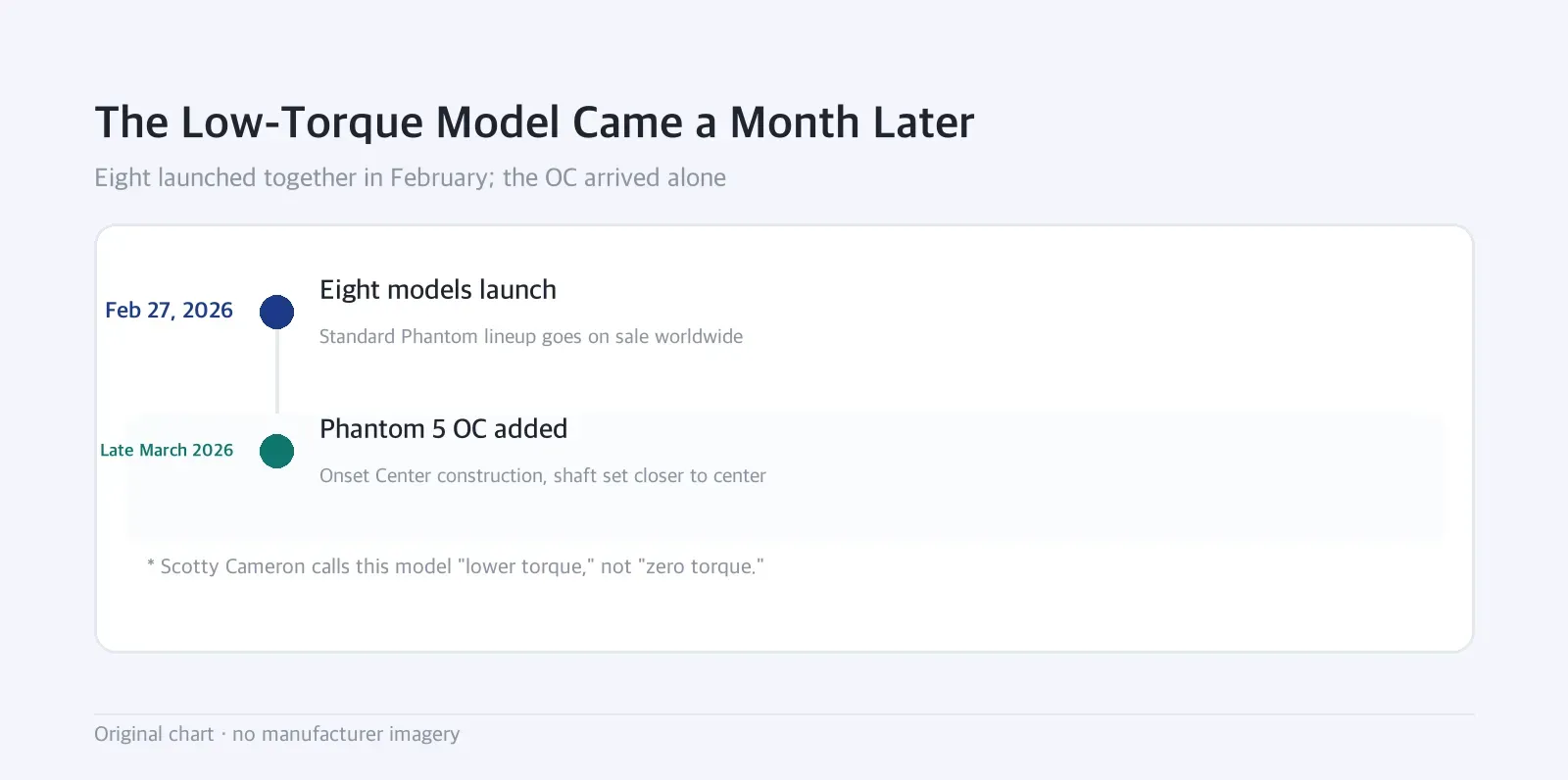
The eight putters launched in February; the Phantom 5 OC was added in late March.
OC stands for Onset Center. The construction sets the shaft closer to the center of the head and pulls the face back behind it — a configuration that reduces the head’s tendency to rotate.
Scotty Cameron describes this model as being “for players looking for a lower-torque option.” The wording is worth noting: “lower torque,” not “zero torque.”
That’s a contrast with Odyssey and TaylorMade, which led with “zero torque” language around the same time. Scotty Cameron avoided that term while releasing a model pointed in a similar direction.
4. What this line is about
Phantom is Scotty Cameron’s mallet family. If Newport represents the brand’s blade lineage, Phantom is the large-head, forgiveness-first side.
Launching eight models at once fits that character. Mallets allow far more shape variation than blades do — wing length, alignment aids, and neck styles can all differ, and that combinatorics is what produces eight putters at once.
Blades have a fixed silhouette with little room to vary; mallets don’t, which is why the lineup is wide here.
This points to a broader trait: releasing eight putters on one day isn’t the “make one and sell it well” approach — it’s a “fit the player” approach. The lineup is built around fitting.
The $499–$549 price range, high for this segment, fits the same logic. This isn’t a line built for volume.
5. How to choose
| Step | What to check |
|---|---|
| 1 | Base number 5/7/9 - bigger for forgiveness, smaller for feel |
| 2 | Decimal suffix .2/.5 - neck and alignment, match your stroke |
| 3 | Want low torque - check the OC, address look differs |
| 4 | Feel matters - test the insert, steel-polymer middle ground |
How to Choose — judgment steps drawn from the manufacturer’s own descriptions.
Start with the base number. 5, 7, and 9 are the three head families, and larger numbers generally mean a bigger head. Go bigger for forgiveness, smaller for feel and control.
Then look at the decimal suffix. .2 and .5 differ in neck and alignment details, which is where balance splits — match it to your stroke. A straight-back-straight-through stroke suits face-balanced options; an arced stroke suits models with more toe hang.
If you want low torque, look at the OC. Its address look differs from the standard models because of the shaft position and onset. Check whether the look suits your eye before worrying about performance.
If feel matters to you, test the insert directly. The carbon steel insert sits between a steel face and a polymer one — softer than the former, firmer than the latter. Whether that middle ground suits you is something you have to hit to know.
6. Who this putter is for
Judgment calls based on confirmed specs.
- Golfers who prefer a mallet shape — all eight models are mallets, giving a wide range of choices
- Golfers who want to fine-tune shape details — few lines offer eight variants within one family
- Golfers who dislike both very hard and very soft feel — the carbon steel insert targets that middle ground
- Golfers who want lower torque but not full zero torque — the OC model occupies exactly that space
It may be less suited for:
- Golfers who want a blade — Phantom is a mallet line; look at the Newport family instead
- Golfers on a tight budget — $499–$549 is high for this category
- Golfers who want true zero torque — the brand’s own language is “lower torque,” a different target
7. What we could not confirm
- Head shape, weight, and length for each of the eight models — the official spec sheet was not available
- The exact rule distinguishing .2 from .5 across the lineup
- Balance point (face-balanced vs. toe hang) for each model
- The onset measurement and shaft lean of the Phantom 5 OC — not publicly disclosed
- Where the “Phantom 11R OC” (a “low torque” model seen in some retail listings but absent from the February launch list) fits into the lineup
In one line
The 2026 Phantom line is eight mallets launched on one day, all sharing the same carbon steel face.
The low-torque model came a month later, and Scotty Cameron calls it “lower torque,” not “zero torque” — a different stance than other brands that led with zero torque around the same time.
Launch details and construction notes here are drawn only from official manufacturer statements. What we couldn’t confirm is left blank.
Sources
- Titleist/Scotty Cameron official statements — launch details and construction notes come from no other source. Eight Phantom models launched first, with the OC model added later in the same window.
🔴 Unconfirmed: head shape, weight and length for each of the eight models — the official spec sheet was not available.
No archived URLs are recorded for these sources in the original research. Items the source does not publish are named as unconfirmed rather than estimated.