There’s a well-known story in golf equipment history.
In 1904, the American Walter Travis won the British Amateur using a Schenectady putter, and a wounded British golf establishment banned the club in response. Several sources tell it in that order.
It’s a well-built story. So we went looking for evidence behind it. We could not find any that supports it.
1. Six years separate the two events
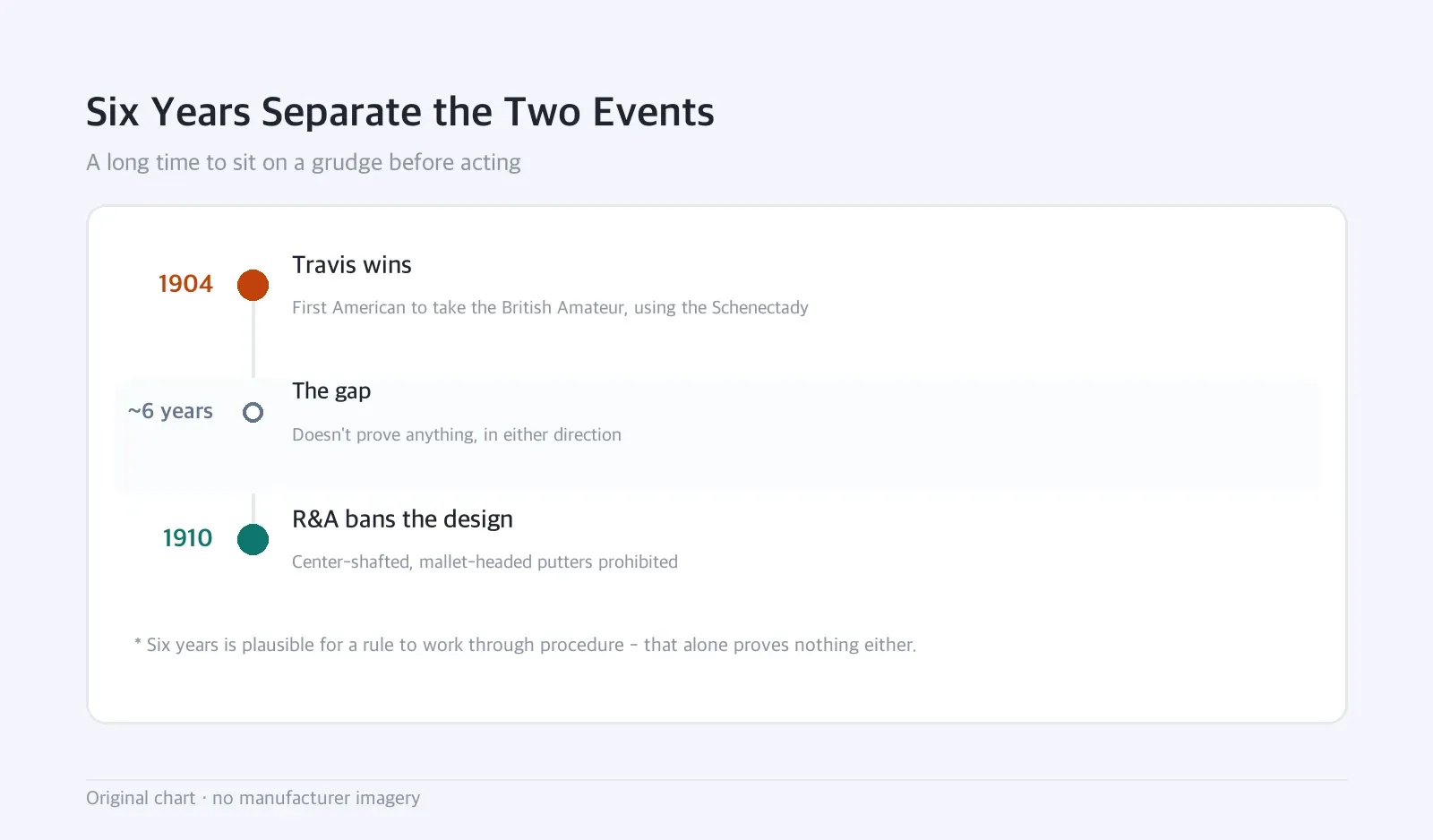
Start by lining up the dates.
- 1904 — Travis wins the British Amateur
- 1910 — the R&A bans center-shafted and mallet-headed putters
That’s a six-year gap.
Six years is a long time to sit on a grudge before acting. It’s hard to see why an organization with the power to change the rules would wait that long.
Granted, six years is plausible for a rule change to work through procedure. But that alone doesn’t prove the grudge story either. The time gap doesn’t prove anything, in either direction.
2. The request for a ban came from New Zealand
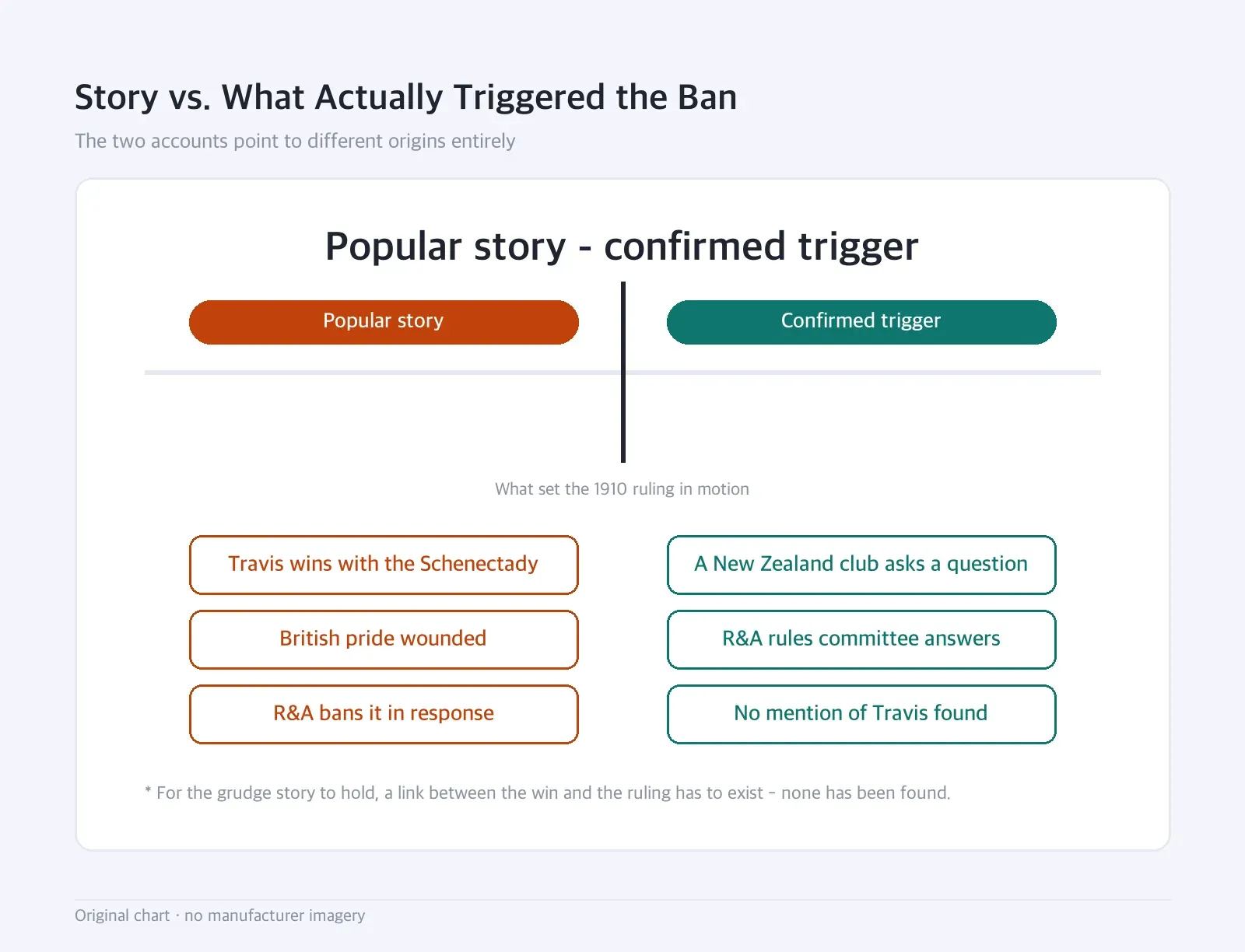
More decisive is how the ruling actually came about.
The R&A’s 1910 decision was not a proactive move — it was a response to an inquiry. And that inquiry came from a golf club in New Zealand.
New Zealand doesn’t fit a story built on Anglo-American rivalry. A club on the other side of the world asked whether such a putter was legal, and the R&A answered.
For the grudge story to hold, there needs to be a link between Travis’s win and the R&A’s decision to act. The actual trigger was somewhere else entirely.
3. Sources call this a “myth”
Material covering this topic is clear on the point.
There is no evidence that Travis’s 1904 win with the Schenectady contributed to the ruling, and yet the story keeps circulating. The word “myth” gets used.
So this isn’t an unresolved theory sitting quietly unchallenged. It’s a story that has already been flagged as unsupported.
4. So why did the story survive
| Version | What it has |
|---|---|
| Real sequence | A club asks, a committee rules - no protagonist, no motive |
| Popular version | A hero, a grudge, an ending - memorable by design |
| Why it lingers | Meeting minutes aren’t public, so it stays unconfirmed either way |
Why a Flatter Story Got Replaced — This part is inference, not confirmed fact. A memorable story tends to outlive the facts - this isn’t the only case in golf equipment history.
From here on this is inference, not confirmed fact, and it’s labeled as such.
One thing worth noting first: this doesn’t look like a story that was invented with malice. Both events really happened, and the order is correct, so it reads naturally as cause and effect.
It’s probably because the story is well-constructed. It has characters, a motive, and an ending. An American bruises British pride, and Britain answers with a rule.
The actual sequence is flatter. A New Zealand club asked a question, a committee issued a ruling, and the Americans read it differently. No protagonist, no moment of revenge.
A memorable story tends to outlive the facts. Golf equipment history has more than one case like this — the story behind why the club limit landed on exactly fourteen is another, covered separately.
One more thing about this particular case: it’s hard to verify either way. Whether Travis’s win came up inside R&A discussions is something only meeting minutes could confirm, and those aren’t easy for an ordinary reader to check. So the story sits unchallenged and unconfirmed at the same time.
5. What’s confirmed and what isn’t
Here’s where the line falls on this one.
Confirmed:
- Travis won the 1904 British Amateur using a Schenectady putter
- The R&A banned center-shafted and mallet-headed putters in 1910
- That ruling was a response to an inquiry from a New Zealand club
- The USGA ruled that center-shafted putters were not covered by the ban
| Claim | Status | Detail |
|---|---|---|
| Travis won the 1904 British Amateur with a Schenectady | Confirmed | Recorded as the first American to take the title. |
| R&A banned center-shafted putters in 1910 | Confirmed | Ruling text confirmed: “center-shafted, mallet-headed implements.” |
| The ban answered a New Zealand club’s inquiry | Confirmed | Not a proactive R&A move. |
| Travis’s win influenced the ban | Not found | No documentary evidence located for this link. |
| His win was discussed inside the R&A | Not found | Meeting minutes were not available to check. |
What’s Confirmed, What Isn’t — Both events being real, and one causing the other, are different claims. This piece does not prove the grudge story false - only that no evidence for it could be found.
Not confirmed:
- That Travis’s win influenced the ban
- That his win was discussed inside the R&A
Both events being real, and one causing the other, are two different claims. The grudge story uses the first to argue the second.
This pattern shows up outside golf too. When two events line up in time, it’s easy to read the earlier one as the cause of the later one. But sequence and causation aren’t the same thing.
6. Who this is useful for
Based on what could be confirmed:
- Golfers interested in equipment history — a widely repeated story turns out to have no confirmed basis.
- Golfers curious about the background of rule changes — the actual trigger for the 1910 ruling was an inquiry from a New Zealand club.
- Readers cross-checking sources — the same event gets told in different orders across different write-ups. Lining up the dates side by side clears it up.
This is less useful for:
- Anyone who just enjoys the story as a story — fact-checking it takes some of the fun out.
- Golfers who only need the current rule — center-shafted putters have no issue under today’s rules.
7. What we could not confirm
- The minutes from the R&A’s 1910 decision process — we don’t know what, if anything, was discussed internally. This is what it would take to rule out the grudge story completely.
- The name and content of the New Zealand club’s inquiry.
- When the grudge story started circulating — we couldn’t trace an original source.
- Anything Travis himself said about it — we don’t know whether he ever commented.
- Contemporary British press coverage.
This is not a piece that proves the grudge story is false. It goes as far as: we couldn’t find evidence supporting it, and the actual trigger has been confirmed elsewhere.
In one line
Travis’s 1904 win and the 1910 ban both really happened. But the link between them — that the first caused the second — we could not find evidence for.
Six years separate the two events, and the ban was triggered by an inquiry from a New Zealand club. Sources covering this call the popular version a “myth.”
Both events being true and one causing the other are different claims.
This piece only goes as far as separating what’s confirmed from what isn’t. Going further would take documents we don’t have.
Sources
- Records of Walter Travis’s 1904 British Amateur win and the R&A’s 1910 ruling — the six-year gap that the grudge story has to account for.
🔴 The 1910 decision is recorded as a response to an inquiry, not a proactive move. The grudge reading is not supported by the record and the body says so.
Wikipedia’s account of the Schenectady putter was opened and read: it states the 1910 ban followed “a request from a golf club in New Zealand” and that “there is no evidence” Travis’s win contributed to it. No further archived URLs are recorded for these sources in the original research. Items the source does not publish are named as unconfirmed rather than estimated.