Research putters for long enough and the term “zero torque” comes up repeatedly.
A few years ago this was one small brand’s idea. Now, running down the current new-release list tells a different story. Odyssey, TaylorMade, Scotty Cameron, and PXG have all released models built this way, and PXG alone has five.
What it actually is, and why several major brands have converged on solving it in different ways, is worth laying out.
1. Torque is the head’s tendency to rotate
| Step | What happens |
|---|---|
| Centre of gravity sits off the shaft axis | Gravity pulls the offset weight down |
| That pull acts at a distance from the axis | The pull becomes rotation — torque |
| The same force acts mid-stroke | The face tends to open or close |
| Zero torque | An attempt to eliminate that force |
Torque Is the Head’s Tendency to Rotate — Balance a putter on a finger and the toe usually drops. Commentary points specifically at putts inside 10 feet, where a small face error is enough to miss.
Balance a putter across a finger, held horizontally, and the head rotates toward one side — usually the toe drops.
That happens because the center of gravity sits off the shaft axis. Weight positioned away from the axis gets pulled down by gravity, and that pull creates rotation. That rotational tendency is torque.
The same thing happens mid-stroke. As the club transitions from backswing to forward stroke, a direction-changing force acts on the head, and if the center of gravity sits off-axis, the face tends to open or close.
Zero torque is the attempt to eliminate that force.
2. The fix — put the center of gravity on the shaft axis
| Where the centre of gravity is measured | Result |
|---|---|
| Off the shaft axis | Gravity has a direction to rotate toward |
| On the axis, held horizontal | A different position than actual play |
| On the axis, at playing lie angle | No direction to tip, at address |
The Fix, and Why “At Address” Matters — L.A.B. Golf systematized this as lie-angle balance. Like weight balanced directly above a seesaw pivot — it will not tip either way.
The principle is simple: keep the center of gravity from sitting off the shaft axis at all.
If it sits directly on the axis, gravity pulling down has no direction to rotate toward — the same as balancing weight directly above a seesaw’s pivot point, which won’t tip either way.
L.A.B. Golf was the first to systematize this, under what it calls “lie-angle balance” — tuning the center of gravity to sit on the shaft axis at the actual playing lie angle, not at some arbitrary reference position.
That “at the actual playing lie” qualifier matters. A putter is played standing over the ball at an angle to the ground, so balance measured holding it horizontal and balance measured at actual address posture are two different things.
3. What it’s claimed to improve
The effect every brand states in common is the same: the face stays square through the stroke.
A face that doesn’t rotate brings two things with it:
- A more consistent starting direction for the ball.
- Less directional loss on a mishit, since the face twists less.
Commentary specifically points to putts inside 10 feet, where the stroke is short enough that even a small face-angle error is enough to miss the hole.
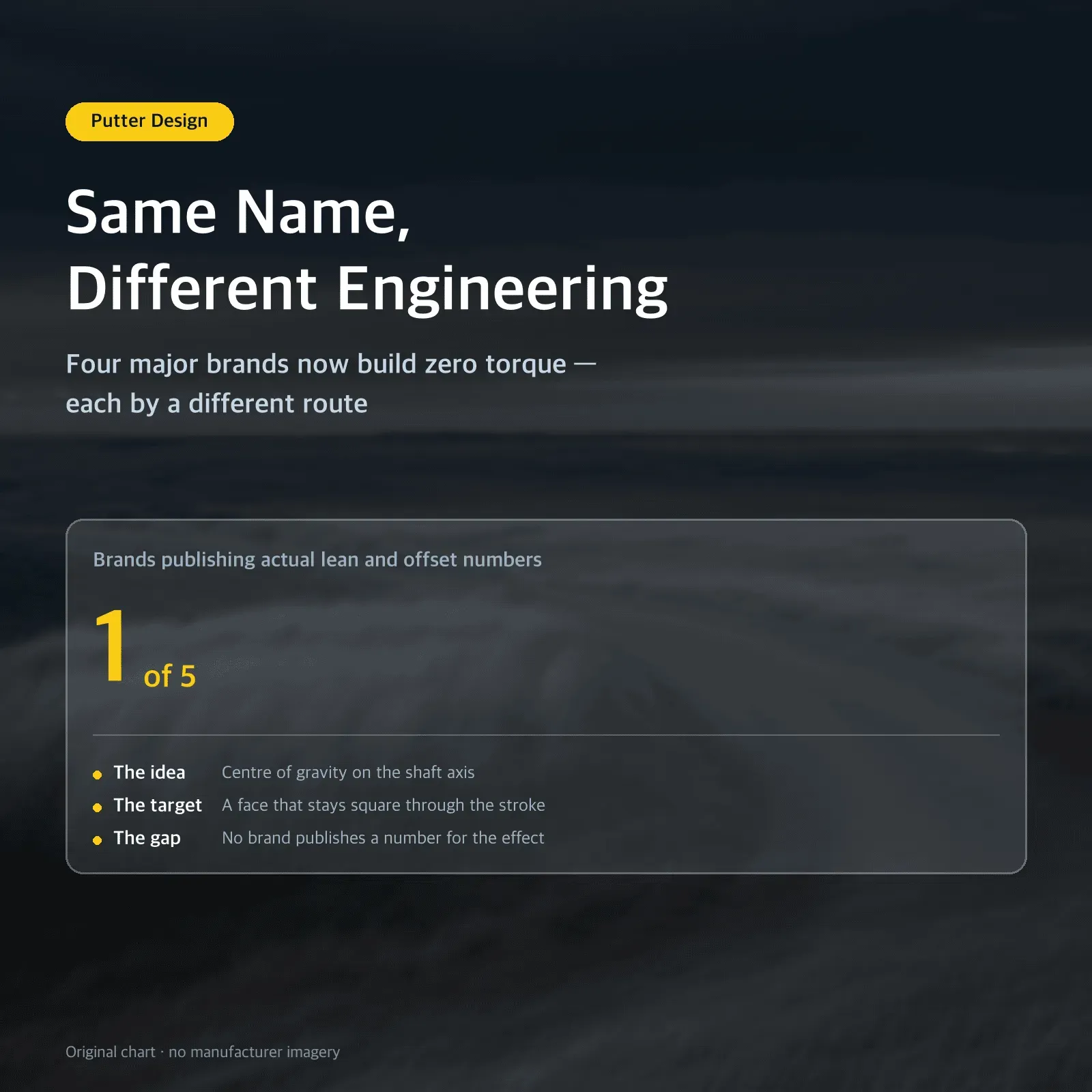
To be direct about it, though: no brand publishes a number for that effect. “Stays square” is the confirmed claim; how many degrees of rotation that translates to isn’t disclosed anywhere.
4. Four brands, four different builds
| Brand | How it is built |
|---|---|
| L.A.B. Golf | Centre of gravity on the axis at playing lie angle |
| Odyssey | Centre shaft, centre of gravity in the shaft plane |
| TaylorMade | Bore near the centre of gravity, toward the toe |
| Scotty Cameron | An onset-centre (OC) construction |
| PXG | Five models across one line |
Same Target, Five Different Routes — Lumping these together as one product misses real differences. With Odyssey the head tilts slightly upward instead of the toe dropping.
Everyone uses the term “zero torque,” but the engineering underneath differs — and that turned out to be the most interesting part of this research.
- L.A.B. Golf — places the center of gravity directly on the shaft axis at the actual playing lie angle. This is the most principle-first approach, and the one that introduced the concept.
- Odyssey — builds a center-shaft design and keeps the center of gravity in the same plane as the shaft, so instead of the toe dropping, the head actually tilts slightly upward.
- TaylorMade — bores near the center of gravity toward the toe to seat the shaft there, and adds a 2-degree shaft lean and 34mm of offset on top of it.
- Scotty Cameron — solves it through an onset-center (OC) construction.
- PXG — extended zero-torque balance across an entire line: five models total, including the Allan, Battle Attack, Mustang, Hellcat, and the One & Done ZT.
Same target, different routes to it. Which is why lumping every “zero torque putter” under one label and comparing them as identical products misses real differences underneath.
5. Few brands publish actual numbers
| Model | Shaft lean | Offset |
|---|---|---|
| Spider ZT | 2° | 34 mm |
| Centre-shaft profile | 1° | 25 mm |
Only One Brand Publishes Figures — TaylorMade is the one confirmed source in this category. Offset is how far the face sits back from the shaft axis. 34 mm is not small against a putter head.
Finding real figures in this category wasn’t easy. TaylorMade is the one confirmed source.
- Spider ZT — 2° shaft lean · 34mm offset
- Center-shaft profile — 1° shaft lean · 25mm offset
Offset is the distance the face sits back from the shaft axis. 34mm isn’t a small figure relative to a putter head’s overall size.
Shaft lean is the forward-lean angle of the shaft. The two figures together tune the relationship between the center of gravity and the axis.
Every other brand explains the structure without publishing the numbers behind it — a gap in the usual approach of comparing brands purely by official spec sheet, which doesn’t work as cleanly for putters.
6. So who’s a fit for this
If direction wanders on short putts, this category is worth a look. That’s precisely the target every brand states.
If you rely on a feel of opening and closing the face through the stroke, it may feel off at first. The whole design is built to remove that rotation, and that can clash with a hand-manipulated feel you’ve built over time.
Before switching, one thing to check. Most zero-torque putters are either center-shafted or carry significant offset. The look at address differs meaningfully from a conventional putter. Check whether the look suits your eye before worrying about performance.
Don’t judge the whole category from one putter. As shown above, brands implement this differently. One brand not working for you doesn’t mean the category doesn’t.
7. Who this is useful for
Useful for golfers whose starting direction wanders on short putts — every brand states this as the specific target.
Useful for golfers prone to mishits — reducing face rotation on off-center strikes is the stated purpose of this design.
Useful for golfers comparing multiple brands — since the engineering differs by brand, one putter’s fit or miss shouldn’t be generalized to the category.
Useful for golfers who want numbers to go on — only TaylorMade currently publishes shaft lean and offset figures.
Less useful for golfers who putt by feel, actively opening and closing the face — this design is built specifically to remove that sensation.
Less useful for golfers particular about the look at address — a center shaft and large offset can look unfamiliar.
Less useful for golfers wanting a published performance number — no brand has disclosed a figure for the actual effect.
8. What we could not confirm
- A published number backing the stated performance benefit — confirmed only as far as “stays square,” with no disclosed figure.
- Shaft lean and offset figures for L.A.B., Odyssey, Scotty Cameron, or PXG — only TaylorMade discloses these.
- Zero-torque models reported to be in development at other manufacturers — reported but with no confirmed model name or specification.
- Head weight for each model — not confirmed.
- Whether “zero” means literally zero or “close to zero” — wording differs by brand and no measured value is disclosed.
- Retail pricing beyond one brand’s stated US list price of $499–$549 — not confirmed elsewhere.
In one line
Zero torque is a design that places the center of gravity on the shaft axis to eliminate the head’s tendency to rotate. The goal is a consistent starting direction on short putts.
With several major brands now in this category at once, the field has widened. But the engineering underneath the same name differs by brand, so don’t judge the whole category from a single putter.
Sources
- L.A.B. Golf — Lie Angle Balance Technology — confirms L.A.B.’s technology “keeps the putter face square to the arc throughout the stroke” and is described as eliminating torque; live as of this check.
- Odyssey — Ai-DUAL Square 2 Square #7 Center Shaft Putter — confirms the center-shaft design with the center of gravity in the shaft plane, and that the head “rests with the toe up” instead of toe-hanging; matches this piece’s description exactly.
- PXG — Allan ZT Putter — confirms PXG’s zero-torque design (an S-hosel that “situates the shaft axis just above the CG”) for at least one current model.
🔴 PXG’s official Zero Torque collection page currently lists six models (Hot Rod ZT, Allan ZT Long, Mustang ZT, Hellcat ZT, Bat Attack ZT, Allan ZT) — not the five named in this piece (“Battle Attack” and “One & Done ZT” do not appear on the live page). That naming has drifted since this piece was researched and is flagged here rather than silently corrected in the body.
TaylorMade (taylormadegolf.com) and Scotty Cameron (scottycameron.com) block automated page access, so the Spider ZT figures and the Scotty Cameron OC-construction claim could not be independently reconfirmed against a live official page.