“Which ball for which swing speed” is a common rule of thumb when choosing a golf ball. What’s rarer is a manufacturer that actually builds that threshold into its own product line.
Titleist states it does not recommend balls by swing speed in its ball-fitting process. Other brands publish compression numbers but don’t draw a speed line.
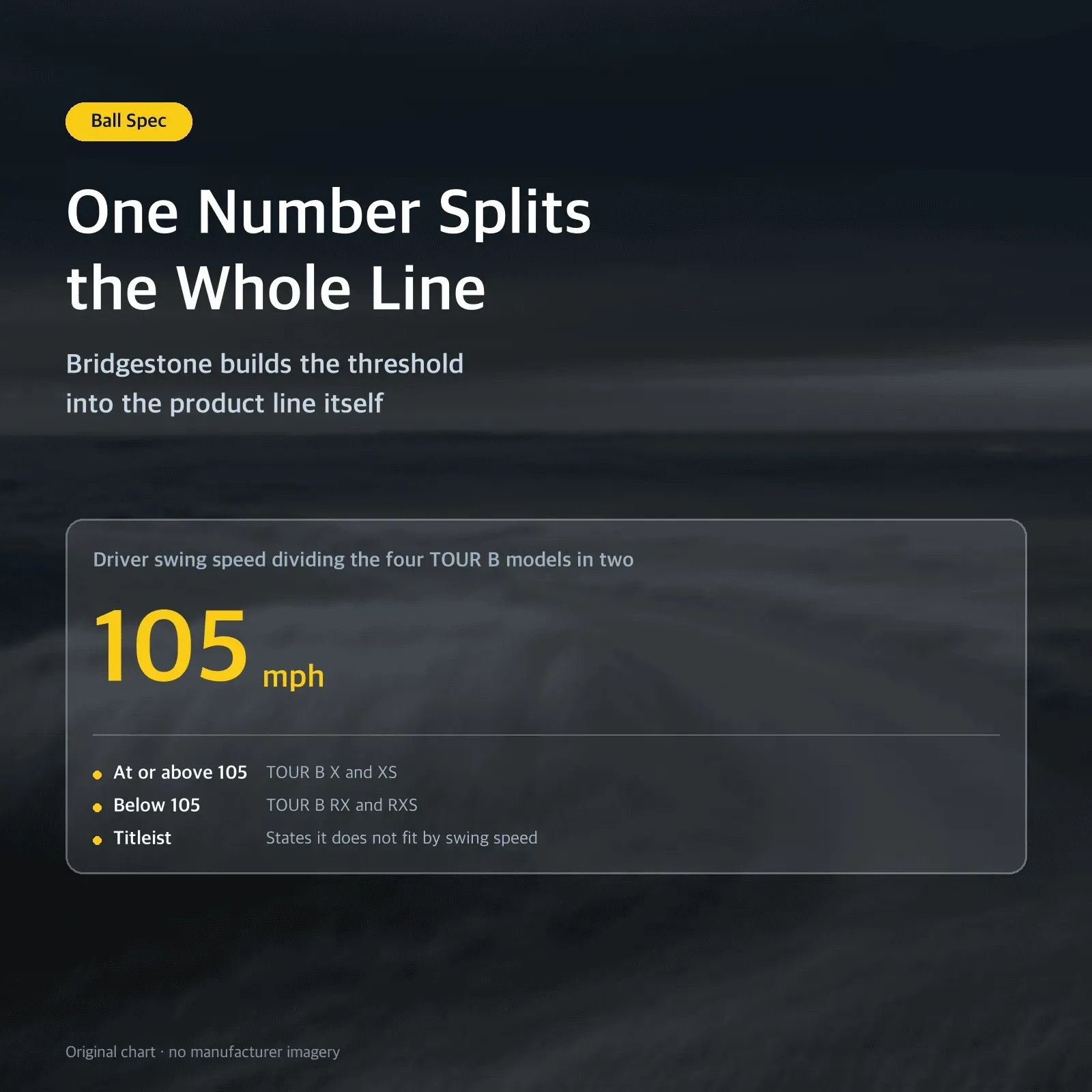
Bridgestone does. Its four 2026 TOUR B models are split into two groups at a stated 105 mph driver swing speed threshold.
1. 105 mph — the line that splits the family
| Speed band | Models |
|---|---|
| 105 mph and above | TOUR B X, TOUR B XS |
| Below 105 mph | TOUR B RX, TOUR B RXS |
The Line That Splits the Family — An “R” prefix means below the threshold; an “S” marks character within a band. Informal rules of thumb are not any maker’s standard. 105 mph is a line this maker actually used.
The 2026 TOUR B line has four models. The names are easy to confuse, but the split itself is clear:
- 105 mph and above — TOUR B X and TOUR B XS
- Below 105 mph — TOUR B RX and TOUR B RXS
An “R” prefix means below 105. An “S” suffix marks a different character within the same speed band.
This threshold matters because it’s a different category of claim from what circulates informally. Rules of thumb like “under 85 mph means low compression” are common online but aren’t any specific manufacturer’s official standard. 105 mph, by contrast, is a line the manufacturer actually used to split its own product line.
So if you already have a driver swing speed measurement, this is the one brand where that single number cuts your candidates in half.
2. X and XS — same speed band, different purpose
| Model | Direction | Built for |
|---|---|---|
| TOUR B X | Flies lower, spins less | Maximum driver distance |
| TOUR B XS | Same core and mantle tech | Feel and greenside control |
Same Speed Band, Different Purpose — Speed is not the deciding factor between these two. XS is described as holding the grip tour players need on fast greens.
The two models above 105:
- TOUR B X — the one that flies lower and spins less of the two. Described as built to maximize driver distance.
- TOUR B XS — aimed at golfers above 105 mph who prioritize feel and control over raw distance. Described as using the same core and mantle technology as the distance-focused X, without giving up greenside bite.
The stated design goal for XS is holding the grip tour players need on fast greens.
In short: X is “farther,” XS is “hold and shape it.” Since both sit in the same speed band, speed itself isn’t the deciding factor between these two.
3. VeloSurge — four models chosen from over 240 prototypes
| Maker | What changed | Layer count |
|---|---|---|
| Bridgestone | Core and mantle, over 240 prototypes tested | Unchanged |
| Callaway | Mantle material | Unchanged |
| TaylorMade | Coating | Unchanged |
| Srixon | Core and cover | Unchanged |
No One Added a Layer This Generation — VS (VeloSurge) works on core and mantle together. TOUR B X is confirmed three-piece in retail listings, alongside Pro V1 and Z-STAR9 on layer count.
This generation’s technology name is VS, short for VeloSurge, described as a technology that works on the core and mantle together.
One figure from the development process stands out: Bridgestone states it tested more than 240 prototypes before narrowing down to the final four models.
The same pattern shows up here as with the other brands: no additional layer, a reworked core and mantle formulation instead. Callaway changed mantle material, TaylorMade changed coating, Srixon changed core and cover. None of this generation’s four major releases increased layer count.
TOUR B X is confirmed as three-piece in retail listings. By layer count alone, that puts it alongside Pro V1 and Z-STAR9.
4. Release timing
| Item | As published |
|---|---|
| U.S. price | $54.99 per dozen |
| Release date | January 30 |
| Other configurations | Co-branded logo balls, small gift sets |
Release and Pricing as Published — U.S. figures from the maker’s own listings. Gift sets differ in quantity and pricing from a standard sleeve — check what is included.
U.S. pricing is $54.99 per dozen, with a January 30 release date.
Regional retail also carries co-branded logo balls and small gift-set configurations. These differ in quantity and pricing from the standard sleeve, so check what’s included before buying one that’s priced differently.
5. So how do you choose
Choosing within this brand is simpler than with most others, because the manufacturer has already made the first decision for you.
Step one — check your driver swing speed
Use a measurement from an indoor simulator or a fitting session. All you need to know is whether it’s above or below 105.
- 105 or above → X or XS
- Below 105 → RX or RXS
Step two — pick a character within that band
- Prioritize distance → the model without the S (X or RX)
- Prioritize greenside control and feel → the model with the S (XS or RXS)
If you don’t have a measurement, skip step one and compare around the green instead. But half the advantage of choosing this brand comes from that threshold, so it’s worth getting your speed measured once before deciding.
6. Who each ball fits
These are inferences drawn from the confirmed specifications, not a ranking.
- A golfer who already has a driver swing speed reading — this is the one brand with a manufacturer-stated threshold, which is the one place that number is directly actionable.
- A golfer whose speed is under 105 — most other brands only make tour balls aimed at faster swings; this line has RX and RXS built specifically for the slower band.
- A golfer looking for a urethane-cover tour ball at a lower price point — this line tends to sit at the lower end among tour balls.
- A golfer who prefers a three-piece structure — X is confirmed three-piece in retail listings.
Cases where the fit runs the other way:
- A golfer with no swing speed measurement and no plan to get one — this brand’s biggest advantage goes unused without it.
- A golfer treating the 105 threshold as an industry-wide standard — it’s this company’s own line-splitting criterion, not a shared standard.
- A golfer assuming layer count tracks with price — X is three-piece and priced at the lower end; the two don’t move together here.
7. What could not be confirmed
- Layer count for XS, RX, and RXS — only X’s three-piece construction was confirmed in retail listings.
- Compression figures for all four models — Bridgestone is reported to disclose compression generally, but model-specific figures were not confirmed here.
- Dimple count — not confirmed.
- Whether RX and RXS are sold through standard retail in all markets — X and XS were confirmed; the other two were not.
- The reasoning behind the 105 mph threshold specifically — the company’s rationale for that exact number is not explained.
Summary
TOUR B is a rare case of swing speed actually shaping a manufacturer’s own product line. One number — 105 mph — splits four models into two groups.
That makes this the easiest brand to shop if you already have a swing speed reading, and half the advantage sits idle if you don’t. Driver head speed is commonly displayed on indoor launch monitors, so it’s worth checking once before deciding.
The thresholds and pricing in this piece are drawn only from Bridgestone’s official specifications and U.S. retail pricing. Where a figure could not be confirmed, it has been left blank rather than estimated.
Sources
- TOUR B X — Bridgestone Golf official shop — confirms “The TOUR B X is higher compression for swing speeds OVER 105 mph” and names the VeloSurge core-mantle technology.
🔴 Rules of thumb such as “under 85 mph means low compression” circulate online but are not any specific manufacturer’s official standard, and are not used here.
One archived URL is recorded above; it confirms the 105 mph threshold and the VeloSurge technology name. The “more than 240 prototypes” figure, TOUR B X’s piece count, and the $54.99/January 30 release details could not be confirmed against a live Bridgestone page in this pass — bridgestonegolf.com’s main news/press pages returned HTTP 403 — so they remain unconfirmed rather than linked. Items the source does not publish are named as unconfirmed rather than estimated.