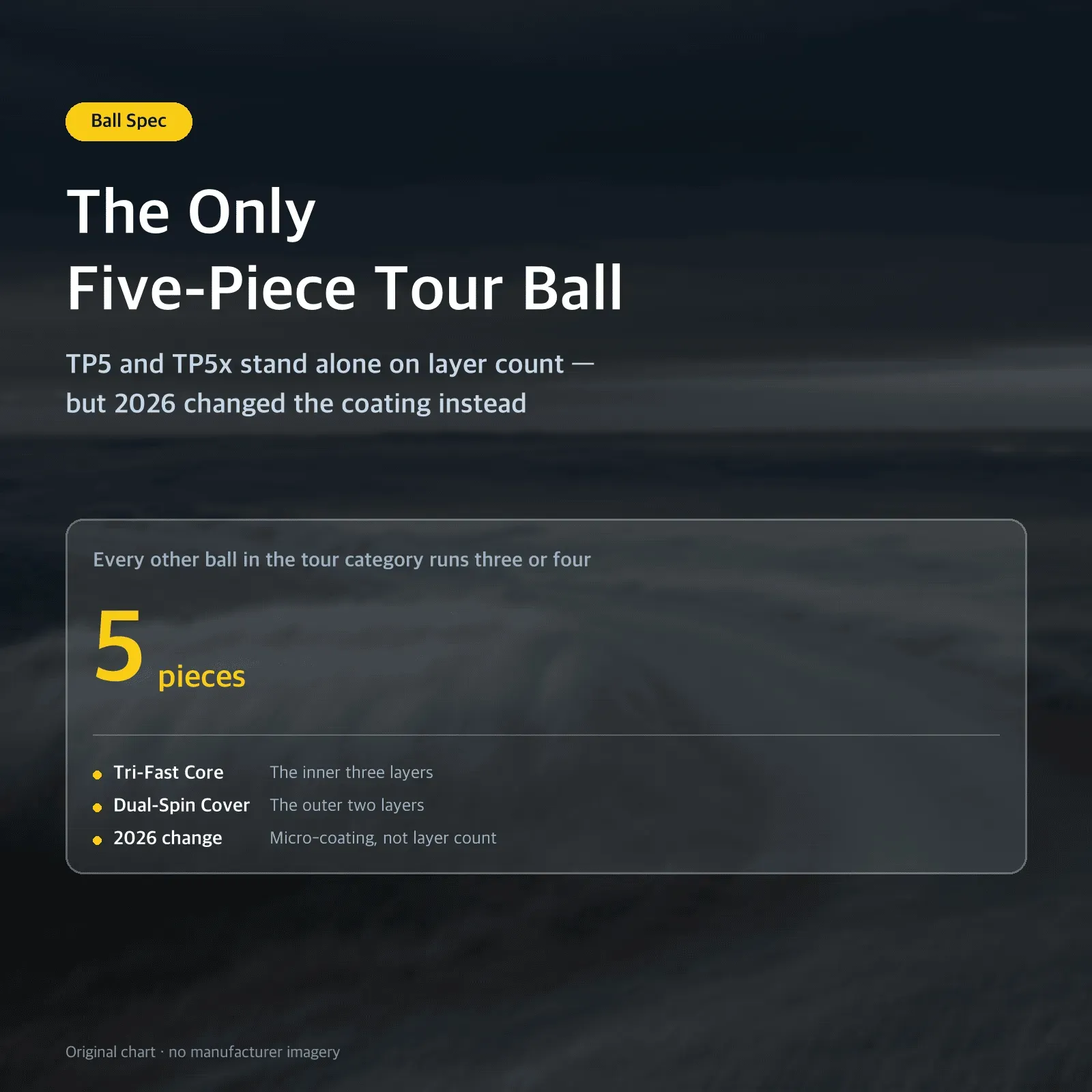
Among the current tour balls we checked brand by brand — Titleist, Callaway, Srixon and Bridgestone — TP5 and TP5x are the only models built with five layers; the rest run three or four. TaylorMade makes the broader claim itself, and we have not audited every tour ball on the market to test it.
More layers might suggest a higher price, but that’s not how the pricing actually lands. This piece looks at what the 2026 update changed, and why the ball is split into five layers in the first place.
1. Five-piece — alone in this category
| Pieces | Balls |
|---|---|
| Three | Pro V1, Z-STAR9, TOUR B X |
| Four | Pro V1x, Chrome Tour, Z-STAR9 XV |
| Five | TP5, TP5x |
Alone at Five in the Tour Category — the current field laid out by layer count. Three inner layers plus two cover layers makes five. More layers segments behavior by impact zone.
Laid out by layer count, the current tour ball field looks like this:
- Pro V1 — three-piece
- Z-STAR9 — three-piece
- TOUR B X — three-piece
- Pro V1x, Chrome Tour, Z-STAR9 XV — four-piece
- TP5, TP5x — five-piece
TaylorMade puts this at the center of its marketing. In the company’s own language, it is “the only five-layer tour ball.”
The reason to add layers is to segment behavior by impact zone. A driver strike compresses the ball down toward the core, while a wedge shot barely goes past the cover — more layers means a different layer can be engineered to do the work in each situation.
2. Two names attached to the structure
TaylorMade attaches two names to this construction:
- Tri-Fast Core — the inner three layers. Stated purpose is maximizing carry through low drag.
- Dual-Spin Cover — the outer two layers. Described as handling performance across the full range from tee to green.
Three plus two makes five.
The 2026 TP5 adds one more change on top of this: the largest core the company has used in a tour ball, intended to reduce contact time with the clubface at impact. The logic is that shorter contact time means less energy loss, which raises ball speed.
3. What’s new in 2026 — the coating
| Maker | What changed | Layer count |
|---|---|---|
| TaylorMade | Micro-coating, applied to a millionth of a gram | Unchanged |
| Callaway | Mantle material | Unchanged |
| Bridgestone | Core composition | Unchanged |
The 2026 Change Is Surface, Not Structure — across brands, none of the 2026 releases touched layer count. Uneven paint shifts the centre of mass off the surface, so the ball stops flying as the dimples intended.
This generation’s new technology isn’t structural — it’s the surface finish, called “micro-coating.”
The core of it is precision in how the coating is applied. The company describes controlling coating volume to one-millionth-of-a-gram increments to produce an extremely thin, even film.
The reason coating matters is that if paint sits even slightly thicker on one side, the ball’s center of mass shifts fractionally out of alignment with its surface. Dimples can be designed with precision, but if the layer covering them isn’t even, the ball won’t fly the way the dimple design intended.
TaylorMade describes the effect of this technology as improved dispersion in wind. The claim is a more predictable trajectory with a tighter left-right spread.
One thing worth noting: among the 2026 releases across brands, none of them touched layer count. Callaway changed mantle material, Bridgestone changed core composition, TaylorMade changed coating. The race to add more layers appears to have settled for now.
4. TP5 and TP5x — roughly 85 and 97
| Model | Compression | How the maker describes it |
|---|---|---|
| TP5 | Roughly 85 | The softest in this five-layer line |
| TP5x | Roughly 97 | The lowest-spinning and fastest in the line |
TP5 and TP5x — roughly 85 and 97. 🔴 These figures are not on TaylorMade’s current product pages, which describe feel qualitatively rather than giving a compression number; they come from the original research and we could not reproduce them on the live site. There is no industry-standard compression test either, so treat them as a relative ordering between the two balls, not a cross-brand measurement.
TaylorMade discloses the difference between the two models as a number.
- TP5 — roughly 85. Described as the softest in the company’s five-layer tour ball line.
- TP5x — roughly 97. Described as the lowest-spinning and fastest in that line.
TP5x is explicitly aimed at golfers who want less driver spin and a higher, longer carry.
One caution when using these figures: there is no industry-standard method for measuring golf ball compression. So 85 and 97 are not numbers meant to be compared against other brands — they describe where the two models sit relative to each other within this company’s own line. Since both figures come from the same manufacturer using the same method, the ordering between them is reliable; comparisons across brands are not.
5. Release timing
| Item | As published |
|---|---|
| U.S. price | $57.99 per dozen |
| Presale opened | February 2 |
| Retail availability | February 12 |
Release and Pricing as Published — U.S. figures from the maker’s own listings. The finest layer segmentation in the category has not translated into a price premium over three-piece rivals.
U.S. pricing is $57.99 per dozen. Presale began February 2, with retail availability from February 12.
6. So how do you choose between the two
The two models share layer count and construction philosophy. What separates them comes down to one question:
Is your driver holding on to too much spin?
- If your tee shots climb high but get eaten up on the way down, TP5x is designed in that direction — it’s the lowest-spinning model in the company’s line.
- If your tee shots fly low and roll out, TP5 is the fit — the softer model produces more spin.
Feel around the green
- If you prefer a softer feel, that’s TP5 (85).
- If you prefer a firmer feel, that’s TP5x (97).
If the numbers alone don’t settle it, compare them around the green first. Over a 30-50 yard approach, the difference between the two balls shows up more than it does off the tee. Hit both on the same day to make it a real comparison.
7. Who each ball fits
These are inferences drawn from the confirmed specifications, not a ranking.
- A golfer who wants a design that behaves differently zone by zone — five layers is the finest segmentation in the category, and that’s an explicit design goal here.
- A golfer who regularly plays windy courses — improved dispersion in wind is precisely what the 2026 update targets.
- A golfer weighing layer count against construction — a five-piece ball whose extra layers are claimed to do specific jobs rather than simply add count. We did not compare street prices across brands, so no pricing claim is made here.
- A golfer who wants to choose between sibling models using a compression number — TaylorMade publishes 85 and 97 directly, which makes that comparison possible within the line.
Cases where the fit runs the other way:
- A golfer reading layer count as a performance ranking — there’s no basis anywhere for treating five layers as superior to three, and pricing doesn’t reflect that either.
- A golfer trying to place 85 and 97 next to another brand’s compression numbers — there’s no shared measurement standard, so that comparison doesn’t hold.
8. What could not be confirmed
- Thickness and material composition of each of the five layers — only the names of the layer groups are disclosed, not their composition.
- Dimple count — not confirmed.
- How much the micro-coating reduces dispersion — the direction is described, but no figure is published.
- The actual diameter of the “largest tour core” — not disclosed.
Summary
TP5 is the most finely segmented ball in the category by layer count, but that hasn’t translated into a price premium over three-piece competitors.
What the 2026 generation changed wasn’t the layer count — it was the coating. This is a generation that shifted from adding more layers to making the existing layers more precisely uniform.
The layer counts, compression figures, and pricing in this piece are drawn only from TaylorMade’s official specifications and U.S. retail pricing. Where a figure could not be confirmed, it has been left blank rather than estimated.
Sources
- TaylorMade official material for TP5 and TP5x — both figures from the same manufacturer using the same method, so the ordering between them is reliable while cross-brand comparison is not.
🔴 Unconfirmed: how much the micro-coating reduces dispersion. The direction is described by the manufacturer but no figure is published.
Partially linkable: TaylorMade’s 2026 TP5/TP5x press release and the official TP5 product page were opened directly and confirmed live as of August 2026: five-layer construction, TP5 as the softest and TP5x as the lowest-spinning/fastest in the line, the one-millionth-of-a-gram micro-coating description, and the $57.99 per-dozen US price all match this piece. The specific 85 and 97 compression figures this Sources bullet describes could not be confirmed on either live official page — TaylorMade’s current comparison table uses qualitative terms (Soft/Solid feel) rather than numeric compression — so that specific claim is left unlinked rather than sourced to a page that doesn’t state it.