Cleveland’s RT i-Forged wedge launched in the Korean market on April 7, 2026 through Dunlop Sports Korea, alongside a women’s CBZ model released the same day. The name is easy to confuse with the RTZ line, but RT i-Forged is introduced as a separate line from RTZ.
Researching this wedge turned up a point of overlap with Srixon’s iron lineup covered separately: the material name and process name are the same. That’s not enough to call these “the same technology,” though. This piece marks exactly where the confirmed facts end.
1. S15C soft iron, condensed forging
| RT i-Forged (wedge) | Srixon i-Forged (irons) | |
|---|---|---|
| Material | S15C soft iron | S15C soft iron |
| Process name | Condense Forging | Condensed Forging |
| “Identical technology” claim | Not stated by Dunlop | Not stated by Dunlop |
A Shared Material and Process Name — same name across two brands, not confirmed as the same technology. “Same material” and “same technology” are different levels of claim; a shared process name isn’t grounds to assume shared equipment.
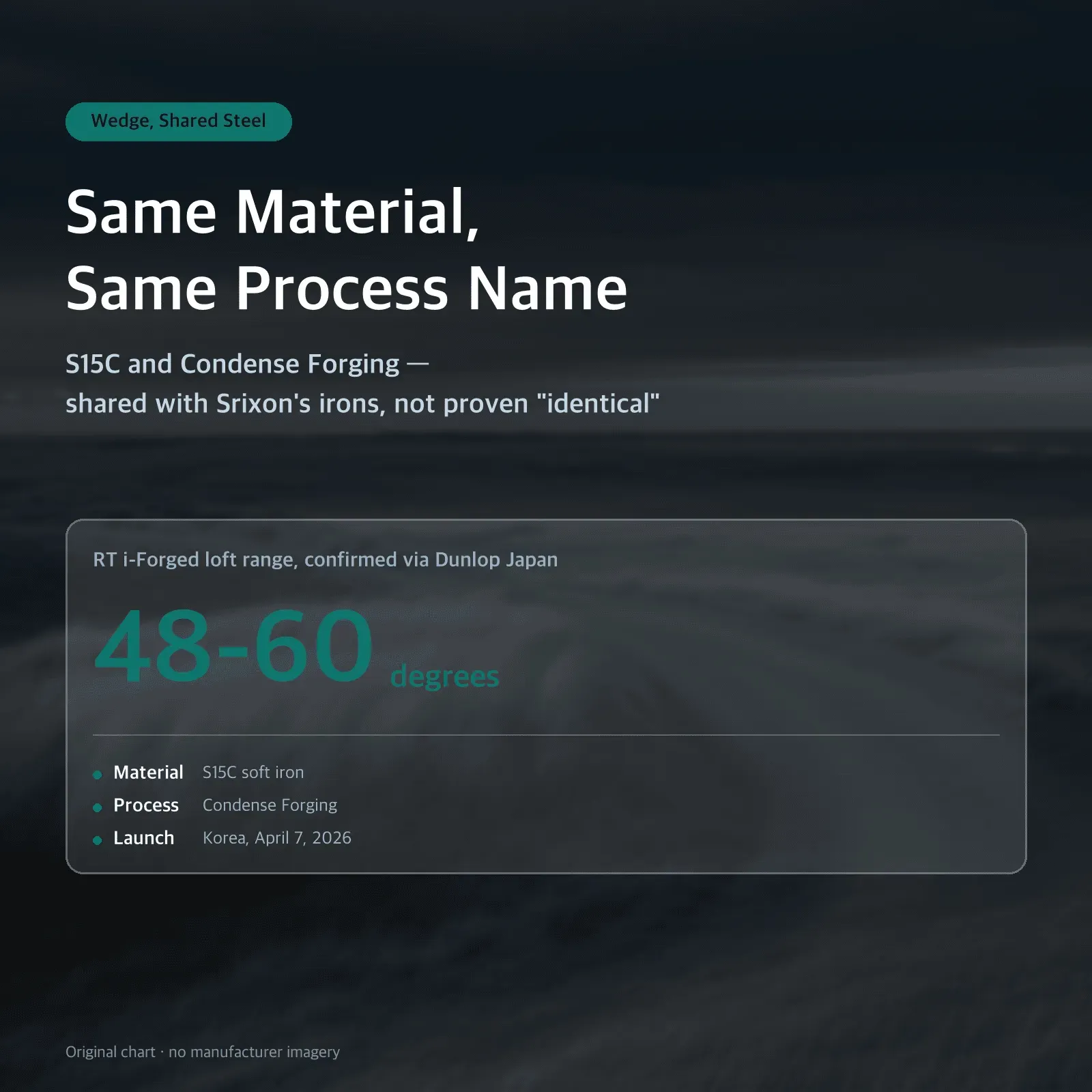
The RT i-Forged is made of S15C soft iron. The process is described as “Condense Forging” — increasing the density of the head structure and reinforcing strength at the neck.
Srixon’s i-Forged irons, covered separately, are also described in official materials using the name “Condensed Forging.” Material (S15C) and process name are documented identically across both brands’ materials.
The term is meant to convey increased structural density and reinforced neck strength — reading as a more compressed structure than standard forging. But we found no published figure for how much more compressed. Only the qualitative claim of “increased density” was confirmed; anything more specific is undisclosed. The specific mention of neck strength isn’t unrelated to the fact that a wedge head is smaller than an iron head and concentrates impact more.
1b. The loft/bounce lineup — confirmed on Dunlop’s Japan site
Reading sports.dunlop.co.jp directly (the RT i-Forged is not listed on Cleveland’s US site — it appears to be a Japan-market-only line, which fits the pattern of Dunlop-group products carrying region-specific listings noted elsewhere in this series) filled in what was previously blank: lofts run 48°, 50°, 52°, 54°, 56°, 58°, 60°. Bounce is Full 10° on 48–52° and Mid 10° on 54–60°. Lie angle is a flat 64° across every loft — the same fixed 64° figure that shows up on Cleveland’s RTZ wedge and on Callaway’s Opus SP+, a convergence covered separately in the five-line wedge comparison. Face progression runs 4.7–5.3mm, length spans 35.25″–35.75″, and swingweight is D2/D3.
That resolves the loft/bounce gap flagged earlier in this piece, but it doesn’t touch the “same technology” question that’s the actual subject of this piece — the two are separate lines of inquiry.
2. Korean trade press described it as “consistent feel from a shared material”
Korean golf trade outlet GolfTimes reported that the wedge “uses the same material (S15C) as the Srixon ZXi7 iron, giving iron-wedge sets a consistent feel.” That statement is used here strictly as a press citation.
One distinction worth being careful about: we found no Dunlop statement declaring the Srixon i-Forged and Cleveland RT i-Forged technologies to be “identical.” What can be said is that they “share the same material and the same process name” — stating that they are “the same technology” goes beyond what’s confirmed.
“Same material” and “same technology” are claims at different levels. Same material means the raw input (S15C) matches. Same technology would mean the specific processing and equipment used on that material also match. A shared process name isn’t grounds to assume shared equipment. Keeping that distinction clear is the main point of this piece.
3. The connection to Srixon’s i-Forged and i-ALLOY piece — a name reused across a corporate group
As noted in the piece on Srixon’s i-Forged and i-ALLOY, the Dunlop group tends to reuse the same material and process names across its brands. The S15C steel and Condensed Forging process used in Srixon’s irons showing up again, unchanged, in Cleveland’s wedge is the key finding here.
Whether this reflects a group-wide shared-material strategy, or simply two brands independently choosing the same steel grade, isn’t something this research can settle. The fact that the name is the same, and the fact that a shared name doesn’t automatically mean shared technology, need to be read separately. S15C itself is a low-carbon soft iron widely used across the golf club industry, so it’s entirely possible both brands arrived at the same steel grade independently.
That said, the process name matching exactly — “Condensed Forging” — is more notable than the material name alone matching. Choosing the same steel grade could simply follow an industry standard, but two brands using the identical proprietary name for a specific process points somewhat more toward shared technology or naming within the group. That’s still an inference, though, not something confirmed within the scope of this research.
4. Launch timeline — two brands used the same name at different times
| Loft | Bounce | Length | Swingweight |
|---|---|---|---|
| 48-52° | Full 10° | 35.75” | D2 |
| 54-56° | Mid 10° | 35.5” | D2/D3 |
| 58-60° | Mid 10° | 35.25” | D3 |
Confirmed Loft/Bounce Table (Dunlop Japan) — fills in what was previously blank; lie is a flat 64° across every loft. Not listed on Cleveland’s US site — appears Japan-market-only. Face progression runs 4.7-5.3mm.
Srixon’s i-Forged process was introduced first, in 2025, applied to the ZXi7. Cleveland’s RT i-Forged followed later, launching in the Korean market on April 7, 2026.
What’s confirmed is that brands under the same Dunlop Sports group attached the same process name to a wedge line at a later date. Whether this was planned as group-wide branding from the start, or Cleveland’s development team independently landed on the same name, we cannot determine. What can be said from the sequence alone is that the iron came first and the wedge followed.
The model name RT i-Forged itself is worth another look. “RT” is a prefix Cleveland has used for a long time; “i-Forged” is a process name that originated on the Srixon side. Combining both elements in one product name reads as a way of carrying Cleveland’s own identity alongside a name shared across the Dunlop group. That’s an observation drawn from how the product name is constructed, though, not an explanation Dunlop has given directly.
5. Who this wedge fits
Judgment calls drawn from the confirmed specs. This does not replace an actual fitting.
- Golfers playing a Srixon iron set who want a wedge from the same material family for a matched feel — the shared material and process name (S15C, Condensed Forging) is confirmed.
- Golfers who want the soft feel typical of a forged wedge — the soft-iron forged construction is confirmed.
Where it may not fit:
- Golfers who want to confirm exact loft and bounce options before buying — not confirmed in this research.
- Golfers who want to buy on the strength of a “same technology” claim — that specific claim was not confirmed in Dunlop’s own materials.
6. What we could not confirm
| Item | Status |
|---|---|
| Retail pricing | Not confirmed |
| Relationship to the RTZ line | Not confirmed — above it, or fully separate? |
| Dunlop statement of “identical” technology | Not found |
| Manufacturer distance/spin claims | Not cited — unverifiable |
What We Could Not Confirm — left blank rather than filled in. Korean trade press (GolfTimes) described “consistent feel from a shared material” — a press citation, not a measured or manufacturer-confirmed result.
- Retail pricing — not confirmed.
- The exact model-name formatting — not confirmed.
- The relationship between this line and RTZ (whether it sits above RTZ within the same line, or is a fully separate line) — not confirmed.
- A Dunlop statement declaring the Srixon and Cleveland technologies “identical” — not confirmed.
- Manufacturer-claimed distance or spin gains — not cited, as we could not verify them.
In one line
The RT i-Forged shares a material (S15C) and a process name (Condensed Forging) with Srixon’s irons. Korean trade press framed this as “consistent feel,” but no Dunlop statement pins the two technologies down as “identical.”
A shared name and a claim of shared technology are different levels of statement, and worth reading as such. What’s solid is that the material and process names overlap — anything beyond that goes past what this research can confirm. The “consistent feel” language from press coverage should be read as “the manufacturer and press described it this way,” not as a measured, verified result. Testing it yourself at a retailer remains the most reliable check. The principle applied across this whole set of pieces — separating what’s confirmed from what’s reported or inferred — came up especially often in this one.
All charts in this piece were built from scratch, and only confirmed figures were used. Where a figure could not be confirmed, the space was left blank.
Sources
- Cleveland official material describing “Condensed Forging,” and Srixon i-Forged official material using the same name, material (S15C) and process.
🔴 Unconfirmed: no published figure for how much more compressed the forging is.
No archived URLs are recorded for these sources in the original research. Items the source does not publish are named as unconfirmed rather than estimated.