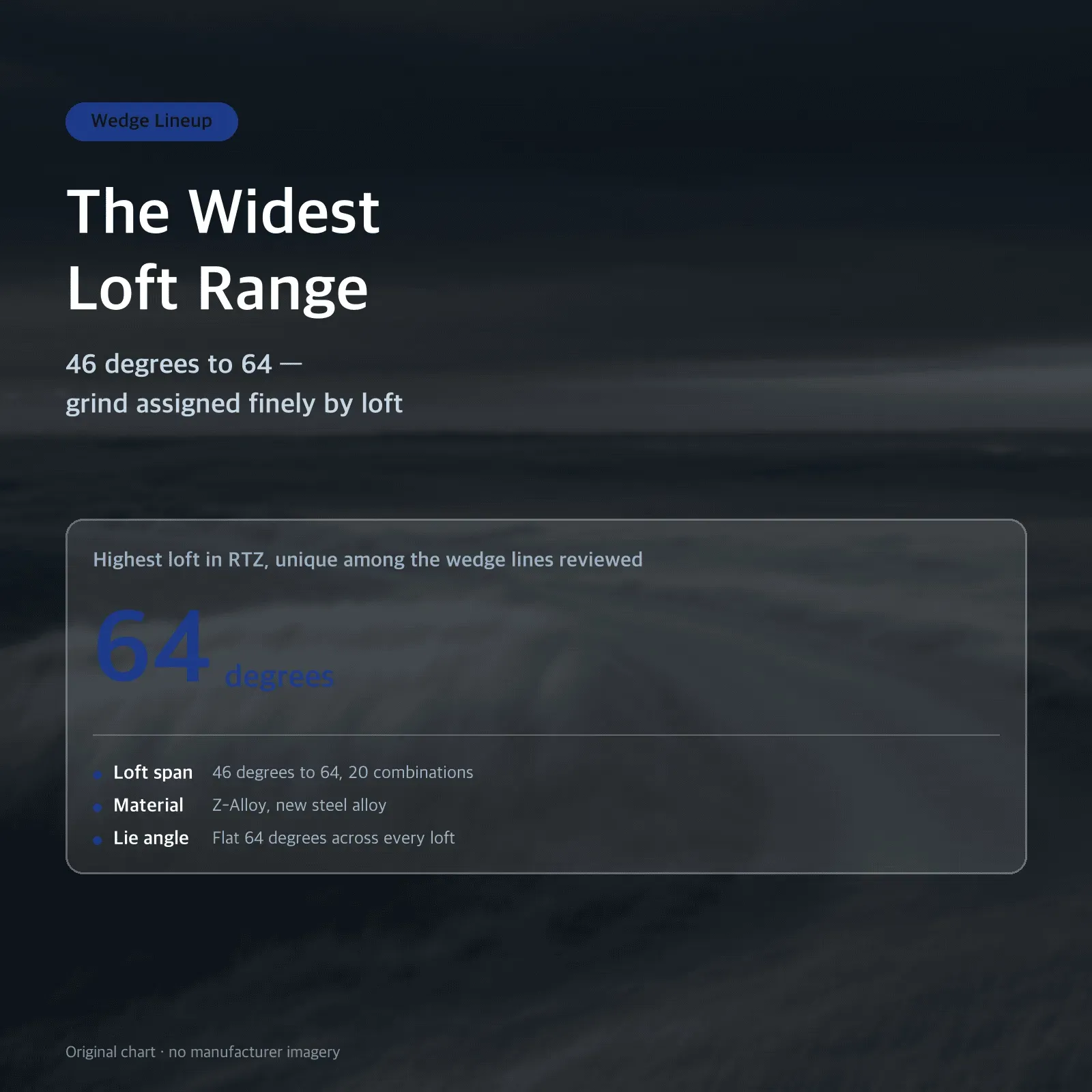
Cleveland’s RTZ is the current wedge line. We could not officially confirm whether the prior generation was RTX6 ZipCore. Reading the DOM of the manufacturer’s US site directly, we recovered a 20-row loft-by-grind combination table.
Working through that table surfaced two things: RTZ has the widest loft range of the current wedge lines we’ve checked, and several names on the spec table — the alloy, the prior-generation lineage — carry no supporting explanation we could find.
1. Lofts 46° to 64° — the widest range here
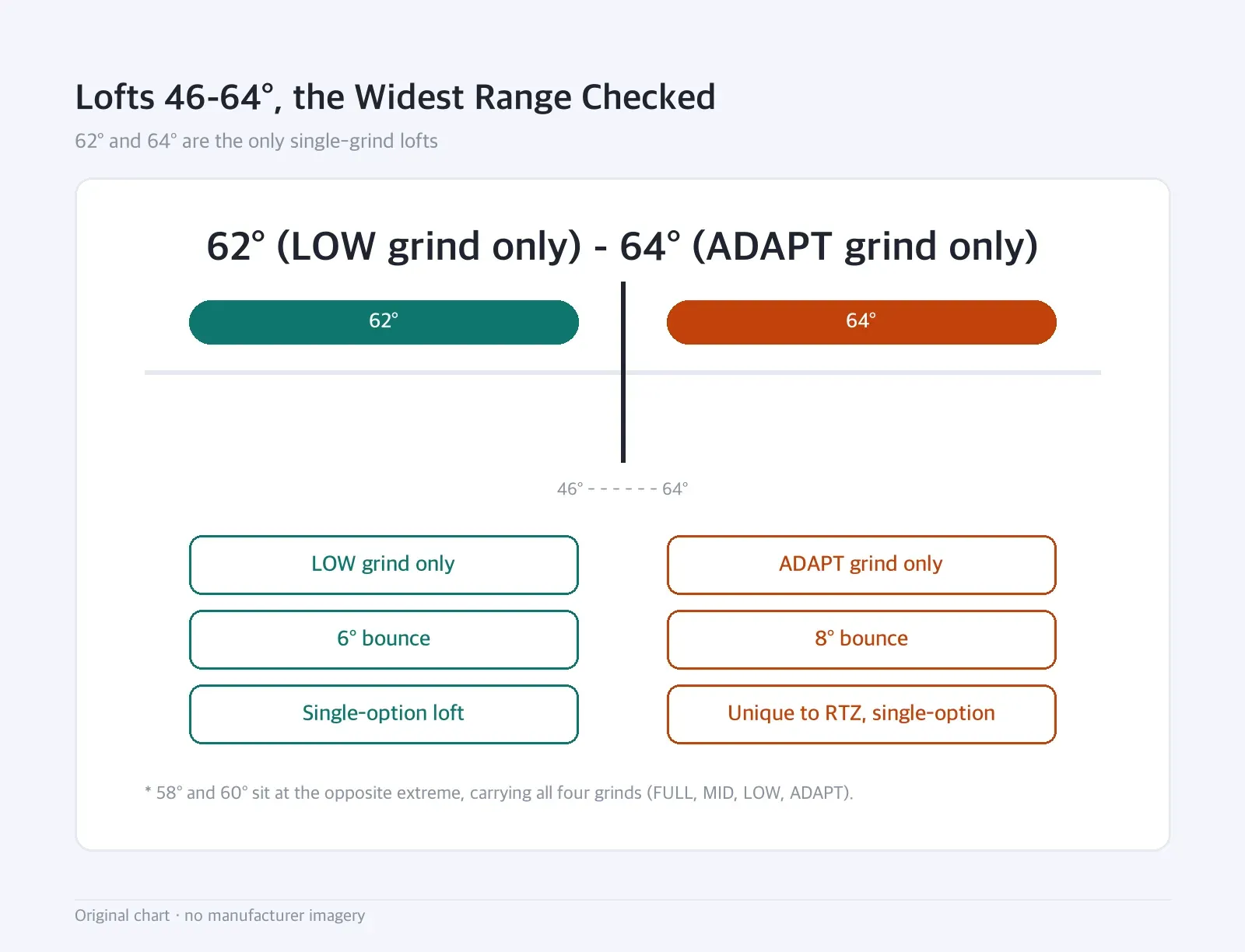
RTZ spans ten lofts from 46° to 64°. 62° is among the higher lofts we’ve seen in this category; 64° is unique to RTZ among the lines we’ve reviewed.
62° exists only with the LOW grind (6° bounce), and 64° only with ADAPT grind (8° bounce). Every other loft carries multiple grind options — these two are the only lofts limited to a single choice.
That single-option status at the extreme lofts reads as a structural choice rather than a shortcoming. Very high lofts see lower usage overall, and offering one representative grind rather than several may reflect that. This is an inference from the shape of the table, though, not something the manufacturer stated directly. Across the full 20-row table, 58° and 60° carry all four grinds (LOW, ADAPT, MID, FULL) and are the most flexible lofts in the lineup.
2. Grind assignment varies by loft
| Grind | Loft range | Groove style |
|---|---|---|
| MID (baseline) | 46-60° | Traditional groove |
| LOW | 58-62° | Traditional groove |
| FULL | 54-60° | Traditional groove |
| ADAPT | 54-64° | Full-face groove |
Grind Assignment Varies by Loft — MID is the baseline; FULL and ADAPT layer on at 54° and above. Lie angle is a flat 64° across every loft — RTZ keeps setup simpler than lines with lie angle shifting by loft band.
RTZ’s four grinds are FULL, MID, LOW, and ADAPT. MID is the baseline grind, spanning the full 46–60° range. FULL and ADAPT are limited to the 54° to 60–64° band. LOW sits in the 58–62° band.
Groove style varies by grind too: MID and LOW use a traditional groove, ADAPT uses a full-face groove. Lie angle is a flat 64° across every loft. The material is described as a new steel alloy called Z-Alloy, with a tour satin finish. FULL grind is confirmed as using the traditional groove, but why “FULL” is used as the name — likely referring to sole width or shape — isn’t explained in any official text we found.
A flat lie angle across every loft is worth noting against s259, where lie angle shifts by loft band. RTZ keeps the setup simpler at the cost of that finer lie-angle adjustment. Which approach suits a given swing is a separate question we’re not settling here.
3. Full spec detail exists — but only on the manufacturer’s fullest published table
We could not find a loft-by-loft spec table (lie angle, length, swingweight) as complete as the 20-row one recovered from the manufacturer’s US site anywhere else we checked, including other regional pages for the same product.
That means the specs in this piece are drawn from the fullest table we could locate, not necessarily the only version published. Whether every regional retail listing carries the identical 20-row set is something we could not confirm.
4. Z-Alloy — the name is confirmed, the explanation isn’t
RTZ’s head material is listed as Z-Alloy, described as a new steel alloy. The name itself is confirmed on the spec table. What isn’t confirmed is any explanation of how it differs from prior materials — hardness, resilience, or anything else describing the change.
The “Z” in the name invites a guess at a connection to the prior ZipCore line, but that’s an inference from the name, not something confirmed in official material. Finish is listed as tour satin, and that’s where the confirmation on finish ends.
A recurring pattern in researching RTZ was “the name exists, the explanation doesn’t” — this showed up with the prior-generation name, the Z-Alloy material, and the depth of the spec table across different sources. The 20-row US-site table is the exception: loft, grind, bounce, groove, lie, length, and swingweight are all filled in there.
5. Who this fits
Based on the confirmed specs. This does not substitute for an actual fitting.
- Golfers looking to fill very high lofts (62–64°) for flop shots around the green — these two lofts are unique to RTZ among the lines we’ve reviewed.
- Golfers who want grind choice broken down finely by loft — MID as the default across 46–60°, with FULL and ADAPT layered on at 54° and above.
May not fit:
- Golfers who want to confirm every number before visiting a store — some regional listings publish only a loft picker without the full spec table, so it’s worth confirming the source of any numbers you’re relying on.
- Golfers who want grind options other than MID in the 46–52° range — that band offers MID only.
6. What we could not confirm
| Item | Status |
|---|---|
| Z-Alloy: hardness/resilience explanation | Name confirmed, explanation not found |
| Prior generation = RTX6 ZipCore? | Not officially confirmed |
| Grind code meanings (FULL, LOW, etc.) | Inferred from the name only |
| Same 20-row table on every regional listing | Not confirmed |
What We Could Not Confirm — left blank rather than filled in. The 20-row spec table came from the manufacturer’s US site DOM — the fullest table found, not necessarily the only version published.
- Official explanatory text for the Z-Alloy material.
- What the FULL, LOW, and other grind code names specifically refer to in terms of sole shape — beyond the inference drawn from the name.
- Whether the prior generation was in fact RTX6 ZipCore.
- Whether every regional listing carries the same 20-row spec table as the source we recovered it from.
- Manufacturer distance/spin claims — not independently verifiable, so not cited here.
Summary
RTZ spans 46° to 64°, the widest loft range among the current wedge lines we’ve reviewed, with grind assignment that varies finely by loft. But several supporting details — the alloy’s properties, the prior-generation lineage, whether the full spec table is published everywhere — remain unconfirmed.
If you need a very high loft like 62° or 64°, RTZ is the only line here that offers it. Confirm the specific combination is actually available wherever you’re buying before committing, since not every source publishes the same level of table detail.
Every figure in this piece came from a confirmed source. Where we couldn’t confirm a value, we left it blank rather than guess.
Sources
- Cleveland RTZ Tour Satin Wedge — official spec page — confirms the 46°-64° loft range, the four grind codes (MID, LOW, FULL, ADAPT), and the Z-Alloy material name, live as of this check.
🔴 The grind-to-condition mapping is an inference from the table’s shape, not something the manufacturer stated.