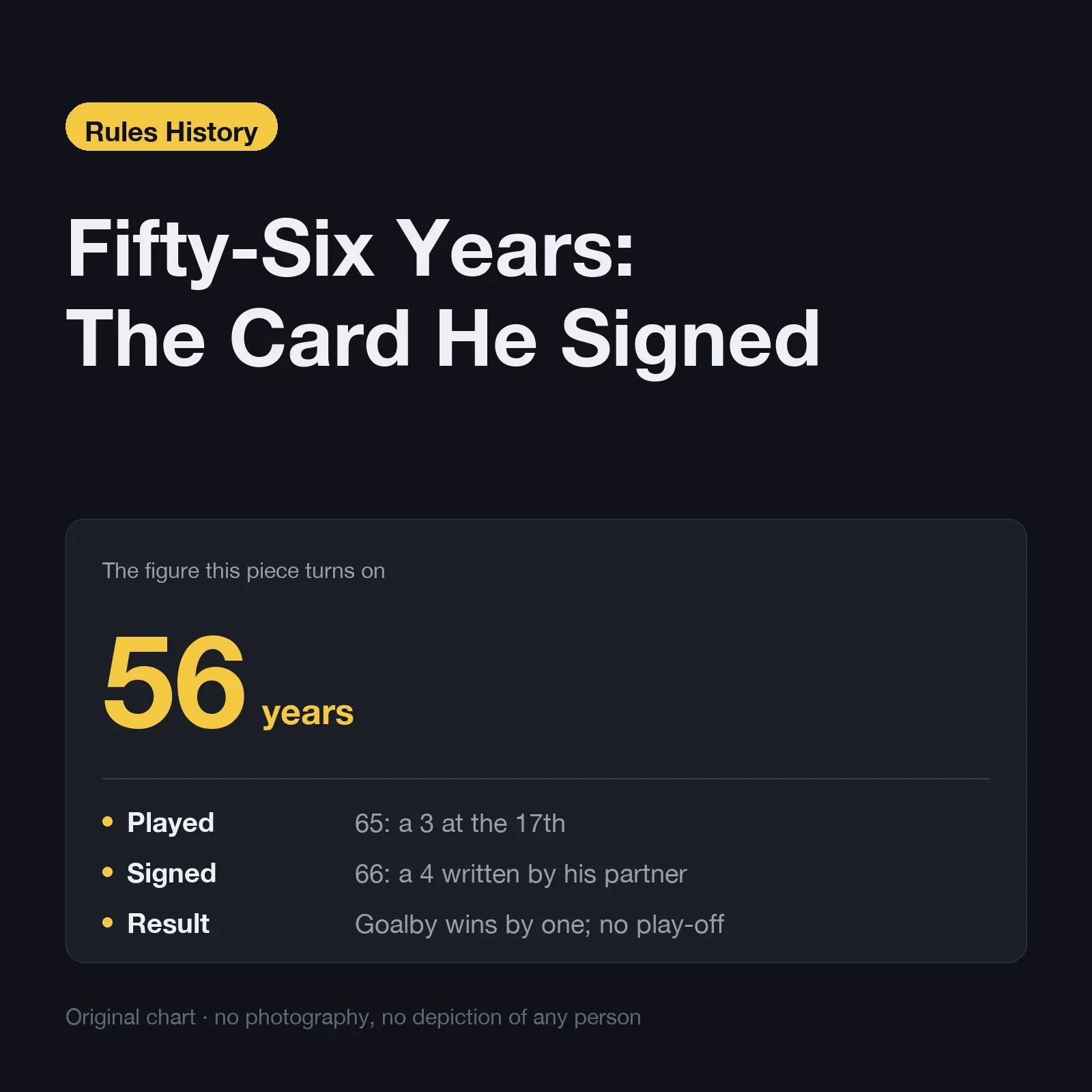
Padraig Harrington replaced his ball on the seventh green, and his hand brushed it on the way back to his stance. Nobody on the course saw a problem. He signed his card that evening leading, or close to it, at the 2011 Abu Dhabi HSBC Championship. He was disqualified the next morning, before he could hit a shot in round two.
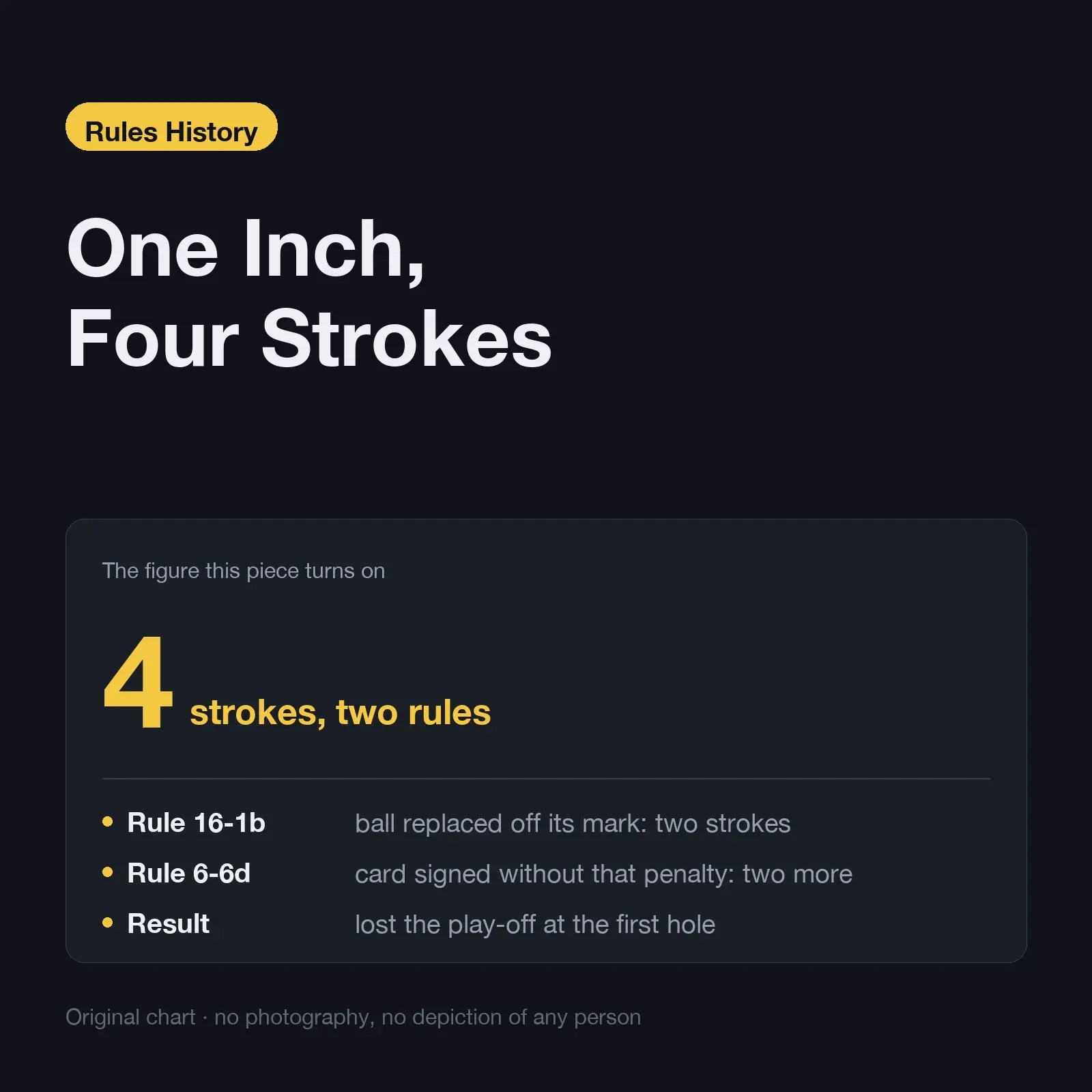
The rule at issue is simple: if a player’s hand or marker moves the ball, the ball must go back to its original spot. If it doesn’t, that’s a two-stroke penalty. Harrington’s ball did not go back to where it started.
1. What happened, hour by hour
| Step | What happened | Why it mattered |
|---|---|---|
| Thursday, 7th green, round 1 | Harrington’s hand brushes the ball as he replaces it in front of his marker | Rule requires the ball to return to its exact original spot |
| Thursday evening | Signs his card with a 3 on the 7th | The card does not include a two-stroke penalty he did not know he owed |
| Friday morning, before round 2 | A television viewer emails European Tour officials about the movement | Officials pull the slow-motion replay |
| Friday morning | Harrington is called in, watches the footage himself, disqualified | Not for the movement — for the signed card |
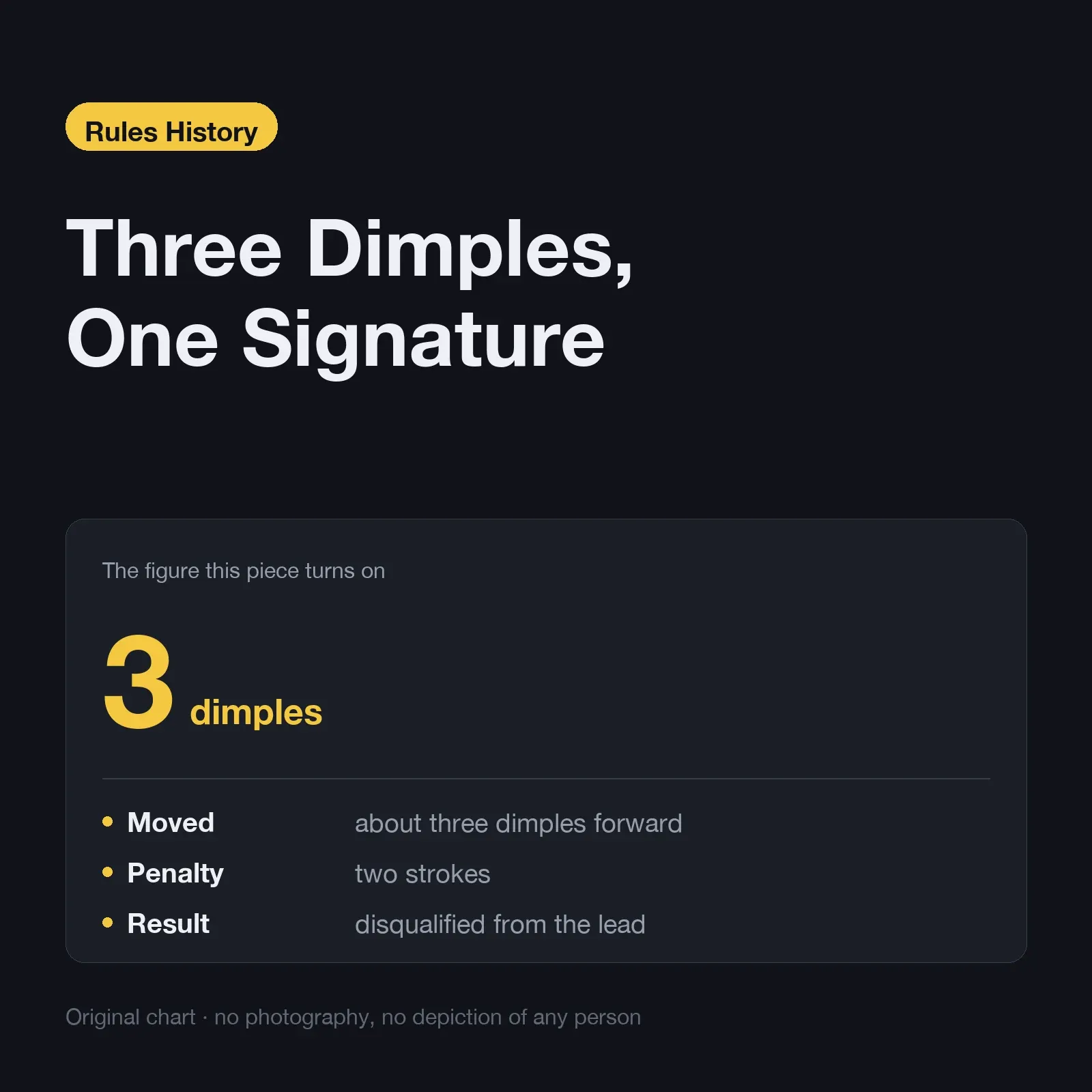
Harrington on the footage, the next morning: “I think with an unbiased view of it, I would comfortably say 99 per cent, the ball moved three dimples forward.”
2. The two-stroke penalty was never the problem
Slow-motion review showed the ball moving, in Harrington’s own description, three dimples forward and back about a dimple and a half — meaning it did not settle back on its original spot. That is a two-stroke penalty under the rule governing a ball moved during replacement.
Two strokes would not have ended his week. He had opened with a 7-under 65, one shot off the lead. What ended it was the card: he had signed for a 3 on the seventh when the correct score, with the penalty, was a 5. Signing for a lower score than actually played was disqualification, no discretion involved.
The movement cost two strokes. The signature cost the tournament.
3. Nobody disputed what the camera showed
This was not a contested call. Harrington watched the replay himself and did not argue it. His account — three dimples forward, a dimple and a half back — is also the number reporters at the time used, sourced from the same slow-motion footage European Tour referee Andy McFee reviewed before making the ruling.
The distance is not a metaphor for “very small.” It is the actual unit the people watching the tape used, because there was no other way to describe a movement that small.
4. What it cost
He was disqualified from the 2011 Abu Dhabi HSBC Championship after round one, forfeiting the rest of the week. He had been one stroke behind the outright leader, Charl Schwartzel, overnight. We did not find a documented prize-money figure attached to the disqualification — a DQ has no finishing position to attach money to, so none of the accounts we checked quote one.
5. The rule changed less than three months later
| When | What changed |
|---|---|
| 7 April 2011 | The R&A and USGA announce a revised interpretation, Decision 33-7/4.5, an hour before the Masters began |
| Under the new decision | A player who breaches a rule they could not reasonably have known about, and signs an incorrect card as a result, is penalised rather than disqualified |
| 2017 | A penalty is not applied where the breach is only visible at the resolution of video technology |
| From 1 January 2018 | A local rule sharply limits penalties that arise from television or video reports |
The AP report announcing the 2011 change named both Harrington’s Abu Dhabi disqualification and Camilo Villegas’s disqualification three weeks earlier at the Hyundai Tournament of Champions as the two incidents behind it. That is a documented link, not a retrospective one — the rule-makers said so at the time.
We did not find the term “Harrington rule” used by the R&A, the USGA, or the wire reports covering the 2011 change. It shows up in later informal golf-forum and blog usage, but not in the primary announcements, so we are not using it as an established name here.
Two things make this case unusual next to the others in this series. The first is that the governing bodies named it. The second is that it was not alone — Camilo Villegas had been disqualified two weeks earlier on the same mechanism, and the two cases are cited together. Twenty-four years before either of them, Craig Stadler lost a runner-up cheque to the same rule with no such relief available.
6. What is confirmed and what is not
Confirmed — the seventh green, the hand brushing the ball on replacement, the “three dimples forward, a dimple and a half back” description (Harrington’s own words, matching contemporaneous reporting), the signed card, the disqualification before round two, and the 7 April 2011 announcement of Decision 33-7/4.5 naming both the Harrington and Villegas incidents as its cause.
Not confirmed here — a prize-money figure for what the disqualification cost him (none of the sources we checked quote one, likely because a DQ leaves no finishing position). One source (Wikipedia’s summary) places the incident on the 16th green rather than the seventh; the contemporaneous RTÉ report and Harrington’s own quoted account both say seventh, so this piece uses the seventh. We also did not find “Harrington rule” in any R&A/USGA primary document, despite its informal circulation.
In one line
A ball moved three dimples and came back a dimple and a half short — and the card he’d already signed, not the movement itself, ended his tournament.
Sources
- RTÉ’s report on the disqualification — the seventh green, the hand brushing the ball, Harrington’s own “three dimples forward… a dimple and a half” quote, and his one-shot-off-the-lead position.
- The Globe and Mail’s account (AP wire) — the Thursday/Friday timeline, the viewer’s email arriving before round two, and Harrington’s morning review of the footage.
- Fox News (AP wire) on the 2011 rule change — dates the Decision 33-7/4.5 announcement to 7 April 2011, an hour before the Masters, and names both the Harrington and Villegas disqualifications as the incidents behind it.
- Wikipedia’s article on trial by television in golf — cross-reference for the incident date (20 January 2011) and the later 2017/2018 rule changes; places the incident on the 16th green, which conflicts with the contemporaneous RTÉ account used above.
All pages were opened and read on 30 August 2026.