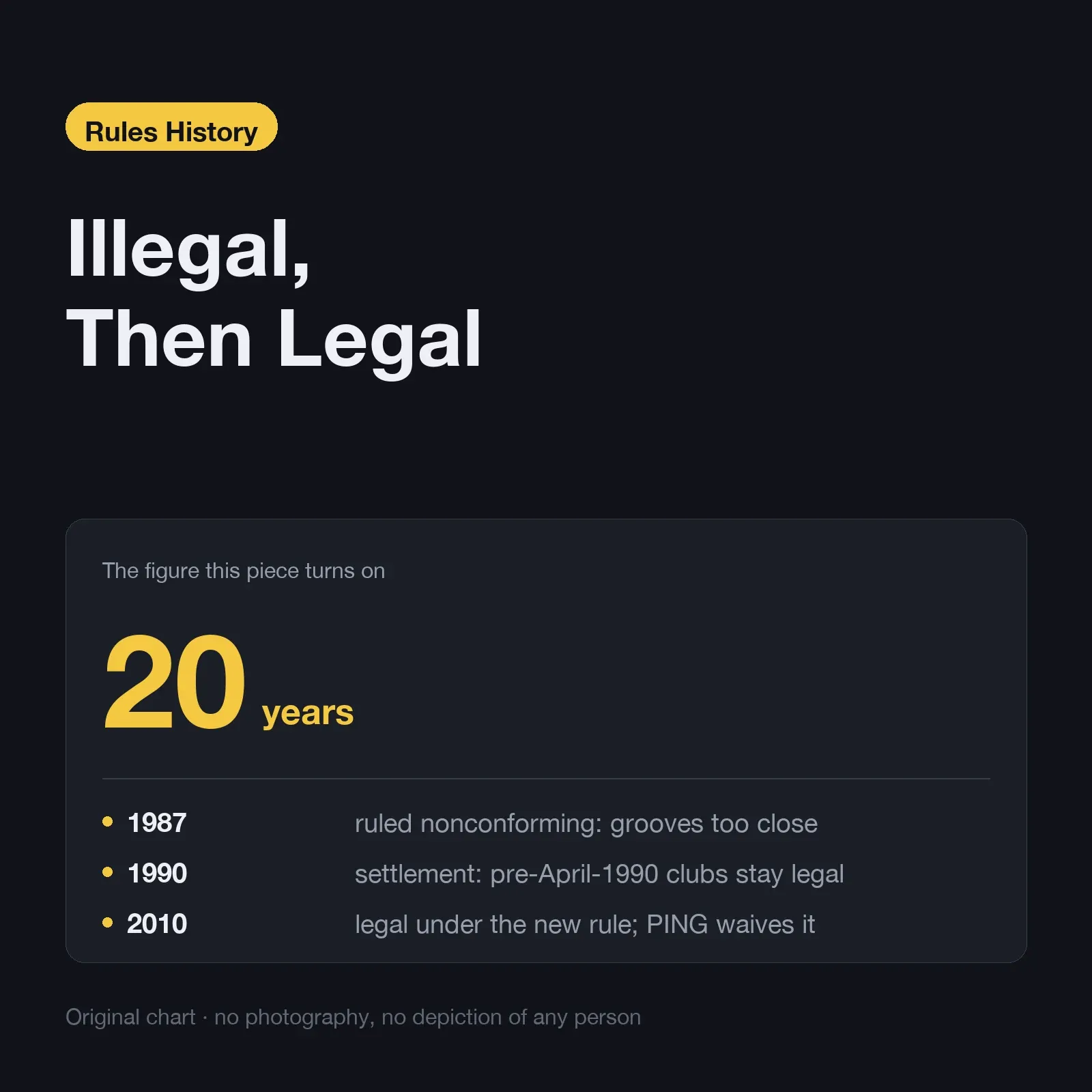
A wedge designed in the 1980s was declared illegal for having its grooves too close together. Twenty years later the same wedge was legal — because the new rule was about grooves being too far apart, and a settlement signed in 1990 said this club was exempt from whatever came next.
Nobody cheated. The only person who could close the loophole was the manufacturer who had won the right to it.
1. What happened
| Step | What happened | Why it mattered |
|---|---|---|
| 1987 | The USGA rules the PING Eye2’s groove spacing nonconforming | Karsten Manufacturing sues, initially seeking $100 million |
| 1990 | The parties settle | Eye2 clubs made before 1 April 1990 stay legal, whatever the specification later says |
| 2010 | New groove rules take effect on tour, aimed at cutting spin | The pre-1990 Eye2 is exempt by the settlement — and its grooves are now too far apart to fall foul of the new rule |
| Jan 2010 | Mickelson, Mahan, Daly, Couples and Dean Wilson put twenty-year-old Eye2 wedges in play | Legal. Scott McCarron tells the San Francisco Chronicle: “It’s cheating, and I’m appalled Phil has put it in play.” |
| 8 Mar 2010 | PING agrees to waive its settlement rights | The waiver takes effect 29 March 2010, after the Arnold Palmer Invitational |
2. The loophole was not a mistake in the 2010 rule
The natural assumption is that somebody drafted the new specification carelessly. That is not what happened.
The 2010 rule did what it was designed to do. The Eye2 escaped it because of a contract, not a drafting error — a clause agreed in 1990 that grandfathered clubs manufactured before a specific date. Settlements are written to end disputes, and this one ended a dispute so thoroughly that it kept working twenty years after everyone involved had moved on.
So the club was not exploiting a badly written rule. It was exercising a right that a court settlement had granted it, against a rule that did not exist when the settlement was signed.
3. What nobody could do about it
Here is the part that makes this a rules story rather than an equipment story.
The USGA could not close it — the exemption came from a settlement, not from the Rules of Golf.
The PGA Tour could not close it — the 1990 settlement’s protections meant it could not ban these specific wedges without PING’s agreement.
The players using them were not breaking any rule, which is why McCarron’s accusation was about the spirit of the thing and why he later apologised for the word he used.
That leaves exactly one party with the power to act, and it is the one that won the right in the first place. A rules body, a tour, and a field of professionals all waited on a private company’s decision about whether to keep something it was entitled to keep.
4. What it cost
- $100 million was the figure Karsten Manufacturing initially sought in the original suit.
- Twenty years of a grandfathering clause outliving the dispute it settled.
- A month of open accusation between professionals in January 2010, ending in an apology.
- A right, given up voluntarily. PING’s chairman John Solheim agreed to waive it on 8 March 2010, saying he had been “consistent in voicing my concerns over the last several years about the challenges of the current rule-making process and the needs to improve it to the benefit of golfers.”
PGA Tour commissioner Tim Finchem’s response names the shape of it precisely: “John Solheim and Ping had a terrific opportunity to do something very positive and significant for the game of golf, and we very much appreciate his willingness to take this action.” An opportunity — not an obligation. Everyone knew PING did not have to.
5. Did the rule change?
The rule did not change. The contract did.
That is what makes this case unusual among the ones we have looked at. When a viewer’s telephone call cost Craig Stadler a tournament in 1987, golf eventually changed how reports reach officials. When Lexi Thompson lost a major in 2017, two rules were withdrawn within the year.
Here there was nothing to amend. The 2010 groove specification was working as written; the exemption sat outside it. The only available fix was for the holder of the exemption to hand it back, and on 29 March 2010 that is what happened.
For the 1987–1993 dispute that produced the settlement — the ruling, the litigation and the argument about how grooves should be measured at all — see PING vs. USGA: manufacturer sues the rules body.
6. What is confirmed and what is not
Confirmed — the 1 April 1990 manufacturing cutoff, the $100 million initially sought, the January 2010 players and the McCarron quote and apology, the 8 March agreement and 29 March effective date, and both the Solheim and Finchem quotations, all from the sources below.
Not confirmed here — the filing date, court and legal theory of the 1989 suit. Accounts describe an antitrust claim filed in Arizona and mention treble damages; the source we could read gives only the $100 million figure and does not state the rest, so we do not assert it.
Not confirmed — how the two sides’ measurement methods actually differed. This is the heart of the original dispute and we still cannot source it precisely. Contemporary reporting reaches for metaphors — one 1990 account describes the offending distance as the width of a strand of hair — rather than giving the procedures.
Not confirmed — the account that PING rounded its groove edges to stop damaging a competitor’s golf balls, and that this rounding is what made the clubs measure as nonconforming. It is a widely told story and we found no primary record of it.
Also unestablished — how many pre-1990 Eye2 wedges were actually in play, and what they were selling for. Figures circulated at the time; we did not find a record that settles them.
In one line
A club ruled illegal in 1987 for grooves too close together was legal in 2010 because they were too far apart, protected by a settlement no rules body could override — until the company that owned the protection gave it away.
Sources
- Ping Eye2 wedges no longer allowed in PGA — The World — the 8 March 2010 agreement and 29 March effective date, the 1 April 1990 manufacturing cutoff, the players who used the wedges, the McCarron quote and apology, and the Solheim and Finchem quotations
- Court to decide golf club groove controversy — The Seattle Times archive, 18 March 1990 — the suit “initially sought $100 million in damages,” the settlement with the USGA earlier that year, the continuing PGA Tour litigation, and the strand-of-hair description of the disputed distance
- McCarron keeps up criticism of Mickelson’s groove choice — Fox Sports — the January 2010 exchange between the two players
All three pages were opened and read on 4 September 2026. Where accounts of the 1989 litigation give details the sources above do not carry — a filing date, a court, an antitrust theory, treble damages — this piece leaves them out rather than repeating them.