Camilo Villegas chipped up the slope at the 15th, and the ball rolled back down toward him — twice. The second time, while it was still moving, he walked over and swatted away a few loose blades of grass in front of it. It looked like tidying up. It was a rules violation, and it ended his tournament before the day was over.
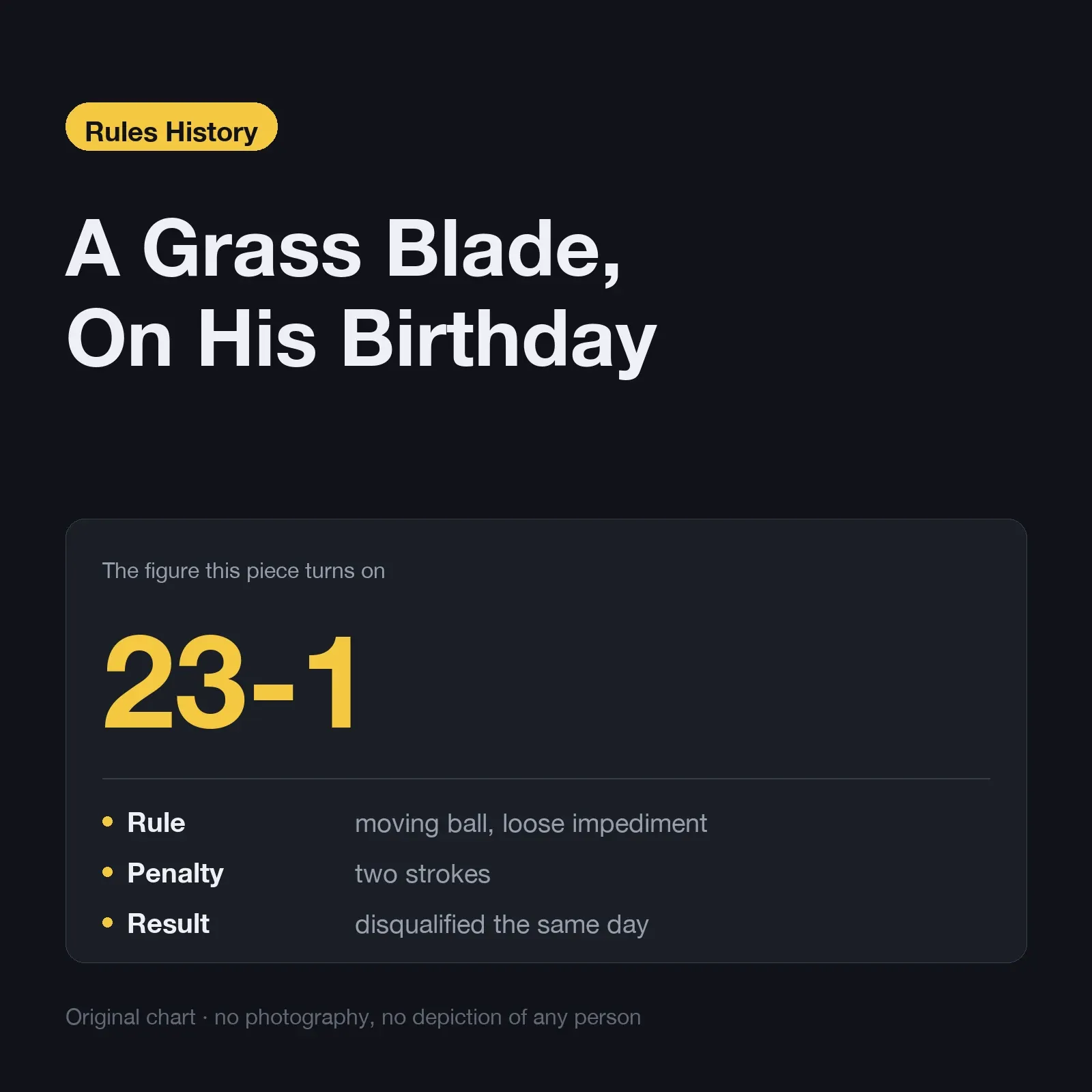
The rule at issue, Rule 23-1 as it then stood: a loose impediment that might influence a ball in motion cannot be removed while the ball is moving.
1. What happened on his birthday
| Step | What happened | Why it mattered |
|---|---|---|
| Round 1, 15th hole | Ball rolls back down the slope twice after a chip | Nothing wrong yet — the ball moving is not a violation |
| Same moment | Villegas swats loose grass from in front of the still-moving ball | Rule 23-1 — removing a loose impediment that could influence a ball in motion — two-stroke penalty |
| Same day, after the round | Villegas signs his card for a 72 | The card omits a penalty he did not know he owed |
| Same day | A television viewer calls in the infraction; PGA Tour officials review it | Disqualified, same day, for the signed card |
It was 6 January 2011, Villegas’s 29th birthday.
2. The two-stroke penalty was never the problem
Two strokes would have made his round a 74, not a 72. On its own that is a bad start to a tournament, not the end of one. What ended it was the card: he had signed for a 72, and the correct score with the penalty applied was two shots higher. Signing for a lower score than actually played meant disqualification — the same mechanism that ended Stadler’s week in 1987 and Harrington’s three weeks after this one.
The grass cost two strokes. The signature cost the tournament.
3. There was no ambiguity about what happened
PGA Tour rules official Slugger White, on the review: “Unfortunately, it was very obvious what he did.” Villegas did not dispute the call. Asked about it, he said: “If somebody called something in, I probably did something wrong.” Unlike Harrington’s three-dimple movement, this was not a marginal case decided by frame-by-frame analysis — the swat was visible at normal speed.
4. What it cost
Villegas was disqualified from the 2011 Hyundai Tournament of Champions, a winners-only, no-cut field at Kapalua, after his first round. We did not find a documented prize-money figure attached to his disqualification — the event’s winner, Jonathan Byrd, took $1.12 million, but a DQ has no finishing position for a payout table to attach to, and none of the accounts we checked quote a figure for what Villegas specifically lost.
5. The rule changed thirteen weeks later
| When | What changed |
|---|---|
| 7 April 2011 | The R&A and USGA announce a revised interpretation, Decision 33-7/4.5, an hour before the Masters began |
| Under the new decision | A player who breaches a rule they could not reasonably have known about, and signs an incorrect card as a result, is penalised rather than disqualified |
| 2017 | A penalty is not applied where the breach is only visible at the resolution of video technology |
| From 1 January 2018 | A local rule sharply limits penalties that arise from television or video reports |
The AP report announcing the 2011 change named this disqualification and Padraig Harrington’s, three weeks later at Abu Dhabi, as the two incidents behind it. That is documented at the time, not asserted after the fact.
This was the first of the pair. Padraig Harrington’s disqualification in Abu Dhabi followed two weeks later, and the two cases are named together in the decision that changed the rule. The mechanism itself was not new — Craig Stadler had run into it in 1987, and in 2005 a reporter’s day of silence turned it on Michelle Wie.
6. What is confirmed and what is not
Confirmed — the hole, the ball rolling back twice, the swat, the rule cited, the same-day disqualification, the birthday, and the naming of this incident alongside Harrington’s in the 7 April 2011 announcement of Decision 33-7/4.5.
Not confirmed here — a specific prize-money figure lost to the disqualification. One secondary account states the disqualification came “after the second round” rather than after the first; the outlet covering it at the time of the event states the incident and the disqualification both fell on round one, the same day as his birthday, and this piece uses that account.
In one line
He tidied loose grass from in front of a moving ball on his own birthday — the tidying cost two strokes, the card he’d already signed cost the week.
Sources
- ESPN’s report on the disqualification — the 15th hole, the ball rolling back twice, the swat, Rule 23-1, the same-day signing of a 72, Slugger White’s quote, and the 29th-birthday detail.
- Fox News (AP wire) on the 2011 rule change — names this disqualification alongside Harrington’s Abu Dhabi disqualification as the two incidents behind Decision 33-7/4.5, dated 7 April 2011.
- Wikipedia’s article on trial by television in golf — dates the incident to 6 January 2011 and the disqualification to Kapalua; its account places the disqualification after the second round, which this piece does not follow, using the same-day account from the contemporaneous ESPN report instead.
All pages were opened and read on 30 August 2026.