Zero torque is the defining topic of the 2026 putter market. Odyssey, TaylorMade, Scotty Cameron, and PXG have all released models built around it.
But the concept didn’t originate with any of them. It came from L.A.B. Golf, a small American brand.
Here’s the idea the larger brands ended up following, and how the original differs from what came after.
1. Lie Angle Balance — the name is the explanation
| Concept | What it means |
|---|---|
| Lie Angle Balance | CG set directly on the shaft axis at playing lie angle |
| The qualifier | Balance measured standing at address, not flat on a finger |
| The result | “No mechanical tendency to rotate in either direction” |
Lie Angle Balance - the Name Is the Idea — center of gravity set on the shaft axis, at the actual playing lie angle. If the center of gravity sits precisely on the axis, there is no direction left to rotate toward.
L.A.B. Golf’s core technology is called Lie Angle Balance.
The idea is singular: set the center of gravity directly on the shaft axis at the actual playing lie angle.
That qualifier — “at the actual playing lie angle” — is the brand’s starting point.
A putter balanced flat on a finger, held horizontally, and a putter balanced standing at address are two different things. A putter is played standing up, but most balance discussions before this brand focused on the horizontal case.
L.A.B.’s claim is that balance has to be measured in the position the club is actually swung from — which is why lie angle is in the technology’s name.
2. If the center of gravity sits on the axis, there’s nothing to rotate around
The principle itself is simple.
If the center of gravity sits off the shaft axis, gravity pulling on that weight creates rotation. If it sits precisely on the axis, there’s no direction left for it to rotate toward.
It’s the same logic as balancing a weight directly above a seesaw’s pivot point — it won’t tip either way.
L.A.B. describes this as having “no mechanical tendency to rotate in either direction” — a physical property built into the design, which keeps the face square.
3. Original versus followers
| Brand | Approach |
|---|---|
| L.A.B. Golf | CG precisely on the shaft axis at playing lie angle |
| Odyssey | Center shaft + CG on the same plane as the shaft |
| TaylorMade | Bore toward the toe + 2 deg lean, 34mm onset |
| Scotty Cameron | Onset Center construction |
| PXG | Zero-torque balancing across five models |
Original vs. the Brands That Followed — every brand aims at the same target, through a different route. Neither side publishes measured results, so this piece does not referee which is better.
Every brand aims at the same target through a different route.
- L.A.B. Golf — center of gravity precisely on the shaft axis at playing lie angle
- Odyssey — center shaft + center of gravity on the same plane as the shaft
- TaylorMade — bore near the center of gravity toward the toe + 2 degrees of lean, 34mm of onset
- Scotty Cameron — Onset Center construction
- PXG — zero-torque balancing extended across five models
L.A.B.’s approach is the most literal reading of the principle. Placing the center of gravity precisely on the axis means aiming at zero without compromise.
The later brands generally kept an existing shape and reduced rotation within it — through a larger onset or a repositioned shaft. Compared purely on principle, that’s a step back from true zero, in exchange for an address look that’s less unfamiliar.
This piece doesn’t referee which is better. Neither side publishes measured results.
4. A newer model that solves alignment through shape
The most recent model is the VZN.1i.
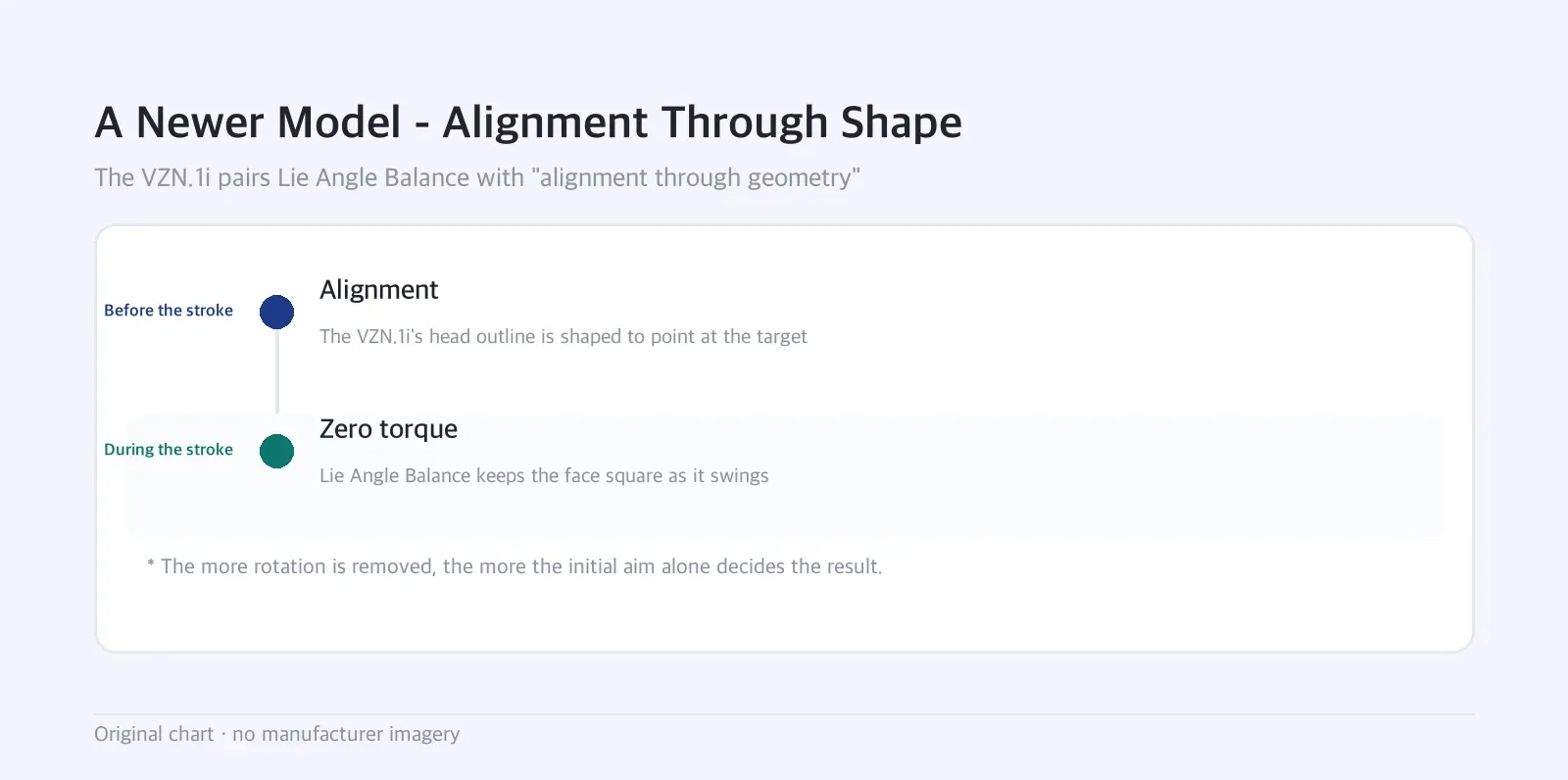
Alongside Lie Angle Balance, this model’s focus is helping alignment through shape. L.A.B. calls it “alignment through geometry” and says it produces clearer aim and more confidence at address.
Putter alignment is usually solved with lines — a marking on the crown, a dot. Solving it through shape instead means the head’s outline itself is designed to point toward the target line.
If zero torque keeps the face square during the stroke, alignment is about squaring the face before the stroke. This model targets both.
That sequencing matters. However well a putter resists rotation during the stroke, if the initial aim is off, the ball rolls off in that wrong direction anyway. The more rotation is removed, the more the initial aim alone determines the result.
That’s why zero torque and alignment meet in the same model.
5. How to approach this brand
| Situation | What to do |
|---|---|
| New to zero torque | Try a major-brand model first (Odyssey, TaylorMade) |
| Major-brand ZT felt like a half-measure | Look at L.A.B.’s more literal approach |
| Any case | Test on short putts, 3-5 feet |
How to Approach This Brand — the shape is unfamiliar, know that before performance. Whether the look at address suits your eye is the first hurdle, before performance.
Know first that the shape is unfamiliar. These putters look considerably different from conventional ones at address, because placing the center of gravity on the axis changes the usual head-to-shaft relationship.
Before performance, whether the look suits your eye is the first hurdle, and that’s where opinion tends to split.
Trying a major-brand model first is a reasonable path. Odyssey and TaylorMade built zero torque into conventional shapes. If that’s comfortable, there’s no strong reason to move to an unfamiliar shape.
Conversely, if a major brand’s zero torque feels like a half-measure, this brand’s more literal approach is worth a look.
Test it on short putts. Whether direction holds steady at 3–5 feet is exactly what this design targets.
6. Who this putter is for
Judgment calls based on confirmed specs.
- Golfers who want zero torque taken to its logical conclusion — the center of gravity is set precisely on the axis at playing lie angle
- Golfers who found major-brand zero-torque putters underwhelming — those models compromise somewhat to keep a familiar shape
- Golfers who struggle with alignment — the VZN.1i targets aim through shape
- Golfers whose direction wavers on short putts — this design targets exactly that
It may be less suited for:
- Golfers who care about the look at address — the shape differs substantially from convention
- Golfers who prefer shopping within a familiar major brand
- Golfers who want numeric confirmation — this brand also doesn’t publish resulting figures
7. What we could not confirm
- Head weight, length, and loft for individual models — the official spec sheet was not available
- Measured values behind the Lie Angle Balance claim — only “no mechanical tendency to rotate” was confirmed
- Detailed construction of the VZN.1i’s shape-based alignment — only the description itself was confirmed
- The full model range beyond the VZN.1i
- Performance differences between the original and the later brands’ versions — neither side publishes figures, so there’s no basis for comparison
In one line
L.A.B. Golf started from the idea that balance has to be measured in the position a putter is actually swung from, and it’s the origin of what the major brands are now building.
It’s the most literal version of the principle, at the cost of an unfamiliar shape. The later brands kept the shape familiar and compromised a little instead. If that compromise bothers you, go to the original; if the unfamiliar look is the bigger problem, go with a follower.
Technical descriptions here are drawn only from official manufacturer materials. What we couldn’t confirm is left blank.
Sources
- L.A.B. Golf official manufacturer materials — every technical description of the zero-torque design in this piece is drawn from these alone.
Verified by opening the linked official page directly: it confirms the core claims that Lie Angle Balance keeps the putter face “square to the arc throughout the stroke,” the 83%-of-starting-direction figure, and the per-fitting balancing process. The page does not use the exact phrasing “center of gravity on the shaft axis” found elsewhere in this piece describing the concept; that specific formulation could not be independently confirmed on this page and is treated as this site’s own restatement of the same idea.