This is the story of a golfer, in his 40s, who came with a question about his club distances. Short version: the club he blamed wasn’t the actual problem.
1. The question
“When I play, my 5-iron and 4-iron seem to go unusually far — they often fly past the green. Is that normal for long irons, or is something off with my swing?”
He’d been playing for about five years and typically shoots in the low 90s. His instinct turned out to be right — something really was off. It just wasn’t where he thought it was.
The only thing asked of him in return was this: measure your carry distance for every club at the range and send it over. Diagnoses based on feel alone are usually wrong.
2. The measured numbers
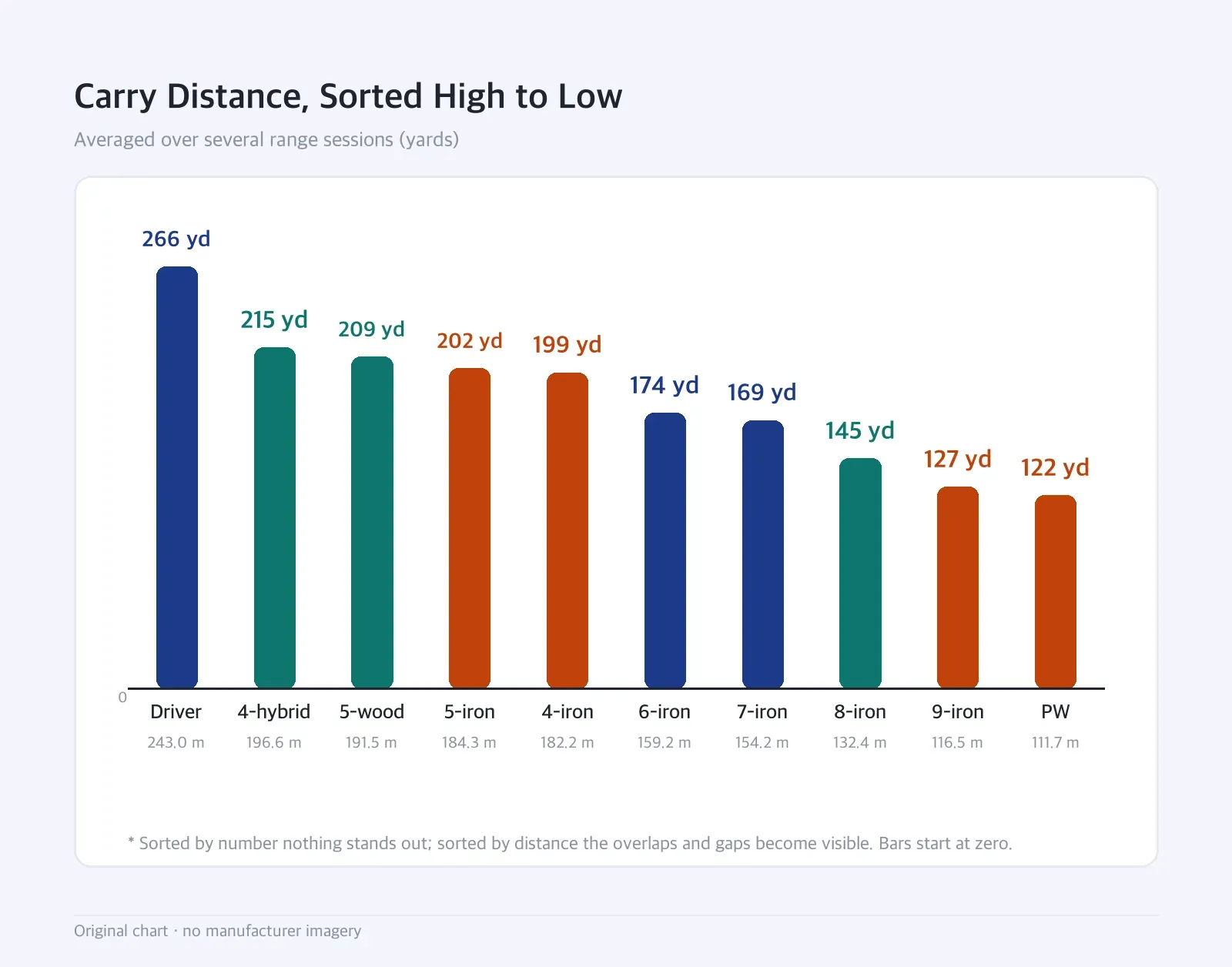
Here’s what came back, averaged over several sessions.
- Driver — 266 yd (243.0 m)
- 4-hybrid — 215 yd (196.6 m)
- 5-wood — 209 yd (191.5 m)
- 5-iron — 202 yd (184.3 m)
- 4-iron — 199 yd (182.2 m)
- 6-iron — 174 yd (159.2 m)
- 7-iron — 169 yd (154.2 m)
- 8-iron — 145 yd (132.4 m)
- 9-iron — 127 yd (116.5 m)
- Pitching wedge — 122 yd (111.7 m)
Here’s the first thing worth pointing out: a distance table needs to be sorted by yardage, not by club number. Sorted by number, nothing stands out. Re-sorted by distance, as above, the problem becomes visible immediately.
3. Diagnosis one — clubs were pairing up
| Pair | Gap |
|---|---|
| 4-hybrid <-> 5-wood | 5.6 yd (5.1 m) - overlap |
| 5-iron <-> 4-iron | 2.3 yd (2.1 m) - overlap |
| 6-iron <-> 7-iron | 5.5 yd (5.0 m) - overlap |
| 9-iron <-> PW | 5.2 yd (4.8 m) - overlap |
| 4-iron <-> 6-iron | 25.2 yd (23.0 m) - dead zone |
| 7-iron <-> 8-iron | 23.8 yd (21.8 m) - dead zone |
| 8-iron <-> 9-iron | 17.4 yd (15.9 m) - dead zone |
Adjacent-Club Gaps: Overlaps and Dead Zones — Under ~5 yd = functionally the same club; the empty stretches are dead zones. Ten clubs in the bag, but only five usable distances once overlaps are grouped.
Calculating the gap between each adjacent pair of clubs revealed the pattern.
Overlapping (within 5 yards / about 4.5 m)
- 4-hybrid ↔ 5-wood: 5.6 yd (5.1 m)
- 5-iron ↔ 4-iron: 2.3 yd (2.1 m)
- 6-iron ↔ 7-iron: 5.5 yd (5.0 m)
- 9-iron ↔ pitching wedge: 5.2 yd (4.8 m)
Empty stretches
- 4-iron ↔ 6-iron: 25.2 yd (23.0 m)
- 7-iron ↔ 8-iron: 23.8 yd (21.8 m)
- 8-iron ↔ 9-iron: 17.4 yd (15.9 m)
When two adjacent clubs differ by less than about 5 yards, they’re functionally the same club on the course. That gap disappears into wind, lie, and daily variation anyway.
Grouped this way, the result was clear. His bag had ten clubs, but only five usable distances.
4. Diagnosis two — the 4-iron went shorter than the 5-iron
| Club | Carry |
|---|---|
| 5-iron | 202 yd (184.3 m) |
| 4-iron | 199 yd (182.2 m) |
The 4-Iron Went Shorter Than the 5-Iron — Less loft, but shorter carry. A 2.3 yd gap alone is within measurement noise, but “4-iron and 5-iron go the same distance” holds regardless. Swing speed cannot handle the 4-iron’s loft.
The most important number was here:
4-iron 199 yd (182.2 m) < 5-iron 202 yd (184.3 m)
Less loft, but shorter distance. That’s a sign the swing speed can’t handle the 4-iron’s loft. Without enough speed to get the ball airborne, taking loft off doesn’t add distance — past a certain point, it actually costs distance.
A 2.3-yard gap on its own is within the range of measurement noise. But the conclusion that “the 4-iron and 5-iron go the same distance” holds regardless of the noise. Whichever one is technically longer, one of the two is essentially dead weight.
The same pattern showed up higher in the bag: the 4-hybrid carried 5.6 yards farther than the 5-wood. The shorter, easier-to-hit club went farther.
5. Why his instinct was right
Translate what felt “off” into numbers, and it lines up:
5-iron 202 yd (184.3 m) ↔ 6-iron 174 yd (159.2 m) = 25.2 yd (23.0 m) gap
That’s a 25-yard swing on a single club change. Switch from a 6-iron to a 5-iron and the ball suddenly clears the green. Feeling like the long irons “go too far” wasn’t a misperception.
The interpretation was off, though. It wasn’t that the 5-iron went too far — it was that there was a dead zone between the 5-iron and the 6-iron. Which is why a distance table needs to be read for its gaps, not its raw numbers.
6. The fix — subtract before you add
| Step | Action |
|---|---|
| 1. Remove | Drop the 4-iron; it duplicates the 5-iron’s distance and is harder to hit |
| 2. Fill the gap | Put a club covering 180-197 yd (165-180 m) where the 4-iron sat |
| 3. Reallocate loft | Rework 6-iron-through-PW loft as one run, not one club at a time |
The Fix: Subtract Before You Add — Three redundant clubs matched three dead zones. Pulling a redundant club is safe immediately; loft adjustments are harder to reverse, so re-measure first.
Interestingly, the number of redundant clubs (three) matched the number of dead zones (three). That means there’s room to rearrange before buying anything new.
Step one — remove. The 4-iron duplicates the 5-iron’s distance while being harder to hit. There’s little reason to keep it. The 5-wood and 4-hybrid are also redundant — though the two aren’t interchangeable in role. The wood flies higher and stops on the green faster; the hybrid escapes rough and mishits more easily. Which one to drop depends on how often par-5 second shots come into play.
Step two — fill the biggest gap. The 180–197 yard range (165–180 m) is completely empty. That’s one of the most common distances for a par-4 approach. The logical move is to put a club that covers that range where the 4-iron used to sit.
Step three — reallocate loft. The 6-/7-iron overlap and the 7-/8-iron gap won’t be solved by buying a new club. There’s a principle at work here: fixing one club’s loft throws off the gap next to it. Flatten the 6-iron’s loft and the gap between it and the 5-iron opens up instead. If a loft adjustment is needed, it has to be done across the whole 6-iron-through-pitching-wedge run at once, not one club at a time.
7. Two things to check before touching anything
Is this carry, or total distance including roll?
Long irons fly low and roll out; short irons stop where they land with spin. If these are total distances rather than carry, the longer clubs have roll baked into their numbers, which can make the top of the bag look more bunched than it actually is.
How many balls per club were hit?
With a small sample, a gap under 5 yards could be noise. But a gap of 25 or 24 yards isn’t explained away by sample size. Treat small differences with suspicion, and trust the large gaps.
Loft adjustments are annoying to reverse, so re-measuring first is the right call before touching a loft machine. Pulling a redundant club, on the other hand, is safe to do immediately — the fact that they overlap doesn’t change no matter what a re-measurement shows.
8. Who this applies to
Judgment calls drawn from this case.
- Golfers who’ve only ever looked at their distance chart sorted by club number — re-sorting it by distance alone can reveal overlapping gaps, the way it did here
- Golfers with ten clubs whose scores aren’t improving — worth checking whether the number of usable distances actually matches the number of clubs in the bag
- Golfers who reduced loft and saw distance stay flat or drop — that can be a sign the swing speed can’t handle that loft (as in the 4-iron/5-iron case above)
It may be less suited for:
- Golfers who haven’t measured their own club-by-club carry distances yet — this diagnosis depends on having real numbers, not feel
- Golfers whose sample size is too small to tell whether a sub-5-yard gap is real or noise — small gaps need re-measurement first; this case only trusted the large gaps (25 and 24 yards)
In one line
The number of clubs in a bag and the number of usable distances aren’t the same thing.
If you have a distance chart, re-sort it by yardage instead of club number. Treat any two adjacent clubs within 5 yards of each other as functionally identical. In this case, re-sorting the numbers was what revealed a ten-club bag was really a five-distance bag.
Evening out the gaps between clubs shows up in your score before hitting the ball farther does.
Sources
- Manufacturer official iron spec sheets — the published lofts the gapping case is built from.
The conclusion that ten clubs yield five usable distances follows from the published loft gaps, not from launch testing.
No archived URLs are recorded for these sources in the original research. Everything above is drawn from first-party manufacturer material; items the manufacturer does not publish are named as unconfirmed rather than estimated.