Data basis: Titleist’s own T-Series comparison table, published on the T150 product page at titleist.com and read in a browser on 2026-09-01. The table carries loft for all five models plus a single lie row and a single length row. Every number below is copied from it. Nothing is taken from a retailer listing, a fitting blog, or a spec aggregator.
Titleist names its irons with a T and a number. T100, T150, T250, T350 — and a T250✶ with a star. Bigger number, and something changes, but the product pages do not tell you what. Each one describes itself.
They do not have to. Titleist publishes one comparison table carrying all five models, and it is sitting on the product page of any of them. Here it is, transcribed in full.
The table
| Club | T100 | T150 | T250 | T250✶ | T350 | Lie | Length |
|---|---|---|---|---|---|---|---|
| 2 | — | — | 18° | — | — | 60.5° | 39.5” |
| 3 | 20° | 19° | 20° | — | — | 61° | 39” |
| 4 | 23° | 22° | 22° | — | 20° | 61.5° | 38.5” |
| 5 | 26° | 25° | 24° | 27° | 23° | 62° | 38” |
| 6 | 29° | 28° | 27° | 31° | 26° | 62.5° | 37.5” |
| 7 | 33° | 32° | 30.5° | 35° | 29° | 63° | 37” |
| 8 | 37° | 36° | 34.5° | 39° | 33° | 63.5° | 36.5” |
| 9 | 41° | 40° | 38.5° | 43° | 38° | 64° | 36” |
| P | 45° | 44° | 43° | 47° | 43° | 64° | 35.75” |
| W | 49° | 48° | 48° | 52° | 48° | 64° | 35.5” |
| W2 | — | — | — | — | 53° | 64° | 35.5” |
How to read it
Three things are worth pulling out before anything else.
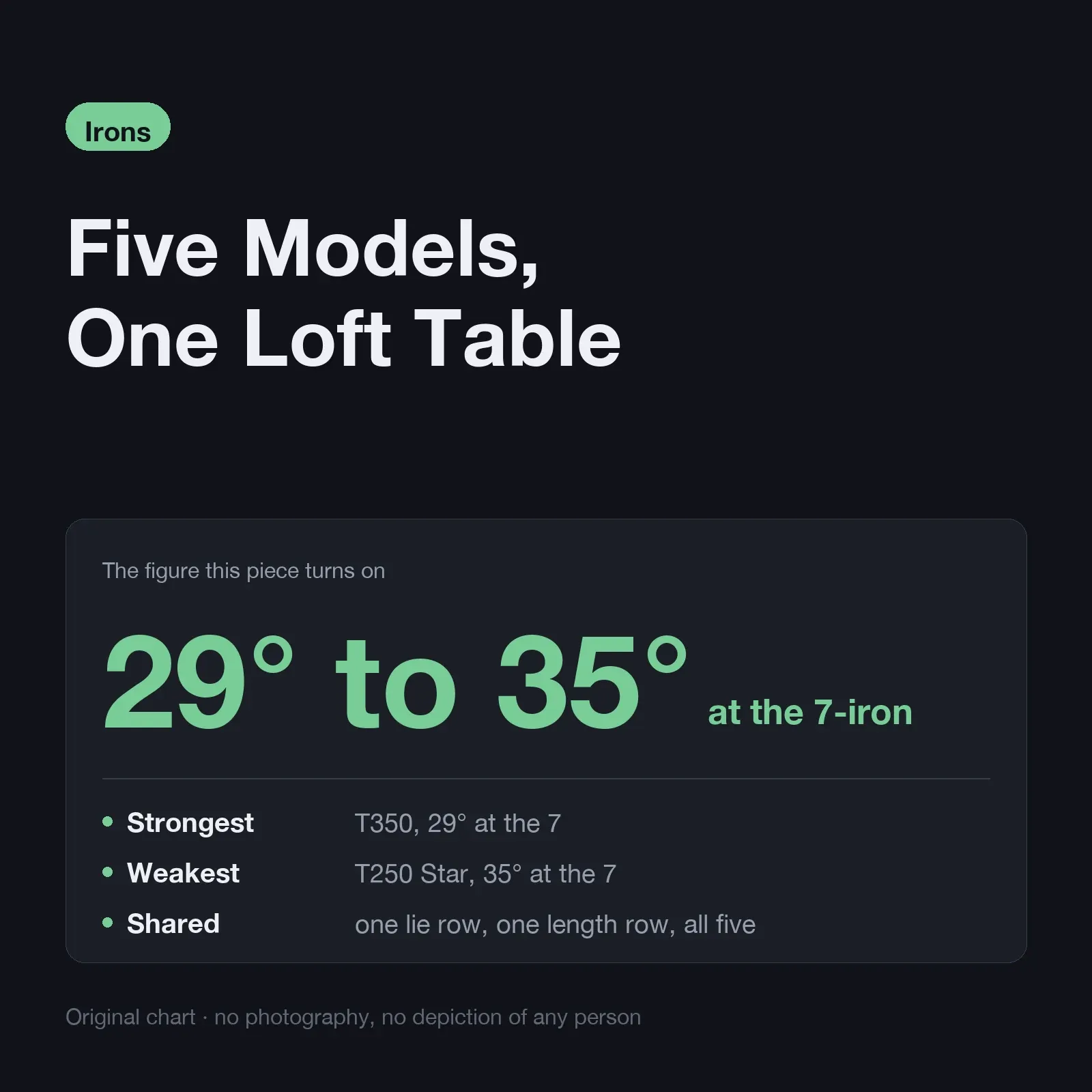
The number in the name is not the loft, and it is not the order. T250✶ is the weakest model in the table at every club it appears in. T350 is the strongest. So the naming runs T100 → T350 by category — player’s iron to game-improvement — while loft runs the other way for four of the five, and then the star model breaks even that.
Lie and length are not split by model. Look at the last two columns: one value per club number, shared by all five. That is a deliberate statement about how the range is built: loft is what you choose between models, and lie is what a fitter sets for you afterwards.
The empty cells carry as much as the filled ones. T250 starts at a 2-iron; T250✶ does not start until the 5; T350 is the only model with a second gap wedge. Set composition differs by model, and the table shows it only by omission — count the blanks in each column before you count the clubs in a set.
What each model is, in one line
- T100 — the tour iron. 33° at the 7, 3 through W.
- T150 — T100 with exactly one degree taken off every club. Titleist’s own copy calls it “1° strong.”
- T250 — the distance player’s iron. 30.5° at the 7 and the only model with a 2-iron.
- T250✶ — T250’s chassis with deliberately weak lofts. 35° at the 7, the weakest number in the table.
- T350 — maximum forgiveness. 29° at the 7, and it runs to a second gap wedge at 53°.
The comparison that matters when you are shopping
A 7-iron is a 7-iron only inside one model. Across this table it is anything from 29° to 35°, and the distance you hit “your seven” moves with it. If you are replacing an old set, the club number on the sole is not the thing to match — the loft is.
Across this table the 7-iron runs from 29° to 35° — six degrees, inside one catalogue. That is a wider spread than most people expect without crossing a brand or a decade, and it is why gapping has to be checked club by club rather than assumed from the number stamped on the sole. For the wedge end of the same problem, see the pitching-wedge gap.
What we could not confirm
- Whether these are current-season figures. The table is live on the manufacturer’s page as read on 2026-09-01. Titleist does not date the table, so a future revision would not announce itself here.
- Custom and Launch Spec variants. Titleist lists a T250 Launch Spec and left-hand availability that the comparison table does not break out separately. Only what the table publishes is reproduced above.
- Bounce, offset and swing weight. Not in this table. The comparison covers loft, lie and length only.
Sources
- Titleist T150 product page — T-Series specifications comparison table — all five loft rows, the shared lie row and the shared length row transcribed above, read 2026-09-01