Buy an iron set and it typically comes with a pitching wedge (PW). Everything below that, the wedge range proper, has to be filled in separately. Lining up confirmed iron and wedge lofts side by side shows exactly where that gap sits.
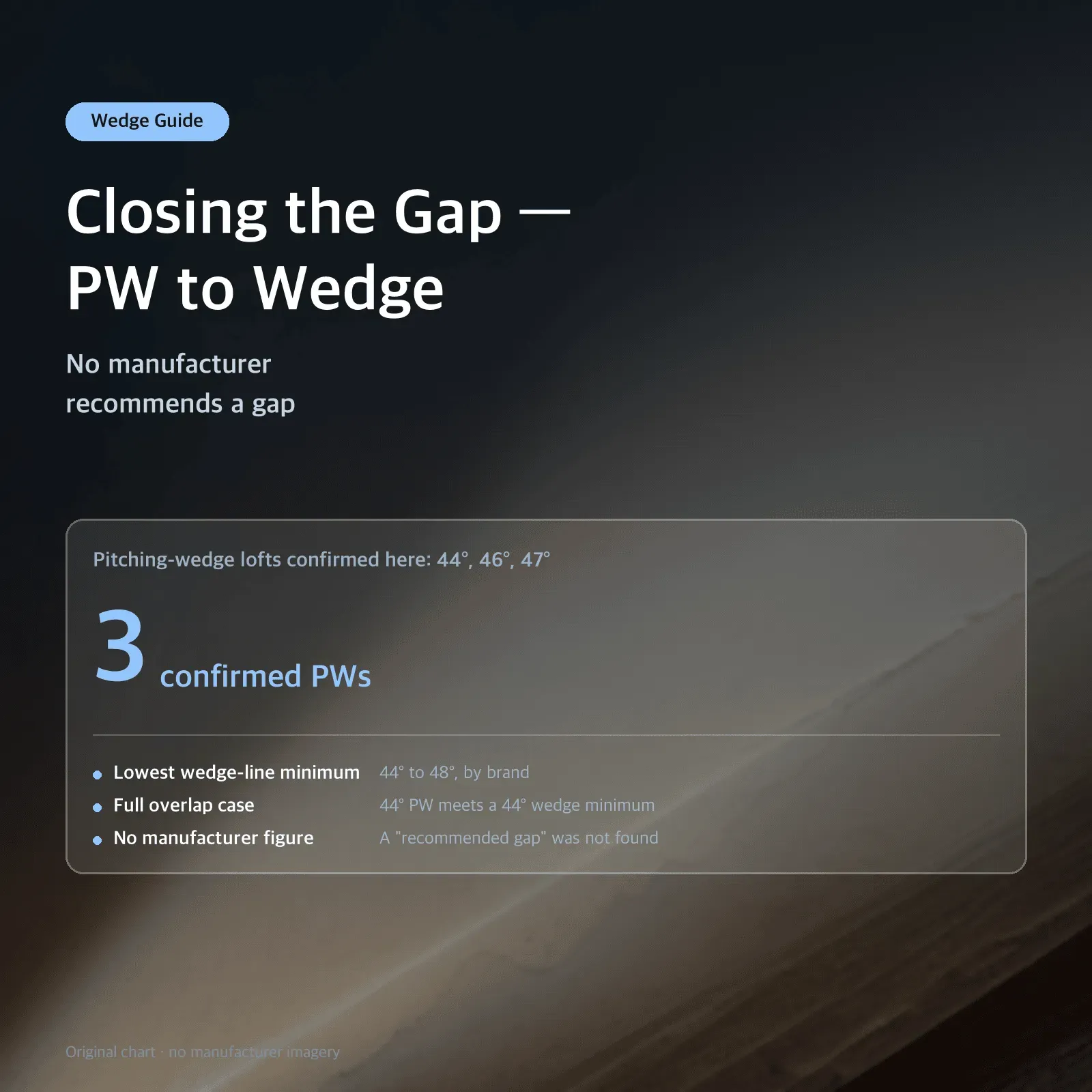
One thing worth stating up front: no manufacturer-recommended gap between a PW and the next wedge turned up in this research. So rather than repeat the common “X degrees is right,” this piece sticks to loft numbers that have actually been confirmed.
1. Three confirmed PW lofts
The confirmed pitching-wedge lofts here are 47 degrees on a players’ cavity iron, 46 degrees on a forged players’ iron, and 44 degrees on a two-piece game-improvement iron. All three irons differ in character, and the PW loft differs with them.
The lower-lofted model leans toward a players’ profile; the higher-lofted model leans toward game improvement. That trend holds across these three models — lower PW loft tracks with a more players-oriented iron, higher PW loft with more game-improvement bias.
2. Five wedge lines, lowest confirmed loft
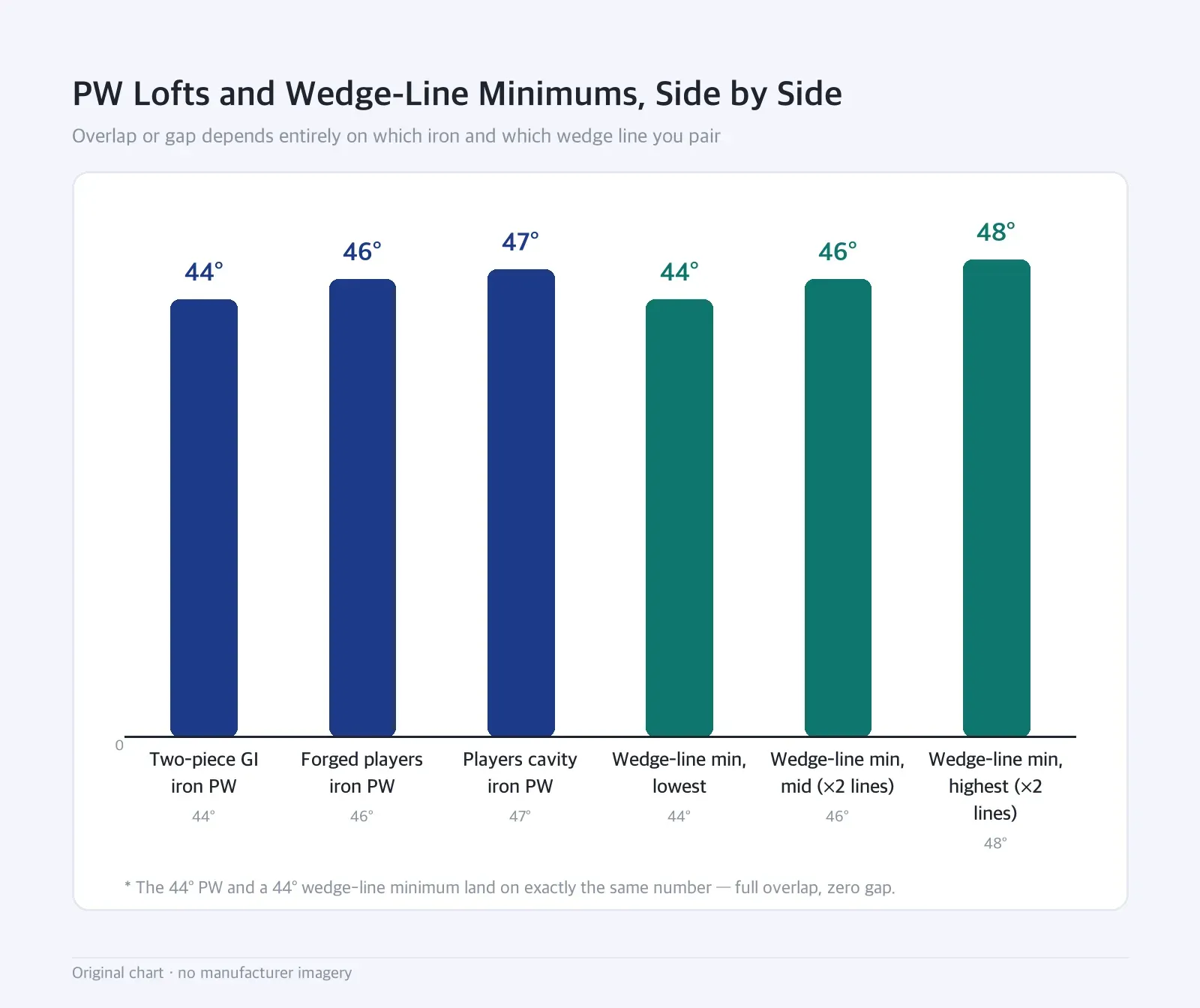
The lowest confirmed loft in each wedge line checked here: 44 degrees, 46 degrees, 46 degrees, 48 degrees, and 48 degrees, across five different manufacturers.
Overlay these against PW lofts and an interesting pattern appears. The 44-degree PW and the 44-degree wedge-line minimum land on exactly the same number — full overlap, zero gap. The 47-degree PW and the 44-degree wedge-line minimum, by contrast, leave a 3-degree gap. Depending on which iron and which wedge line you pair, the gap can close entirely or stay open.
Pair a 48-degree wedge minimum with a 47-degree PW and the wedge loft is actually slightly higher than the PW — no reversal, but only a 1-degree gap. Pair a 46-degree PW with that same 48-degree wedge minimum and the gap opens to 2 degrees. Even without matching brands, gaps this varied show up in practice. The most reliable way to check is to measure your own set’s actual PW loft against your actual wedge loft in a shop.
3. Why “4-degree gap” isn’t used here
You may have run into golf-community advice that a 4-degree gap between the PW and the next club is the rule to follow. Across the official material from five major wedge and iron brands checked here, no such recommended-gap figure turned up anywhere.
So this piece doesn’t assert a number as correct. Instead it lays the actual confirmed loft values side by side, so you can see for yourself whether your PW and your wedge minimum overlap or leave a gap. What can be inferred from the confirmed facts: an overlap can mean a redundant club, and a wide gap can mean a distance with nothing to cover it.
Where the “4-degree” idea likely comes from is a reasonable guess: iron sets themselves typically step 3 to 4 degrees between clubs, and that pattern seems to have been carried over into wedge territory in casual conversation. That’s a guess about where the idea originated, not evidence that manufacturers actually designed around it.
Even once you calculate the gap you want to fill, there’s a separate question of whether a wedge with that exact loft is actually available to you — calculating the gap and finding a product that fills it are two different steps.
4. The character behind the three reference irons
| Iron type | PW loft | Character |
|---|---|---|
| Players cavity iron | 47° | Players-oriented |
| Forged players iron | 46° | Players-forged |
| Two-piece game-improvement iron | 44° | Game-improvement |
The Character Behind Each Reference PW — Lower PW loft tracks with a more players-oriented iron in this set. Choosing a wedge by iron character, not just the PW loft number, is the more accurate approach.
When checking this gap, don’t just look at the PW loft number — look at what kind of iron it came from. The 47-degree PW belongs to a players’ cavity iron, the 46-degree PW to a forged players’ iron, and the 44-degree PW to a two-piece game-improvement iron.
Lined up by loft, a trend appears: lower loft tracks with a more players-oriented character, higher loft with more game-improvement character. That trend comes from how these three models are positioned, not a claim that loft itself determines character. Choosing a wedge by iron character, not just PW loft number, is the more accurate approach.
The five wedge lines checked here can be read the same way. One line leans toward a players’ profile with a wide grind selection; two lean toward a more standard build with a narrower configuration; the remaining two lean toward game-improvement or general use with a wider loft range. Matching iron character to wedge character matters alongside matching the loft numbers themselves.
5. Who this is useful for
Useful for golfers who know their current iron’s PW loft and want to confirm directly whether a new wedge will overlap or leave a gap.
Less useful for golfers looking for a definitive “X degrees is correct” answer. Since no manufacturer-recommended figure could be confirmed, checking the actual gap requires an individual fitting — this guide won’t provide that certainty on its own.
6. What we could not confirm
- A manufacturer-stated “recommended loft gap” — not found in official material from any of the five brands checked.
- PW lofts for iron models beyond the three referenced here — outside the scope of this research.
- Manufacturer distance or spin claims — not cited, as they could not be verified.
In one line
PW loft varies by iron, roughly 44 to 47 degrees, and the lowest wedge loft varies by brand, roughly 44 to 48 degrees. Depending on the pairing, they can overlap or leave a gap — and the popular “ideal gap” figure could not be confirmed in any manufacturer’s material.
When shopping for a new wedge, start by checking your current iron’s PW loft and compare it directly against the wedge’s lowest loft. Measuring what’s actually in your hands is a more reliable starting point than trusting a rule of thumb.
Sources
The negative finding rests on pages we opened rather than on pages we failed to find. Each of these publishes a full wedge spec table, and none of them carries a recommended gap to the pitching wedge — checked 30 August 2026:
- TaylorMade MG5 — grind, loft, bounce, length, lie, hand and swingweight for all 21 combinations. No gapping guidance.
- Titleist Vokey SM11 — model code, loft, bounce, grind, length and swingweight across 27 rows, plus a note that standard lie is 64° on every model. No gapping guidance.
- PING s259 — loft, length, lie, offset, effective bounce and swingweight. The page points to a fitting app for grind selection, not for loft gaps.
- Cleveland RTZ — loft options 46° through 64° and four sole grinds. No gapping guidance.
What these pages do publish is the loft of each wedge; what none publishes is how far it should sit from your pitching wedge. That gap is left to the fitter, and this piece works from the published lofts rather than inventing a recommendation.