These are the three irons golfers most often agonize over within TaylorMade’s P-series. Search around and you’ll find summaries like “P7MC is for better players, P790 is for distance” — which is true, but tells you nothing. What’s missing is how much they actually differ.
So we laid the official spec sheets for all three side by side. Overlaying them produced one clear, sharper pattern than expected. That’s what this piece is about.
1. First, the three models are different generations
Before comparing, one thing has to be said. These three are not siblings released in the same year.
- P7MC — 2023 model (2nd generation, current)
- P770 — 2024 model (4th generation, current)
- P790 — 2025 model (5th generation, current)
Each is being compared as its own current generation, not as a lineup that launched together. On top of that, P7MC is absent from TaylorMade’s current US iron lineup listing, and both generations’ product pages are marked out of stock.
Generation mismatch is the biggest reason P-series comparisons online contradict each other. Check the year before you trust any spec table.
2. Overlay the lofts
| Club | P7MC (2023) | P770 (2024) | P790 (2025) |
|---|---|---|---|
| 3-iron | 20 deg | 19 deg | not offered |
| 4-iron | 23 deg | not published | 20 deg |
| 5-iron | 26 deg | not published | 23 deg |
| 6-iron | 30 deg | not published | 26.5 deg |
| 7-iron | 34 deg | 33 deg | 30 deg |
| PW | 47 deg | 45 deg | 44 deg |
Loft Overlay, Club by Club — Official spec sheets - current generation of each model. P7MC-P770 gap is a near-constant 1 degree; the P790 gap widens to 4 degrees at the 7-iron.
The three lines run in parallel, and the order never flips. From top to bottom: P7MC, P770, P790.
The gap between P7MC and P770 is a near-constant 1 degree. 20° vs 19° at the 3-iron, 34° vs 33° at the 7-iron, 47° vs 45° at the PW. It’s essentially the same array with 1 degree layered on top.
P790 is different. At the 7-iron, the gap widens to 4 degrees.
3. The point this piece really wants to make
| P7MC | P790 |
|---|---|
| 3-iron, 20 deg | 4-iron, 20 deg |
| 4-iron, 23 deg | 5-iron, 23 deg |
| 5-iron, 26 deg | 6-iron, 26.5 deg |
| 6-iron, 30 deg | 7-iron, 30 deg |
| 7-iron, 34 deg | 8-iron, 34 deg |
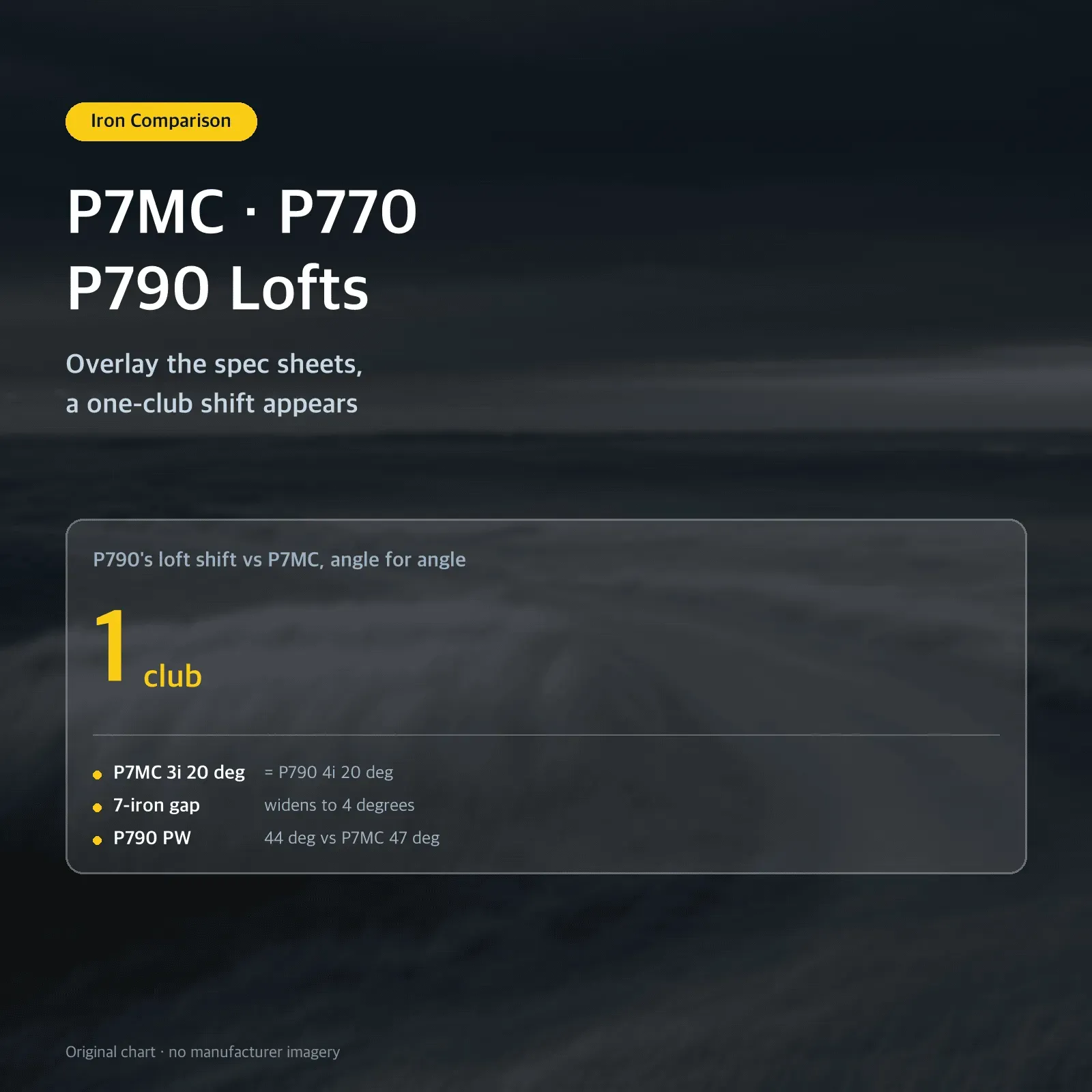
A One-Club Loft Shift — Line up P790 against P7MC one number higher. Not a coincidence - the two sets are shifted by exactly one club number. P790 flying “one club longer” is the angle, not the club.
Line up P790’s lofts against P7MC’s one number higher, and this happens:
- P7MC 3-iron 20° = P790 4-iron 20°
- P7MC 4-iron 23° = P790 5-iron 23°
- P7MC 5-iron 26° ≈ P790 6-iron 26.5°
- P7MC 6-iron 30° = P790 7-iron 30°
- P7MC 7-iron 34° = P790 8-iron 34°
That’s not a coincidence. The two sets are shifted by exactly one club number.
This is where the important conclusion lives. The common claim that “P790 flies one club longer” is only half true. If the loft is stronger by one club’s worth, of course the distance is stronger by one club’s worth. That’s not the club performing better — it’s the angle being set that way.
So the comparison worth making when switching irons isn’t “7-iron to 7-iron.” It’s matching angle to angle, or measured carry distance to measured carry distance. Compare 7-iron to 7-iron and P790 always wins — because the conditions aren’t equal to begin with.
And that shift comes with a cost. The P790 set has no 3-iron. If the top of the set is pushed up by one club, the bottom of the set gets pushed too. P7MC’s PW is 47°; P790’s PW is 44°. The lower you go, the wider the gap a wedge has to cover.
4. Narrowing to a single 7-iron
| Spec | P7MC | P770 | P790 |
|---|---|---|---|
| Loft | 34 deg | 33 deg | 30 deg |
| Lie | 62.5 deg | 62.5 deg | 62.5 deg |
| Length | 37.00 in | 37.00 in | 37.00 in |
| Swingweight | D2 | D2 | D2 |
| Offset | disclosed | not disclosed | not disclosed |
| Bounce | match | match | match |
Same 7-Iron Slot, Three Specs — Lie, length, and swingweight match; loft and structure differ. Offset has no field on P770/P790’s official sheets - not an omission here, TaylorMade simply doesn’t publish it for those two.
Splitting what’s the same from what’s different:
Same — 62.5° lie, 37.00-inch length, D2 swingweight. All three models match exactly. Different — loft, and internal head structure.
So the three clubs feel identical in the hand for length and weight balance. What separates them is just two things: angle, and structure.
One thing worth flagging. The offset field is filled in only for P7MC. The other two are listed as “not disclosed.” That’s not an omission on our part — TaylorMade’s official spec sheets for the P770 and P790 simply don’t carry an offset field. Bounce and blade length match across all three too.
Offset tables in millimeters for P770 and P790 circulate online, but checking them shows most trace back to the 2017 first-generation or 2019 spec values. Filling in a number that doesn’t exist for the current generation just makes the table wrong. So it’s left blank here.
5. Structure — this is where the real split is
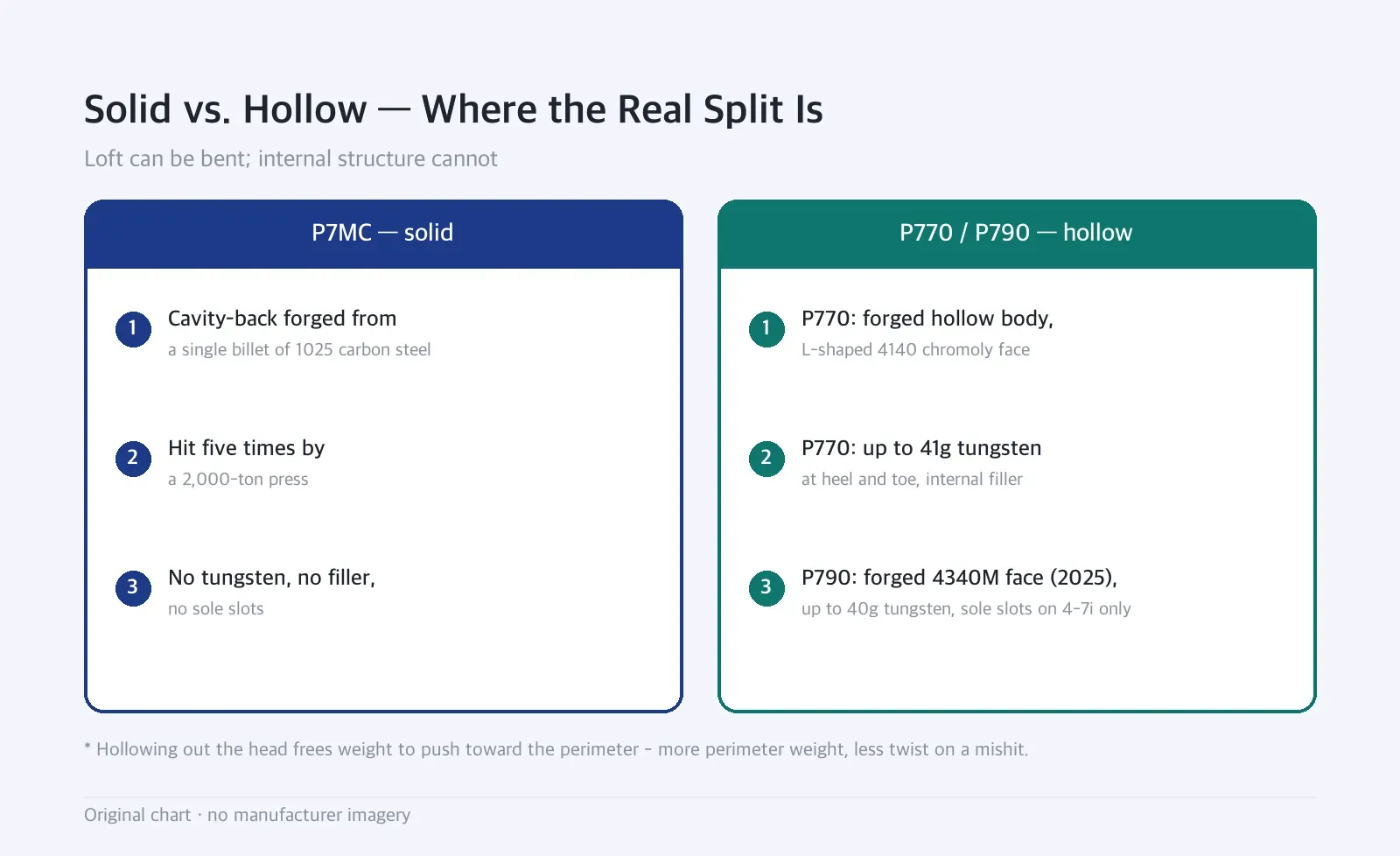
Loft can be adjusted by bending. Structure cannot.
P7MC is a cavity-back forged from a single billet of 1025 carbon steel, hit five times by a 2,000-ton press. The inside is solid — no tungsten, no filler, no sole slots.
P770 is a forged hollow body. An L-shaped forged face in 4140 chromoly, up to 41g of tungsten placed at the heel and toe, internal filler, and through sole slots.
P790 is also hollow. The 2025 model switched to a forged 4340M face — 20% stronger than the previous generation, which the manufacturer says let them make the face thinner and expand the sweet spot by up to 24% (a comparison against the 2023 7-iron, per the manufacturer). Up to 40g of tungsten, sole slots on the 4- through 7-irons only.
The principle is simple. Hollow out the inside and the freed-up weight can be pushed toward the perimeter of the head. The more weight sits at the edges, the less the head twists on a mis-hit. That’s where forgiveness comes from.
P7MC has no weight to redistribute. That’s not a design failure — it’s a choice. In exchange, the feedback in your hands is sharper.
6. The manufacturer’s own ranking
| Model | Distance | Forgiveness | Spin |
|---|---|---|---|
| P790 | LONGER | MID-HIGH | MID |
| P770 | MID LONG | MID | MID-HIGH |
The Manufacturer’s Own Ranking — Pulled directly from TaylorMade’s official comparison chart. P7MC does not appear on this official chart at all - it lists P7CB, P770, P790, and P8CB.
This is pulled directly from TaylorMade’s official comparison chart.
P790 rates LONGER for distance, MID-HIGH for forgiveness, MID for spin. P770 rates MID LONG for distance, MID for forgiveness, MID-HIGH for spin.
What’s worth noting is that P7MC doesn’t appear on this official comparison chart at all. The chart lists P7CB, P770, P790, and P8CB — four models. That’s a signal for which lineup combination the manufacturer is currently promoting.
7. So which one do you pick?
| Priority | Pick |
|---|---|
| Reduce mishit distance loss, hold greens | P790 - widest handicap range of the three |
| Thinner topline without going full tour-forged | P770 - thinner and more compact than P790 |
| Shape spin and trajectory on purpose | P7MC - trades forgiveness for shot-making control |
So Which One? — Three broad paths by priority. Each pick is a tradeoff, not a universal winner.
Three broad paths:
P790 — if you want to reduce distance loss on mis-hits and struggle to hold greens because your trajectory runs low. Of the three, it covers the widest handicap range.
P770 — if a thick top-line at address bothers you but a fully forged iron feels like too much to ask. The manufacturer itself describes it as thinner-topline and more compact-shaped than P790.
P7MC — if you can absorb the distance loss from mis-hits, and shaping spin and trajectory intentionally is central to your scoring. It’s a trade: give up forgiveness, buy shot-making control.
8. Who this comparison is useful for
A judgment framework drawn from the confirmed differences between the three models.
- Golfers stuck comparing 7-irons to see “which one goes further” — that comparison doesn’t actually hold, which is the core point of this piece. Compare angle to angle, or measured carry to measured carry.
- Golfers bothered by the missing 3-iron in P790 — once you know the set is shifted one club relative to P7MC, you can judge for yourself whether you actually need a 3-iron.
- Golfers trying to gauge forgiveness from the structural differences (solid / hollow + 41g tungsten / hollow + 40g tungsten) — the matrix in section 6 is the basis for that judgment.
This may not fit:
- Golfers who assume a model isn’t “current” just because it’s absent from one region’s retail listing — P7MC is absent from the current US official lineup and from the official comparison chart (P7CB, P770, P790, P8CB).
- Golfers trying to compare P770 and P790 offset numerically — neither model’s official spec sheet has that field.
9. What we could not confirm
- P770 and P790’s per-club offset, bounce, and blade length — the official spec sheets have no such field.
- Sole width and top-line thickness figures for all three models — neither is published.
- A like-for-like distance test — media test figures vary by tester and conditions, so none are cited here.
In one line
The difference between these three clubs comes down to almost exactly two things: 4 degrees of loft, and how much empty space sits inside the head.
And the loft difference isn’t a performance difference — it’s the club numbers pushed over by one. Don’t compare the 7-irons in the catalog. Compare angle to angle, or measured carry to measured carry. The real difference is whether the inside is hollow or solid.
Every chart here was built directly, and every number comes from each model’s current-generation official spec sheet. Anything we could not confirm was left blank.
Sources
- TaylorMade official spec sheets for P770 and P790 — confirmed live and matching this piece’s figures. P7MC could not be linked (see below).
🔴 Noted in the body: P7MC is absent from TaylorMade’s current US iron lineup listing, and both generations’ product pages are marked out of stock. As of August 2026 this has gone further than “out of stock”: both known P7MC product-page URLs now redirect to other current products (P7CB, or the general irons category) instead of showing an out-of-stock P7MC page.
P770 and P790 above were opened directly and confirmed live as of August 2026. P7MC has no live official page, so it is not linked; everything about P7MC above is drawn from first-party manufacturer material as recorded during the original research. Items the manufacturer does not publish are named as unconfirmed rather than estimated.