The P790 is the club that popularized the term “players distance iron” — a club that looks like a better-player’s blade but produces the distance of a game-improvement design. The original 2017 P790 is what made that combination mainstream.
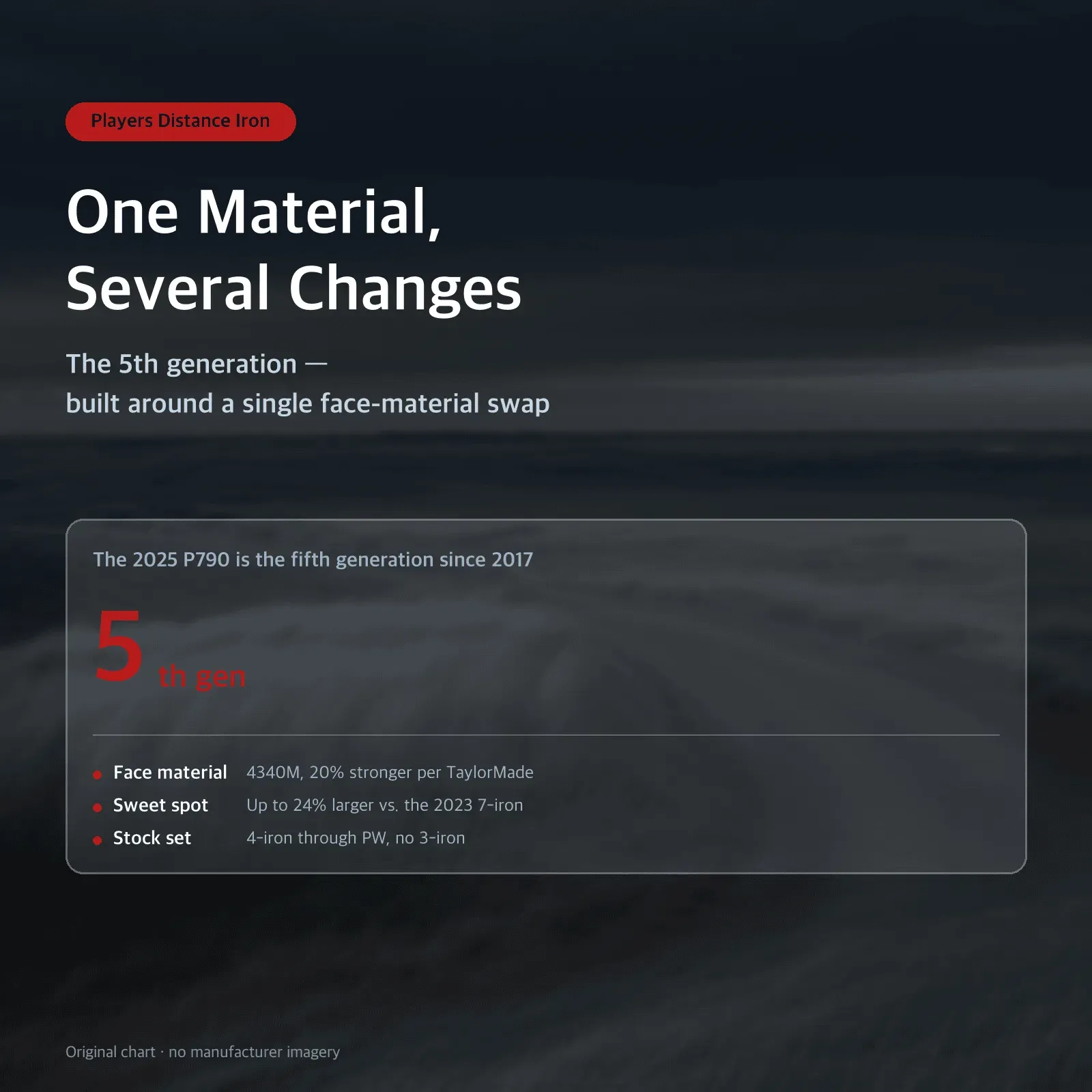
In 2025, the fifth generation arrived. Every new generation claims to have been “rebuilt from scratch,” but this time the actual change is comparatively easy to point to: the face material. Here is what that one change pulled along with it.
1. The current P790 is the 2025, fifth-generation model
- 1st generation 2017 → 2nd generation 2019 → 3rd generation 2021 → 4th generation 2023 → 5th generation 2025
The 5th generation went up for pre-order in February 2025 and reached retail in March. A “Battle Won” special edition closed out in August 2025, but the head itself did not change. As of August 2026, no 6th generation has been released.
One caution when looking up specs: the 2025 stock set does not include a 3-iron. The set runs from 4-iron through pitching wedge, with an approach wedge added on top. Searches often turn up tables listing “P790 3-iron at 19 degrees, 4-iron at 21 degrees” — those are 2019 or 2023 figures. The current 4-iron is 20 degrees.
2. Official specifications
| Club | Lie | Length | Swingweight (steel) |
|---|---|---|---|
| 4-iron | 61° | 38.5” | D2 |
| 7-iron | 62.5° | 37” | D2 |
| 9-iron | 63.5° | 36” | D2 |
| PW / AW | 64° | 35.5”–35.75” | D3 |
Official spec highlights, 2025 P790 — lie, length and swingweight from the manufacturer’s sheet. Offset is not listed: TaylorMade’s 2025 sheet does not publish a millimetre figure for it.
Lie angle runs from 61 degrees on the 4-iron to 64 degrees on the pitching wedge and approach wedge. Length runs from 38.5 inches (4-iron) to 35.5 inches (approach wedge). Steel-shafted swingweight is D2 for the 4- through 9-iron and D3 for the pitching and approach wedges; graphite versions run two points lighter, at D0 and D1.
Offset is not listed here because TaylorMade’s official spec sheet does not include that line item for the 2025 model. We could not find a millimeter figure published anywhere, so none is stated.
3. Loft progression — the gaps widen toward the short irons
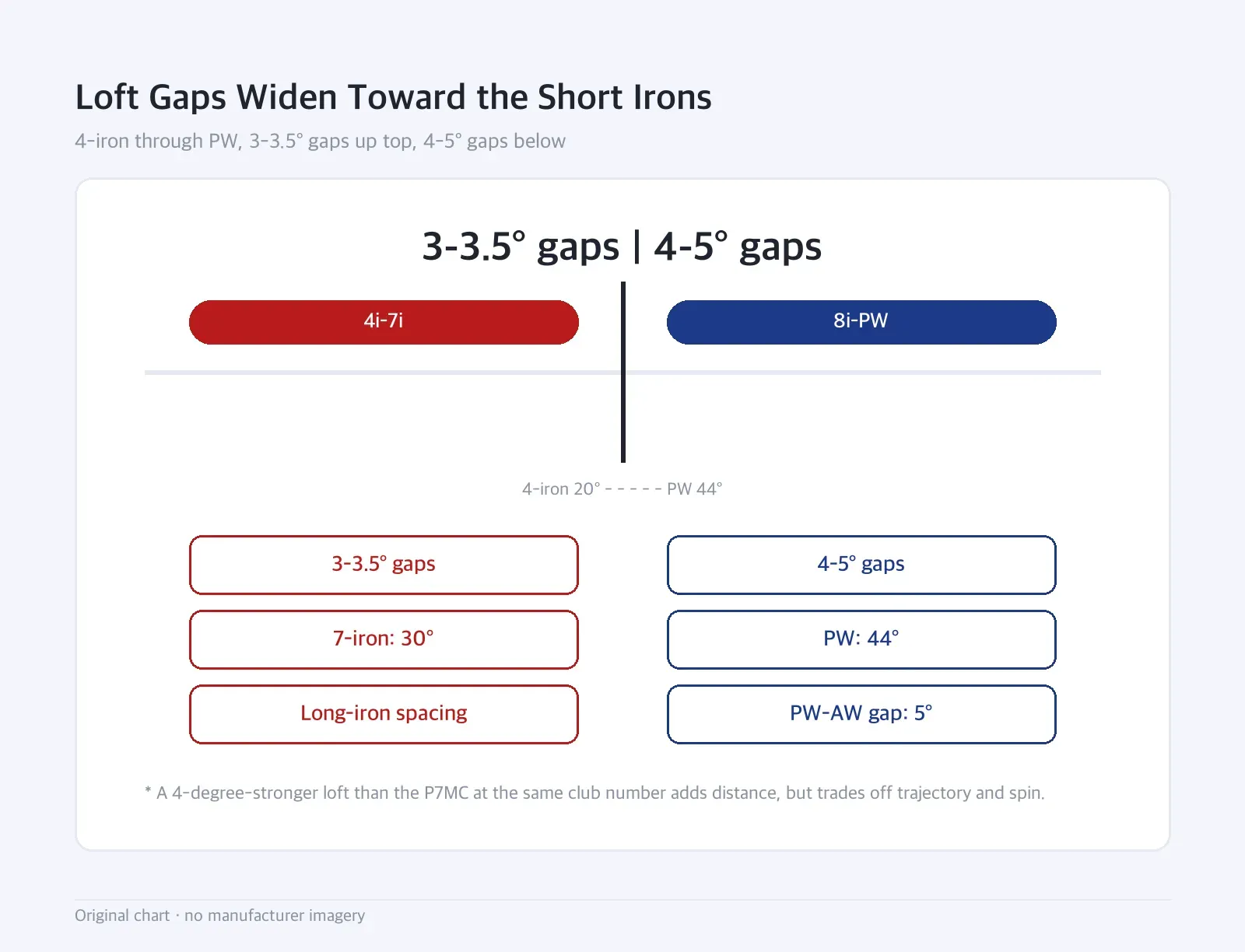
- 4-iron through 7-iron: 3 and 3.5-degree gaps
- 8-iron through pitching wedge: 4 and 5-degree gaps
- Pitching wedge to approach wedge: 5 degrees
Of the three TaylorMade players-iron models, the P790 carries the strongest lofts. The 7-iron sits at 30 degrees, the pitching wedge at 44 degrees — four degrees stronger than the P7MC at the same numbers.
This is where a common misreading creeps in. “The P790 goes one club further” is not purely a statement about head performance. A 4-degree-stronger loft produces more distance on its own. In exchange, trajectory and spin drop, which can make it harder to hold a green. The question worth asking isn’t just “how far,” but “does the ball stop where it lands.”
The more practically relevant numbers are the 5-degree gaps between 9-iron and pitching wedge, and between pitching wedge and approach wedge. With wider gaps at the bottom of the set, wedge selection needs to be planned alongside the irons. Pair a 44-degree pitching wedge with only a 56-degree wedge below it, and 12 degrees fall into a single gap.
4. What the 5th generation actually changed
| Category | P790 (2025) | P770 (2024) |
|---|---|---|
| Feel | Soft | not shown here |
| Distance | Longer | Mid-long |
| Forgiveness | Mid-high | Mid |
| Spin | Mid | Mid-high |
| Trajectory | Mid-high | not shown here |
Manufacturer Comparison Chart Ratings — TaylorMade’s own scale, P790 vs. P770. TaylorMade positions the P790 as the longer, more forgiving, lower-spin option of the two.
The core change is the face material.
| 2025 P790 | Prior gen | |
|---|---|---|
| Face material | 4340M, 20% stronger (mfr.) | Previous-generation material |
| Sweet spot | Up to 24% larger (7-iron only) | Baseline for comparison |
| Tungsten | Up to 40g, toe-weighted mid-irons | Construction detail |
| Sole slot | 4i-7i only | Short irons: no slot |
What the 5th Generation Changed — the face material is the core change; the rest follows from it. The 24% sweet-spot figure compares only the 2023 7-iron to 2025 — not a set-wide average.
According to the manufacturer, the new 4340M face material is 20% stronger than the previous generation’s material. That extra strength allowed the face to be made thinner, which the manufacturer says expanded the sweet spot by up to 24%.
That 24% figure needs its baseline stated alongside it: it’s a comparison against the 2023 7-iron specifically, not a set-wide average. When reading manufacturer numbers, it’s worth always asking “compared to what, and which club number.”
The rest of the construction:
- Hollow body with internal filler
- Up to 40g of tungsten — positioned toward the toe in the mid-irons to raise moment of inertia, and left out of the short irons entirely
- Through-slot in the sole, applied only to the 4- through 7-irons
- Club-specific center-of-gravity design — low in the long irons, higher in the short irons
- Variable back-wall thickness that removes mass from the upper portion of the impact zone
- A thinner topline, a larger sole radius, and a leading edge that varies by club number
The fact that the sole slot appears only on the 4- through 7-irons tells you where the priorities sit. The long and mid-irons are built for ball speed; the short irons are built for control.
5. Where the manufacturer positions it
| Item | Status |
|---|---|
| Offset, bounce, blade length | Not listed by club |
| Face thickness (mm) | Not published |
| Body material | Sources conflicted; not adopted |
| Internal filler weight/amount | Not disclosed |
What We Could Not Confirm — Left blank on the official 2025 spec sheet. Stock steel shafts are KBS; stock graphite is Mitsubishi MMT 55/65/75 — sources vary on the exact steel label, so confirm before ordering.
On TaylorMade’s own comparison chart, the 2025 P790 is rated:
- Feel: SOFT
- Distance: LONGER
- Forgiveness: MID-HIGH
- Spin: MID
- Trajectory: MID-HIGH
For comparison, the 2024 P770 is rated MID LONG for distance, MID for forgiveness, and MID-HIGH for spin on the same chart. TaylorMade positions the P790 as the longer, more forgiving, lower-spin option of the two.
6. Shafts and target golfer
Stock steel shafts are from the KBS lineup; stock graphite is Mitsubishi’s MMT 55/65/75. The stock grip is a Golf Pride Z-Grip at 52g. Sources vary on whether the steel model is labeled KBS Tour or KBS Tour Lite, so confirm before ordering — stock configurations also vary by region.
The P790 targets a wide band, from low- to mid-handicap players. English-language reviews generally place it around a 5 to 18 handicap, with some extending that up to 20. Of the three comparable models, it targets the widest range of golfers.
7. Who this club fits
Judgment calls drawn from the confirmed specs:
- Golfers who want distance along with meaningful forgiveness across a wide handicap range — the manufacturer’s own chart marks it LONGER for distance and MID-HIGH for forgiveness, and reviews generally place its target range (roughly 5–20 handicap) as the widest of the three comparable models.
- Golfers who want moment of inertia in the mid-irons — up to 40g of tungsten is concentrated toward the toe in that range.
- Golfers who never wanted a 3-iron anyway — the stock set already starts at 4-iron.
Where it may not fit:
- Golfers who want precise trajectory control to hold greens — at 30 degrees, the 7-iron carries the strongest loft of the three comparable models, meaning lower trajectory and spin at the same club number.
- Golfers who want to fit off offset and bounce figures — the 2025 official spec sheet does not list either.
8. What we could not confirm
- Offset, bounce, and blade length by club — not listed on the official spec sheet.
- Face thickness in millimeters — not published for the 2025 model.
- Body material — we could not settle this from official sources. The Korean official product page’s material description did not match the face description elsewhere, so we did not adopt it.
- The weight and fill amount of the internal filler.
In one line
What changed in the 5th-generation P790 was the material. The material change thinned the face, and the thinner face widened the range of players it suits.
When talking about distance, though, keep the loft in view. A 30-degree 7-iron is four degrees stronger than the P7MC’s. Distance produced by better club performance and distance produced by a loft that simply isn’t as high are two different things, and worth separating.
All charts in this piece were built from scratch, and every figure comes from the manufacturer’s official spec sheet.
Sources
- TaylorMade official P790 specifications, 5th generation — including lie angles from 61° (4-iron) to 64° (PW and AW).
🔴 Generation warning: tables listing “3-iron at 19°, 4-iron at 21°” are 2019 or 2023 figures, not current.
The link above was opened directly and confirmed live as of August 2026; its loft/lie/length/swingweight table and the 4340M face material, 20%-stronger, and 24%-larger-sweet-spot claims all match this piece’s figures exactly. Items the manufacturer does not publish are named as unconfirmed rather than estimated.