Look at a wedge spec sheet and you’ll find several different configurations under the same loft. Comparing loft, bounce, and grind tables across a set of current wedge lines shows that the axis producing “same loft, different combination” is bounce and grind.
This piece collects only the explanations manufacturers have made official — where a brand hasn’t published a description, we list the code and stop there rather than guessing.
1. Bounce — a value expressed in degrees
| Line | Bounce range |
|---|---|
| Vokey SM11 | 4° to 14° |
| TaylorMade MG5 | 8° to 14° |
| Cleveland RTZ | 6° to 12° |
| PING s259 | 6° to 14° |
Bounce Ranges Overlap Heavily Across Brands — A bounce number alone is common across brands — what differs is which grind it’s paired with. Eight degrees alone appears across Vokey, MG5, RTZ, and PING — the number by itself doesn’t tell brands apart.
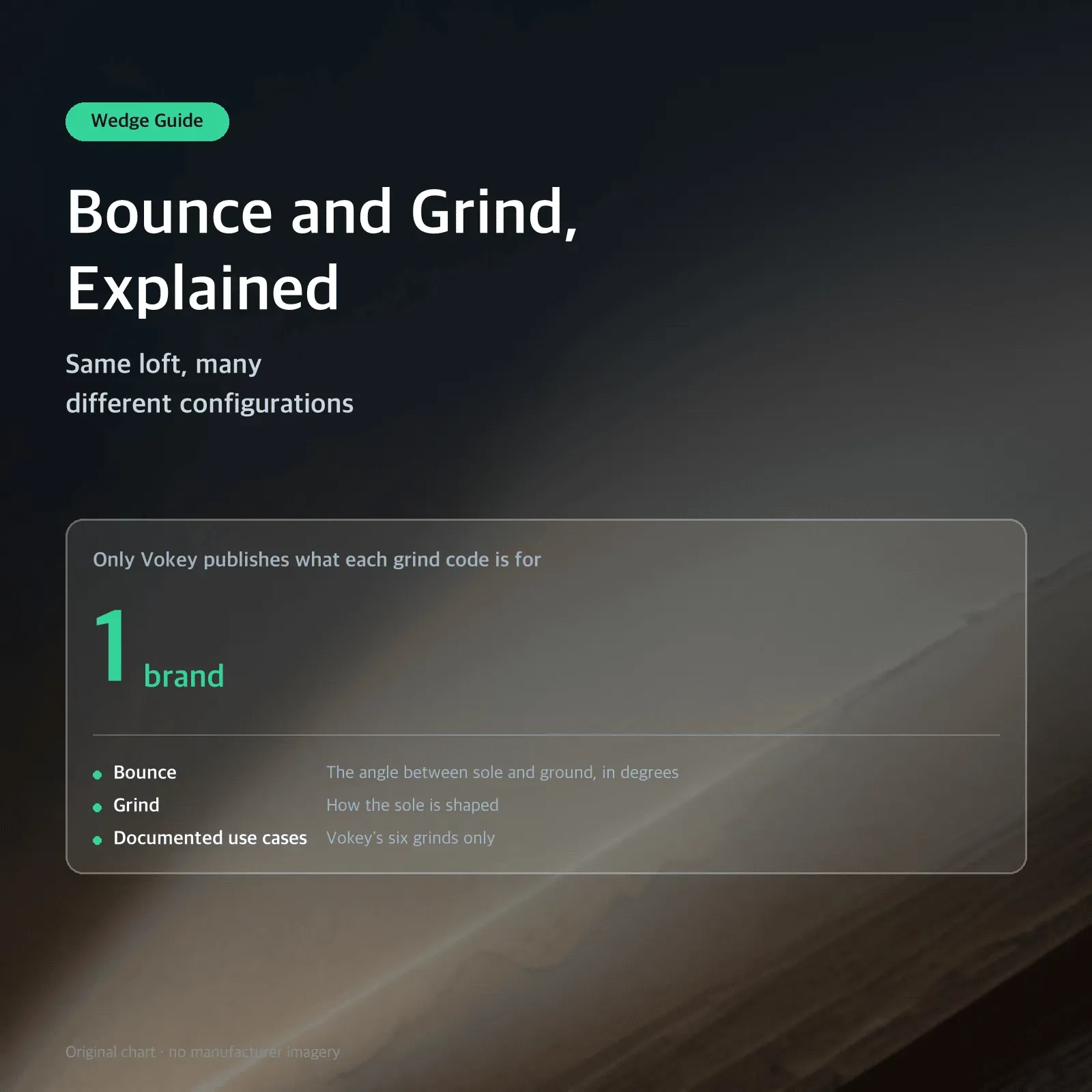
Bounce is the angle between a wedge’s sole and the ground. Across the lines checked here, the range runs 4–14 degrees for Vokey, 8–14 for MG5, 6–12 for RTZ, and 6–14 for Ping’s s259.
Lower numbers are called low bounce, higher numbers high bounce. Vokey’s official material describes its T grind (low bounce) as suited to precision shots and its D grind (high bounce) as suited to steep swings. That explanation comes directly from Vokey’s own copy; no other brand’s bounce-to-use-case explanation turned up in this research.
Looking at the numbers alone, the bounce ranges of these lines overlap heavily. Eight degrees alone appears across Vokey, MG5, RTZ, and Ping. In other words, a bounce number by itself is common across brands — what differs by brand is which grind code that number is paired with. Even the same number can feel different in hand once sole shape changes with the brand.
2. Grind — how the sole is shaped
| Line | Grind codes | Use-case documented? |
|---|---|---|
| Vokey SM11 | T, M, F, S, D, K | Yes — all six |
| TaylorMade MG5 | SB, SC, SX, HB, LB | No official copy found |
| PING s259 | S-12, W-14, H-10, S-10, E-8, T-6, H-8, B-8 | No official copy found |
| Cleveland RTZ | FULL, MID, LOW, ADAPT | No official copy found |
| Callaway Opus SP | T, C, S, X, W | No official copy found |
Grind Codes by Line — Documented or Not — Vokey is the only brand with official use-case descriptions for every code. Guessing performance from a grind name and confirming it from official documentation carry different weight.
Grind is a code for how the sole has been shaped. Vokey officially describes six: T, M, F, S, D, and K. T is for low-bounce precision shots; M is the grind its own designer favors as an all-around choice; F is a full-sole shape for full shots; S is a narrower sole for general use; D is high bounce for steep swings; K is built to handle sand and varied lies.
TaylorMade’s MG5 lists five grind codes — SB, SC, SX, HB, LB — but no official copy explaining what each is for turned up in this research. Ping’s s259 lists eight — S-12, W-14, H-10, S-10, E-8, T-6, H-8, B-8 — and the same is true there: codes are confirmed, use-case explanations are not.
RTZ and Opus SP also have their own confirmed grind codes — FULL, MID, LOW, ADAPT for one and T, C, S, X, W for the other — but across this whole survey, Vokey was the only brand that had documented what each code is for.
RTZ’s FULL/MID/LOW naming reads somewhat intuitively — LOW suggesting lower bounce, FULL suggesting a wider sole shape — but that’s a guess drawn from the name, not an official explanation. Guessing performance from a name and confirming it from official documentation carry different weight, and that distinction runs through this whole piece.
If you’re choosing between bounce and grind options, a workable order is this: first check whether the brand’s official page explains what each grind is for. If it does, use that. If it doesn’t, don’t guess at the code’s meaning from its name — testing several grinds in person is the more reliable path.
3. Keeping documented and undocumented separate
The point handled most carefully here is this distinction. Vokey’s official page explains what each grind is for; MG5 and Ping list codes with no explanation attached.
Absence of an explanation is not license to guess at intended use. So this piece lists use-case descriptions only for Vokey’s six grinds, and lists MG5’s and Ping’s codes by name alone. Trying a grind in person, or getting a fitting, is more reliable than reading a code name and inferring intent.
4. A common pattern — more loft, more grind options
| Line | Low-loft grind options | High-loft grind options |
|---|---|---|
| Vokey SM11 | F only, 44-48° | Six grinds, 58-60° |
| Cleveland RTZ | MID only, 46-52° | Adds FULL and ADAPT from 54° |
A Common Pattern — More Loft, More Grind Options — No manufacturer explanation for this pattern turned up in this research. A bounce number alone doesn’t identify a grind — Vokey’s D grind and K12 grind both carry 12° bounce with different sole shapes.
Looking across these lines, one pattern recurs: lower lofts have fewer grind options, and higher lofts have more. Vokey offers a single F grind across 44–48 degrees, but six different grinds from 58 to 60 degrees. RTZ has a single MID grind from 46 to 52 degrees, then adds FULL and ADAPT starting at 54.
No manufacturer explanation for why this pattern exists turned up in this research. What can be inferred: lower lofts (46–52 degrees) are used mostly for full shots, where the swing is relatively consistent, while higher lofts (54 degrees and up) cover approach shots and bunker shots, where lie conditions and swing styles vary far more. That’s an inference drawn from the shape of the spec tables, not a stated manufacturer rationale.
A bounce number alone is also not enough to infer a grind’s character. Vokey’s D grind carries 12 degrees of bounce — so does its K grind at K12. Same number, different sole shape, different character. For that reason this piece always states the bounce number and grind code together, and never generalizes “X degrees suits Y swing style” from the number alone.
5. Who this is useful for
Useful for golfers choosing Vokey wedges who want to confirm what each of T, M, F, S, D, K is for by reading the manufacturer’s own wording — this is the one brand with documented explanations.
Less useful for anyone trying to guess MG5’s or Ping’s grind purposes from code names alone. Both brands have confirmed codes but no explanation attached, which makes in-person fitting the necessary next step.
6. What we could not confirm
- Official use-case descriptions for MG5’s grinds (SB, SC, SX, HB, LB).
- Official use-case descriptions for Ping s259’s grinds (S-12, W-14, and the rest).
- Official grind descriptions for Opus SP and RTZ.
- Manufacturer distance or spin claims — not cited, as they could not be verified.
In one line
Bounce is the angle between sole and ground; grind is how the sole is shaped. Vokey documents both officially; MG5 and Ping provide codes without explanation.
When choosing a grind from a brand that doesn’t document it, don’t trust the code name alone — test it in person. Separating what’s documented from what isn’t is the principle running through this whole piece. Knowing bounce and grind precisely can matter more on the course than loft alone.
Sources
- Cleveland RTZ Tour Satin Wedge — official spec page — confirms the FULL/MID/LOW/ADAPT grind codes and the 46°-64° loft range.
- PING s259 Wedge — official spec page — confirms bounce values from 6.0° to 14.0° and the grind codes S-12, W-14, H-10, S-10, E-8, T-6, H-8, B-8.
- Callaway Golf — Opus SP Wedges press release — confirms the five grind codes S, T, C, W, and X by name, with no use-case explanation attached, matching this piece’s “documented or not” distinction.
Vokey (vokey.com) and TaylorMade (taylormadegolf.com) block automated page access, so the SM11 and MG5 figures in this piece could not be independently reconfirmed against a live official page.