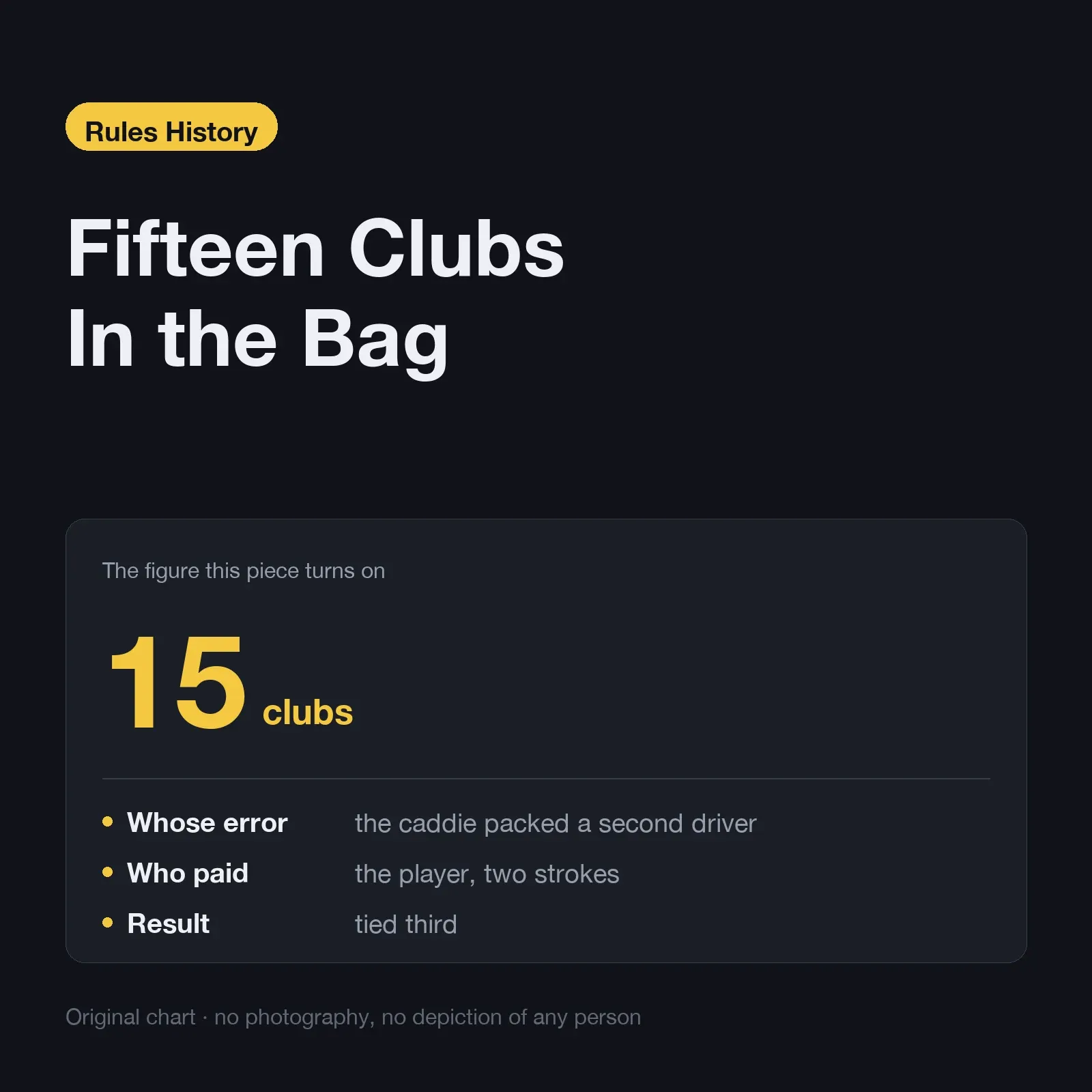
Ian Woosnam birdied the first hole of the final round of the 2001 Open Championship and stood alone at the top of the leaderboard. On the second tee, his caddie told him something that had nothing to do with the shot he was about to play: there were two drivers in the bag. Fifteen clubs, one over the limit. Woosnam had not put either driver there and had not counted them that morning. The penalty was his.
1. What happened on the first two holes
| Step | What happened | Why it mattered |
|---|---|---|
| 1st hole (par 3) | Woosnam birdies to take the outright lead | Sets up the moment the penalty would erase |
| 2nd tee | Caddie Miles Byrne tells him: “We’ve got two drivers in the bag” | Fourteen clubs is the legal maximum; the bag holds fifteen |
| 2nd tee | Woosnam throws the extra driver into the bushes | Removes the extra club, but the breach already occurred |
| Ruling | Two-stroke penalty applied for starting the round with too many clubs | Turns the opening birdie into a net bogey on the scorecard |
2. The extra club was a second driver, not a stray wedge
The 15th club was a fairway wood Byrne had kept in the bag from the practice range, alongside Woosnam’s usual driver. Nobody has suggested the second driver was carried deliberately for an advantage — carrying two drivers gains a player nothing the rule doesn’t already prevent by penalizing the count itself. The breach was a checklist failure: the bag was not counted down to fourteen before the round started, and it was Byrne’s job to do that count, not Woosnam’s.
3. The rule does not ask who packed the bag
This is the axis of the case. The Rules of Golf address the number of clubs a player carries; they do not carve out an exception for a caddie’s mistake. Woosnam never swung the second driver. He never intended to use it. He did not know it was there. None of that mattered under the rule as it applied to his round — the two-stroke penalty attached to him, not to Byrne.
That gap — the person who erred and the person who is penalized are two different people, and the rules put them on the same side of the ledger without asking whose fault it was — is what separates this case from a player misjudging a bunker or a slope. Woosnam did nothing wrong on the course. He was penalized anyway, because the rule is written around the bag, not the intent.
4. What it cost
Woosnam shot a final-round 71 and finished tied for third at six under par, four shots behind winner David Duval. He kept Byrne on the bag immediately afterward, telling reporters it was “the biggest mistake he will make in his life” and that he would not sack him over it. Byrne was dismissed two weeks later, after a separate incident in which he missed a tee time.
5. No rule change followed
Unlike several cases in this series, this one did not lead anywhere. The 14-club maximum and the two-stroke-per-hole penalty (capped at four strokes per round) were already the rule before 2001, and neither changed afterward as a direct result of Woosnam’s round. The rule that produced the penalty is, as of this writing, the same rule.
The series is mostly about players punished for something they did not know they had done. This one is about a player punished for something somebody else did. Compare it with Dustin Johnson at Whistling Straits, where the information existed and went unread, and with Stadler’s towel, where the player was the only one who could have prevented it.
6. What is confirmed and what is not
Confirmed — the birdie on the first hole, the caddie Miles Byrne informing Woosnam on the second tee that the bag held two drivers, the two-stroke penalty, Woosnam discarding the extra driver into the bushes, his final round of 71, his tie for third at six under (four shots behind David Duval), his decision to keep Byrne on immediately afterward, and Byrne’s dismissal two weeks later over an unrelated missed tee time.
Not confirmed here — a specific prize-money figure for what the two strokes cost Woosnam. One source puts the runner-up-adjacent money he missed at £218,333; we did not find that figure corroborated on a second page and are not repeating it as fact. We also did not find a source establishing that this incident prompted any rules body to review the 14-club penalty structure — as far as we can tell, none followed.
In one line
The caddie packed the extra club and never touched it; the player carried it, and the penalty went to the player.
Sources
- Golf.com’s account of the incident — names caddie Miles Byrne, quotes his “We’ve got two drivers in the bag” warning on the second tee, confirms the two-stroke penalty, and describes Woosnam flinging the extra driver into the woods.
- Wikipedia’s article on the 2001 Open Championship — confirms Woosnam’s tie for third place at 278 (−6) in the final round.
- Wikipedia’s article on Ian Woosnam — states he finished third “despite suffering a two-stroke penalty for starting the final round with 15 clubs in his bag,” names Byrne as the responsible caddie, and records that Woosnam dismissed Byrne two weeks later after he missed a tee time.
- WhyWeLoveGolf’s account — confirms the birdie on the opening par-3, the “We’ve got two drivers” quote, and the tied-for-third finish at −6 with David Duval winning at −10.
All four pages were opened and read on 30 August 2026. Accounts differ on which hole the discovery is tied to — some describe it as happening “on the first hole” (referring to the sequence starting with the opening birdie), others specifically place the discovery on the second tee. This piece uses the second-tee detail, sourced to Golf.com’s direct quote from the moment.