Dustin Johnson stood over his ball on the 72nd hole of the 2010 PGA Championship one shot out of the lead. The patch of sand under his feet had been walked on all week by thousands of spectators standing outside the ropes. It looked like dirt. He grounded his club before the shot, the way any player grounds a club on a fairway. The course had told him, in writing, not to.
1. What happened on the 72nd hole
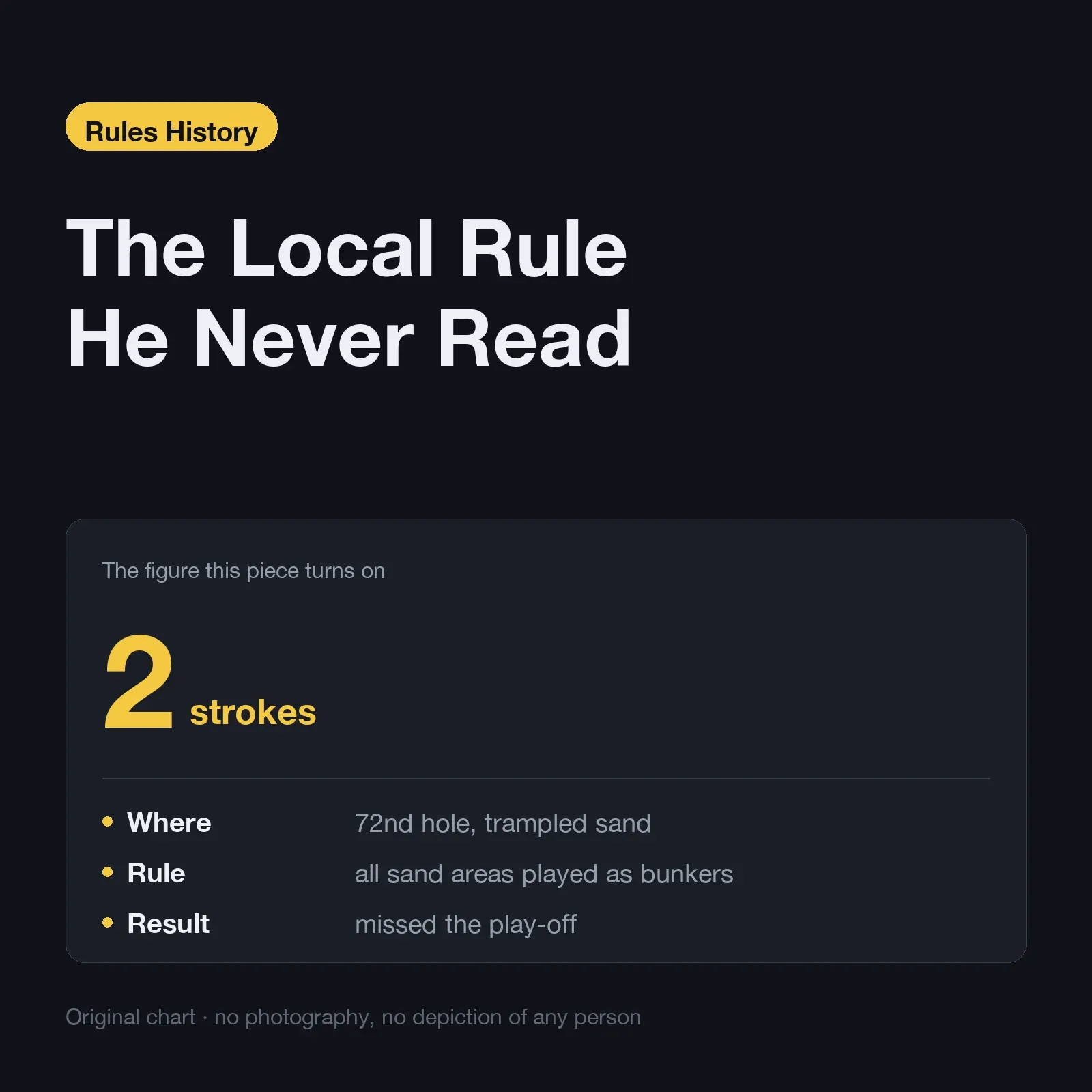
Whistling Straits has roughly 1,000 bunkers, many of them well outside the corridors of play. Before the championship started, the PGA of America issued a local rule and gave it to every player.
| Step | What happened | Why it mattered |
|---|---|---|
| Before the round | Local rule distributed: all designed sand bunkers play as bunkers, “whether or not they have been raked” | Made trampled, footprint-covered sand areas outside the ropes into hazards under the rules |
| 18th hole, second shot | Johnson’s ball is in a sandy area to the right of the fairway, flattened by the gallery | The area is a designed bunker under the local rule, regardless of its condition |
| Address | Johnson grounds his club before playing the shot | Grounding a club in a hazard was a two-stroke penalty under the rules then in force |
| After the round | Rules officials review the video and assess two strokes | His score moves from 12-under to 9-under |
2. The rule was not new — reading it was the missing step
Nothing about the underlying rule changed for the 2010 PGA Championship. Grounding a club in a hazard had been a two-stroke penalty for decades. What was specific to Whistling Straits was the local rule broadening the definition of “bunker” to include areas that no longer looked like one after a week of foot traffic.
The rule sheet was posted in the locker room and, by multiple accounts, handed directly to players. Johnson has said he did not know the sandy area counted as a bunker. The rule did not require him to guess — it told him in advance, in a document he was given and did not read closely enough to apply on the 72nd hole.
That is the axis of this case. It is not a bad bunker shot, and not an official inventing a technicality. It is a printed local rule, distributed before play began, that one player did not carry into the moment he needed it.
3. What Johnson intended
Johnson has said publicly that he believed he was standing on a trampled piece of ground, not in a hazard — “a piece of dirt that the crowd had trampled down,” in his own description after the round. Nothing in the record suggests he tried to gain an advantage by grounding the club; a two-stroke penalty for grounding a club in a scruffy patch of sand off the fairway gained him nothing worth risking. The violation was a failure to apply a rule he had been given, not an attempt to bend one.
4. What it cost
The two-stroke penalty moved Johnson from a share of the lead to a tie for fifth place, two shots outside the playoff between Martin Kaymer and Bubba Watson. Kaymer won that playoff. Johnson’s final-round 73 became a 75 once the penalty was applied to his card.
5. The definition of a bunker changed later — the sequence, not the cause
| When | What changed |
|---|---|
| August 2010 | Johnson penalized two strokes for grounding his club in a local-rule bunker at Whistling Straits |
| 2019 | New Rules of Golf take effect; Rule 12.2b generally permits touching the sand with a hand or club in a bunker, removing the blanket “no grounding the club” prohibition |
We have not verified that Johnson’s penalty was a cause of the 2019 change. The USGA’s stated rationale for Rule 12.2b was that bunker play should be about escaping sand, not about avoiding incidental contact or loose debris — a rationale that is broader than any single incident. The sequence is on the record; the causation is not something we checked.
This case sits apart from the rest of the series. The others turn on a card signed before anyone knew there was a penalty — Stadler in 1987, Wie in 2005, Harrington in 2011. Johnson signed nothing wrong. He was told the penalty on the spot, and it still cost him a major, because the rule he broke was one he had been handed in writing and had not read.
6. What is confirmed and what is not
Confirmed — the existence and wording of the local rule (“All areas of the course that were designed and built as sand bunkers will be played as bunkers (hazards)”), that it applied regardless of raking, the two-stroke penalty, Johnson’s finish tied for fifth, two shots outside the playoff, Kaymer’s playoff win over Watson, and the 2019 change to Rule 12.2b permitting hand or club contact with bunker sand.
Not confirmed here — the precise number of players who, like Johnson, said afterward they were unaware the area was a bunker. Some contemporary accounts describe player confusion as widespread; we did not find a documented count of how many players raised the same objection. We also did not verify Johnson’s exact final-round score card hole by hole beyond the totals reported.
In one line
A local rule handed to every player in writing turned a footprint-covered patch of sand into a bunker — and cost Dustin Johnson two strokes and a playoff spot he never got to play for.
Sources
- ESPN’s report on the penalty — the local rule text, the two-stroke penalty for grounding the club, Johnson’s score dropping from 12-under to 9-under, his tie for fifth two shots out of the playoff, Martin Kaymer’s playoff win over Bubba Watson, and Johnson’s quote that he never thought he was in a bunker.
- Golf.com’s summary of the 2019 bunker rule change — the shift from a blanket “no grounding the club, no touching the sand” rule to one generally permitting a player to touch sand with a hand or club, effective 1 January 2019.
Both pages were opened and read on 30 August 2026.