🔴 Correction, 30 August 2026. This post originally listed Opus SP+‘s face material as “1025 forged steel,” the same as Opus SP. That’s wrong. Callaway’s official Opus SP+ announcement (https://www.callawaygolf.com/press/callaway-golf-introduces-opus-sp-plus-wedges) describes the re-engineered 3-piece construction as “Tungsten, MIM Face, Cast 8620 Body” — the face is metal-injection-molded (MIM), not forged 1025 steel. The 1025-forged-face figure applies only to Opus SP (the two-piece predecessor). The comparison table and body text below have been corrected.
Callaway’s Opus SP+ was announced as the current wedge in its line. The name is easy to confuse with the similarly named Opus SP (the prior generation), and it turns out the confusion runs deeper than the name: the two are built differently. Opus SP is a two-piece construction; the generation before that was the 2024 Opus.
This piece keeps two things separate: the structural difference between SP and SP+, and what we could and couldn’t confirm about SP+‘s own spec table.
1. SP is two-piece; SP+ is a three-piece with tungsten
| Opus SP | Opus SP+ | |
|---|---|---|
| Pieces | Two | Three |
| Face | 1025 forged steel | MIM (metal-injection-molded) Face |
| Body | 8620 cast steel | 8620 cast steel + tungsten weight |
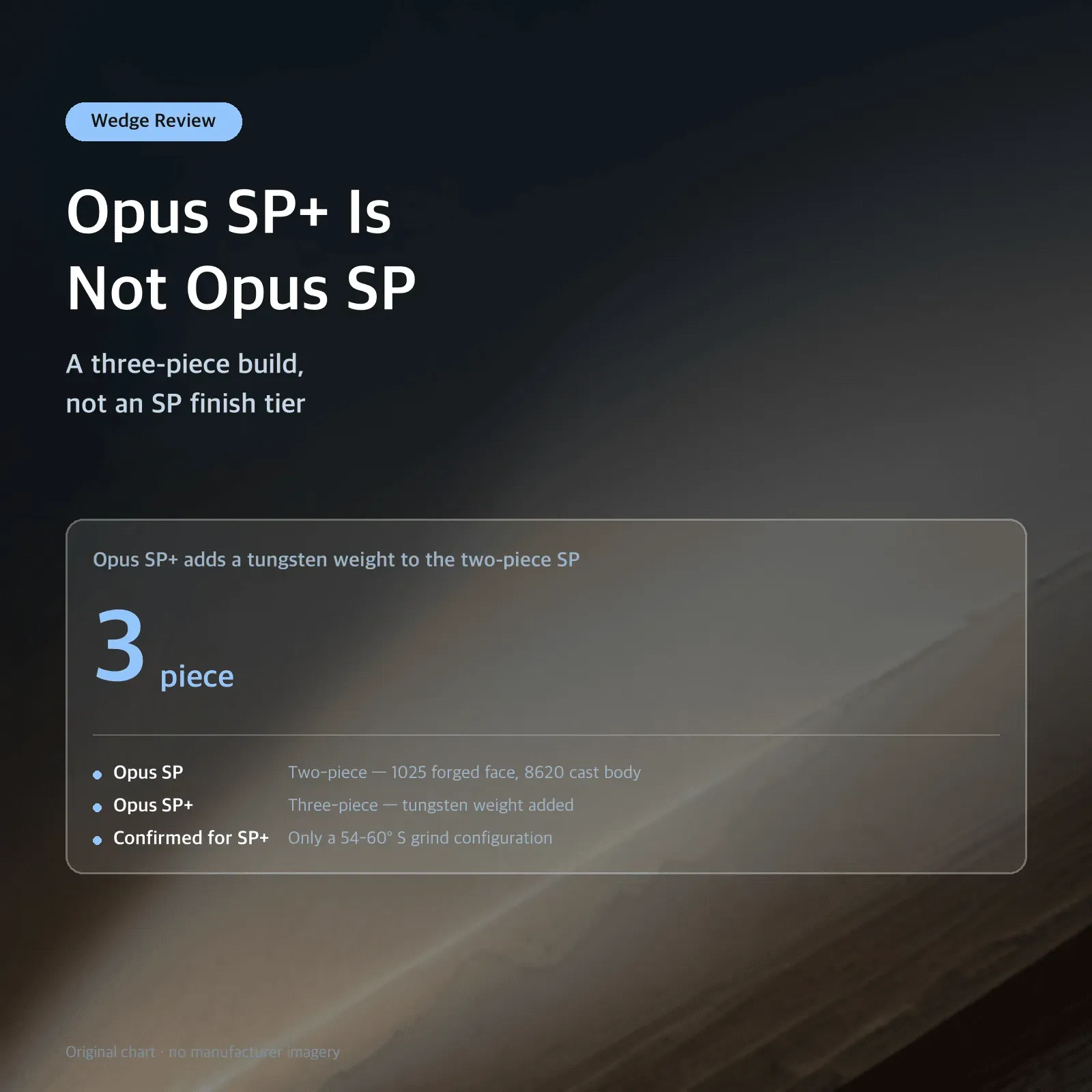
Two Different Constructions — the name suggests a finish tier, but Callaway’s own announcement describes SP+ as a materially different product, not a finish variant of SP. SP+‘s face is MIM (metal-injection-molded), not the forged steel face used on SP.
Opus SP is a two-piece construction: a 1025 forged face on an 8620 cast body. Opus SP+ is a three-piece construction with a MIM (metal-injection-molded) face, tungsten weighting, and an 8620 cast steel body — per Callaway’s own official announcement wording: “Tungsten, MIM Face, Cast 8620 Body.”
The naming makes SP+ look like a premium finish tier of SP, but the official announcement describes it as a materially different product — a tungsten weighting element added to what was previously just a face and body. It would be easy to assume SP and SP+ are the same head in different finishes; the official materials describe them as distinct products with different construction.
Name confusion like this isn’t unique to Opus SP+. Other current wedge lines carry similarly overlapping names across brands, and Callaway’s own lineup shows it can happen within one brand too. The practical lesson is the same either way: confirm the full, exact product name before buying, not just the family name.
2. The spec table we confirmed belongs to Opus SP, not SP+
| Spec | Opus SP (Chrome) | Opus SP+ (confirmed) |
|---|---|---|
| Loft range | 48-60° | 54-60° |
| Bounce | 6°, 8°, 10°, 12°, 14° | 10° (S grind only) |
| Lie angle | 64.0°, flat | 64° |
| Length | 35.75-35.00in | 35.25-35.00in |
| Swingweight | D3 or D5, by shaft | D5 (steel) / D0 (graphite) |
The Confirmed Spec Table Belongs to SP, Not SP+ — the two loft ranges don’t fully overlap; using the SP table as a stand-in for SP+ buying decisions risks errors on that basis alone.
The full spec table we could confirm belongs to Opus SP (Chrome finish): lofts 48° through 60°, bounce options of 6°, 8°, 10°, 12°, and 14°, lie angle flat at 64.0° across all lofts, length from 35.75 inches at 48° down to 35 inches at 58–60°, and swingweight of D3 or D5 depending on shaft. Material is listed as a 1025 forged face on an 8620 cast body.
This is worth stating plainly: that table describes Opus SP, not Opus SP+. We could not obtain a full spec table for SP+ itself in this research.
If a source presents one table covering both products, check which one it’s actually describing. We came across secondhand sources that blurred the two together; tracing them back, most turned out to cite the official SP (two-piece) table. Beyond a handful of confirmed combinations, we found no separately published SP+ numbers.
3. Five grinds are official; the loft range we could confirm covers only one
Checking the official spec table directly, the Opus line’s grind lineup is five codes: T, C, S, X, and W. Some secondhand sources describe a three-grind lineup instead — that doesn’t match what we found on the official table.
The specific configuration we could confirm as available consists of four lofts — 54°, 56°, 58°, 60° — with a single grind, S (10° bounce). Lie angle is 64°, swingweight D5. That’s one grind out of the five official codes.
Checking Callaway’s US official spec table directly (callawaygolf.com) filled in the piece that was missing: length runs 35.25″ at 54–56° down to 35.00″ at 58–60°, and swingweight is D5 across all four lofts on the steel-shaft build — with a graphite-shaft variant listed separately at D0. That’s a full loft/length/swingweight table for SP+ itself, not borrowed from the SP baseline.
4. Why the SP table shouldn’t be read onto SP+
Looking back at the Opus SP (Chrome) table, its loft range starts at 48°. The SP+ configuration we confirmed starts at 54°. The two ranges don’t fully overlap.
That’s more than a numbers mismatch — it suggests the two products may follow different spec structures altogether. SP is a two-piece design covering the full 48–60° range; SP+ adds tungsten and, in the configuration we found, covers only 54–60°. Because the construction differs, swingweight distribution across lofts may differ too, but we only confirmed a single D5 value for SP+, not a full range. Using the SP table as a stand-in for SP+ buying decisions risks introducing errors on that basis alone.
We were not able to confirm current pricing for Opus SP, nor whether SP and SP+ are sold in parallel or whether SP has been fully discontinued in favor of SP+. When asking about either product, it’s worth specifying “Opus SP” versus “Opus SP+” explicitly to avoid confusion.
5. Who this fits
Based on the confirmed specs. This does not substitute for an actual fitting.
- Golfers who need the 54–60° range with a standard S grind (10° bounce) setup — that’s exactly the confirmed SP+ configuration.
- Golfers interested in the added tungsten weighting of the three-piece build — though what we confirmed here is limited to the construction description and one configuration.
May not fit:
- Golfers who want the T, C, X, or W grinds — we could not confirm those as available for SP+.
- Golfers looking to fill 48–52° lofts with Opus SP+ — the configuration we confirmed starts at 54°.
6. What we could not confirm
| Item | Status |
|---|---|
| SP+ three-piece weight distribution detail | Not confirmed |
| Whether T, C, X, W grinds will be offered for SP+ | Not confirmed |
| Opus SP current market pricing | Not confirmed |
| Manufacturer distance/spin claims | Unverifiable, not cited |
What Could Not Be Confirmed — five grind codes are official for the Opus line (T, C, S, X, W), but only S grind is confirmed for SP+.
- The detailed weight distribution of SP+‘s three-piece tungsten construction.
- Whether T, C, X, and W grinds will be offered for SP+.
- Opus SP’s current market pricing.
- The full construction lineage across Opus (2024), Opus SP, and Opus SP+ — this piece focused on comparing SP and SP+, not the earlier generation.
- Manufacturer distance/spin claims — not independently verifiable, so not cited here.
Summary
Opus SP+ shares a name with Opus SP but is a structurally different, three-piece tungsten-weighted product. The only full spec table we could confirm belongs to Opus SP; what we confirmed for SP+ itself is a single configuration — 54–60°, S grind only.
Not confusing the two products is the most important takeaway here. Don’t judge specs off the “Opus” name alone — confirm whether it’s SP or SP+ before relying on any spec table.
Every figure in this piece came from a confirmed source. Where we couldn’t confirm a value, we left it blank rather than guess.
Sources
- Callaway official announcement for Opus SP+ — describing it as a materially different product from Opus SP, with a tungsten weighting element, not a finish tier.
🔴 The spec table for SP+ was missing from official materials at time of research; the piece says so rather than borrowing SP figures.
Confirmed live on Callaway’s official Opus SP+ press release: the re-engineered 3-piece construction — “Tungsten, MIM Face, Cast 8620 Body” — versus SP’s 2-piece build. This piece originally listed SP+‘s face as “1025 forged steel”; that was wrong and has been corrected above to MIM Face per the official announcement. Items the manufacturer does not publish remain named as unconfirmed rather than estimated.