Callaway’s hybrid line has three models: Quantum Max, Quantum Max OS, and Quantum Max Fast.
The similar names might suggest similar specs, but the loft lineups themselves differ — and not just by a degree or two. Two of the three models offer a 3-hybrid; the third doesn’t carry one at all.
Saying “Quantum Max 3-hybrid” alone doesn’t tell you which model, or which loft, you’re talking about.
🔴 Correction, 30 August 2026. This piece originally said the Quantum Max Fast has no 3-hybrid and starts at 4H, 22°. That is wrong. Callaway’s current spec sheet for the Max Fast lists a 3H at 20°. Every other loft in this piece was checked against Callaway’s own pages and is correct. Whether the 3H was absent from the sheet we first read or we misread it, we cannot now establish — either way the claim should not have run. The piece below has been rewritten around what the spec sheets actually say. The header card that carried the wrong claim has been removed.
1. Three models, three starting lofts
| Model | Lowest hybrid |
|---|---|
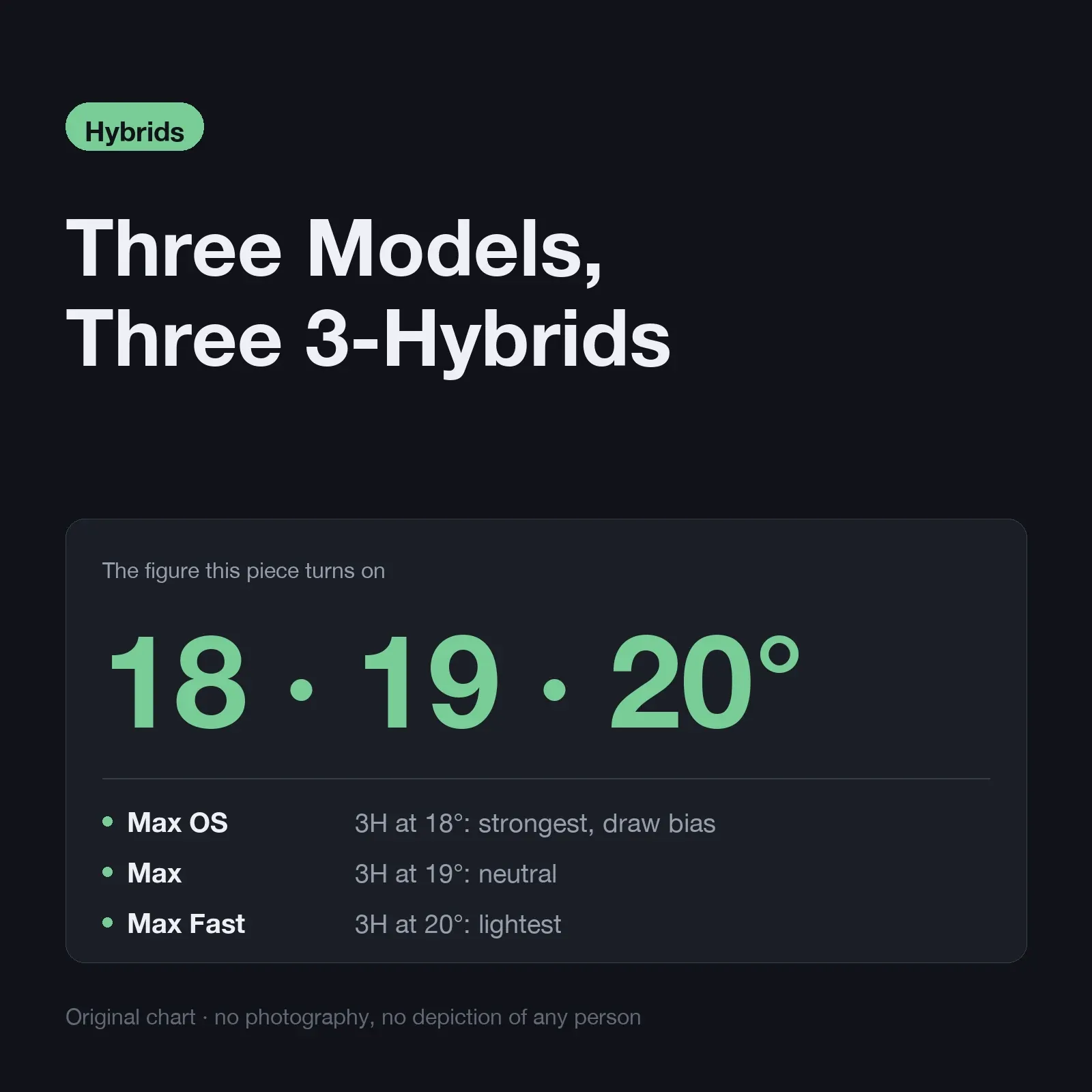
| Quantum Max OS | 3H, 18° |
| Quantum Max | 3H, 19° |
| Quantum Max Fast | 3H, 20° |
Three starting lofts, two degrees apart end to end — the same club number means something different in each model.
The lowest-numbered hybrid in each line, per Callaway’s official spec sheet:
- Quantum Max OS — 3H, 18°
- Quantum Max — 3H, 19°
- Quantum Max Fast — 3H, 20°
All three start at a 3-hybrid, and no two start at the same loft. The spread is two degrees from the strongest (OS) to the weakest (Fast), and it holds the whole way up: at every club number, OS is the strongest and Fast the weakest, with the standard Max in between.
Callaway does not explain the offset directly. What the spec sheets alone support: OS is the largest-headed, most forgiving model, Fast the lightest and aimed at slower swing speeds, and the loft ladders are pitched accordingly — a Fast 3H at 20° sits exactly where the standard Max’s 4H (21°) nearly lands.
If you’re comparing “3-hybrids” across these three models, only two of them actually have one to compare.
2. What separates the three models
Callaway’s own description of the three:
- Quantum Max — the neutral all-rounder. Mid-size head, neutral center of gravity, a moderate face height.
- Quantum Max OS — oversized with a draw bias. Built for maximum forgiveness.
- Quantum Max Fast — the lightest of the three. Lightweight components aimed at speed and forgiveness, built for slower swing speeds.
This is a different approach from PING, which separates shot bias by loft number within a single model. Callaway separates it by model itself.
That changes the order in which you choose. With PING, picking a loft number brings a shot bias along with it. With Callaway, you pick the model first, then the loft number within it.
3. The full loft range — up to an 8-hybrid
| Model | Loft lineup |
|---|---|
| Quantum Max | 3H 19 / 4H 21 / 5H 24 / 6H 27 / 7H 30 / 8H 33° |
| Quantum Max OS | 3H 18 / 4H 20 / 5H 23 / 6H 26 / 7H 29 / 8H 32° |
| Quantum Max Fast | 3H 20 / 4H 22 / 5H 25 / 6H 28 / 7H 31 / 8H 34° |
The Full Loft Range - Up to an 8-Hybrid — all three lines top out in the low-to-mid 30s. Standard Max gaps run 19→21→24→27→30→33 — 2° steps low, 3° steps high, same widening pattern as Ping.
The three lines, in full:
- Quantum Max — 3H 19° · 4H 21° · 5H 24° · 6H 27° · 7H 30° · 8H 33°
- Quantum Max OS — 3H 18° · 4H 20° · 5H 23° · 6H 26° · 7H 29° · 8H 32°
- Quantum Max Fast — 3H 20° · 4H 22° · 5H 25° · 6H 28° · 7H 31° · 8H 34°
All three lines reach an 8-hybrid, and all three top out in the low-to-mid 30s — 32° to 34° — which sits roughly where a 7-iron would be.
That range is nearly identical to PING’s (17° to 34°). Titleist’s line, by contrast, stops at 24°. Callaway and PING both reach into the middle of an iron set; Titleist stops around the long-iron range.
Looking at the standard Quantum Max gaps: 19 → 21 → 24 → 27 → 30 → 33°. The lower gaps run 2°, the upper gaps run 3°. Same as PING’s pattern (3° then 4°), this is a structure that widens toward the higher lofts.
4. OptiFit4 — seven shot-shape combinations
| System | Range | Settings |
|---|---|---|
| Ping | ±1.5° | One range only |
| TaylorMade | 3° sleeve | One range only |
| Callaway OptiFit4 | 3° (loft + lie together) | 7 shot-shape settings |
Adjustment Range vs. Number of Settings — same magnitude of movement, different combination counts. A wider set of options raises the odds of finding the right one, but also means more to test.
The adjustment mechanism is the OptiFit4 hosel. It adjusts loft and lie together and is described as offering seven shot-shape settings.
The adjustment range itself is 3° — the same magnitude as TaylorMade’s 3° sleeve and PING’s ±1.5°. What differs is the number of combinations available.
Since it adjusts loft in combination with lie rather than loft alone, it presents seven distinct settings, which raises the odds of finding the right one. It also means more combinations to test through.
A wider set of adjustment options is an advantage, but it also means it’s harder to dial in alone. If you’re planning a professional fitting, this works in your favor; if you’re planning to buy and use it as-is, getting the initial spec right matters more.
5. Head technology
Callaway’s stated construction is called Speed Wave 2.0.
A tungsten weight is placed low and forward inside the head, described as raising ball speed and launch consistency. Low-and-forward weighting tends to reduce spin and stabilize trajectory.
The face is also engineered to flex more, increasing energy transfer — with the biggest effect described as occurring on low-face strikes. Since a hybrid is a club typically struck close to the turf, low-face contact is common, and this is the strike point the design targets.
6. So how do you choose
Pick the model first, the loft number second. That’s the order this brand is built around.
- No particular issue to solve — Quantum Max (neutral).
- A frequent miss to the right, or forgiveness as the priority — Max OS (draw bias).
- Slower swing speed with trouble getting the ball airborne — Max Fast (ultra-lightweight).
Once the model is set, check which loft its 3H actually is. All three offer one, but at 18° (OS), 19° (Max) and 20° (Fast). If you need a specific number rather than a specific club label, the model you pick moves it by up to two degrees.
If you miss left frequently, avoid OS. Its draw bias overlaps with that miss.
Remember the range runs up to 8H. If a 6- or 7-iron isn’t holding the green for you, 7H or 8H can take its place. Not many brands offer that option.
7. Who this club fits
These are inferences drawn from the confirmed specifications, not a ranking.
- A golfer looking to replace mid-irons with hybrids — the range runs up to 8H at 33°, well past Titleist’s 24° ceiling.
- A golfer planning a professional fitting — OptiFit4’s seven shot-shape settings widen the odds of finding the right setup.
- A golfer with a slower swing speed — Max Fast pairs an ultra-lightweight build with an extra degree of loft.
- A golfer who tends to strike low on the face — Speed Wave 2.0 is described as targeting that exact contact point.
Cases where the fit runs the other way:
- A golfer who misses left frequently — Max OS carries a draw bias.
- A golfer buying based on model name alone, expecting every “Quantum Max” line to offer a 3H — OS and standard Max do, at 18° and 19°; Fast doesn’t, starting instead at 4H, 22°.
- A golfer with no intention of testing the adjustment settings themselves — finding the right one among seven options requires trial.
8. What could not be confirmed
- Why the three ladders are offset from each other — Callaway’s spec sheets list the lofts but do not explain the design reasoning.
- Length, lie angle, and swingweight — not confirmed.
- Head volume — only described qualitatively as “oversized” or “mid-size,” with no figure given.
- The weight of the tungsten weight — its position is described, but not its mass.
- The specific combinations within the seven shot-shape settings — not confirmed.
Summary
Callaway’s hybrid line is built to be chosen model first, loft number second — a direct result of the three models running different loft lineups, down to which ones even offer a 3-hybrid at all.
It’s also one of the few brands offering an 8-hybrid across all three lines, topping out in the low-to-mid 30s. If you’re considering replacing mid-irons with a hybrid, this line is worth putting on the shortlist.
The loft figures and technology descriptions in this piece are drawn only from Callaway’s official specifications. Where a figure could not be confirmed, it has been left blank rather than estimated.
Sources
- Callaway Quantum Max hybrid specifications — 3H 19° through 8H 33°.
- Callaway Quantum Max OS hybrid specifications — 3H 18° through 8H 32°.
- Callaway Quantum Max Fast hybrid specifications — 3H 20° through 8H 34°.
All three pages were opened on 30 August 2026 and every loft in this piece was read off them directly. They are also what established that this piece’s original claim — that the Max Fast has no 3H — was wrong; the correction at the top of the page records that. Items the manufacturer does not publish are named as unconfirmed rather than estimated.