Callaway drivers also start with checking the generation. The 2025 Elyte still turns up often in searches, but as of 2026, Callaway’s current driver is the Quantum, the Elyte’s successor. All models share a new face technology called Tri-Force Face.
Quantum spans five models. The names look similar and are easy to confuse, but underneath there’s a split between “models with a movable weight” and “models with a fixed build.”
1. The five Quantum models
| Model | Positioning |
|---|---|
| Max | Standard forgiving build, 10g neutral/draw weight |
| Max D | Fixed internal heel weight, dedicated slice correction |
| Max Fast | Moderate swing speed, 360-degree carbon chassis |
| Triple Diamond | Tour-oriented at 450cc, 10g neutral/fade weight |
| Triple Diamond Max | A more forgiving variant of Triple Diamond |
The Five Quantum Models — Callaway’s 2026 successor to the Elyte, all sharing Tri-Force Face. Max D’s “D” reads like a Max setting, but it is a separate head built with a draw bias from the start.
- Max — the standard forgiving build, with a 10g weight for neutral/draw adjustment
- Max D — dedicated slice correction, with a fixed internal heel weight built for a draw bias
- Max Fast — built for moderate swing speed, with a 360° carbon chassis
- Triple Diamond — tour-oriented at 450cc, with a 10g weight for neutral/fade adjustment
- Triple Diamond Max — a more forgiving variant of the Triple Diamond
Max D is worth a closer look. The “D” in the name makes it sound like one of Max’s adjustment settings, but Callaway’s own description calls it “an internal heel weight, a fixed draw bias for reducing slice.” Unlike Max’s 10g movable weight, Max D is a separate head built with a draw bias from the start. Similar name, different structure.
2. Cross-referenced spec table
| Model | Weight system | OptiFit hosel |
|---|---|---|
| Max | 10g movable, neutral/draw | Eight configurations |
| Max D | Fixed heel weight, draw bias | Eight configurations |
| Max Fast | None - 360-degree carbon chassis | Eight configurations |
| Triple Diamond | 10g movable, neutral/fade | Eight configurations |
| Triple Diamond Max | Not confirmed | Eight configurations |
Weight System vs. Hosel Adjustment — loft and lie adjustment is identical across the line; only the movable-weight presence differs by model.
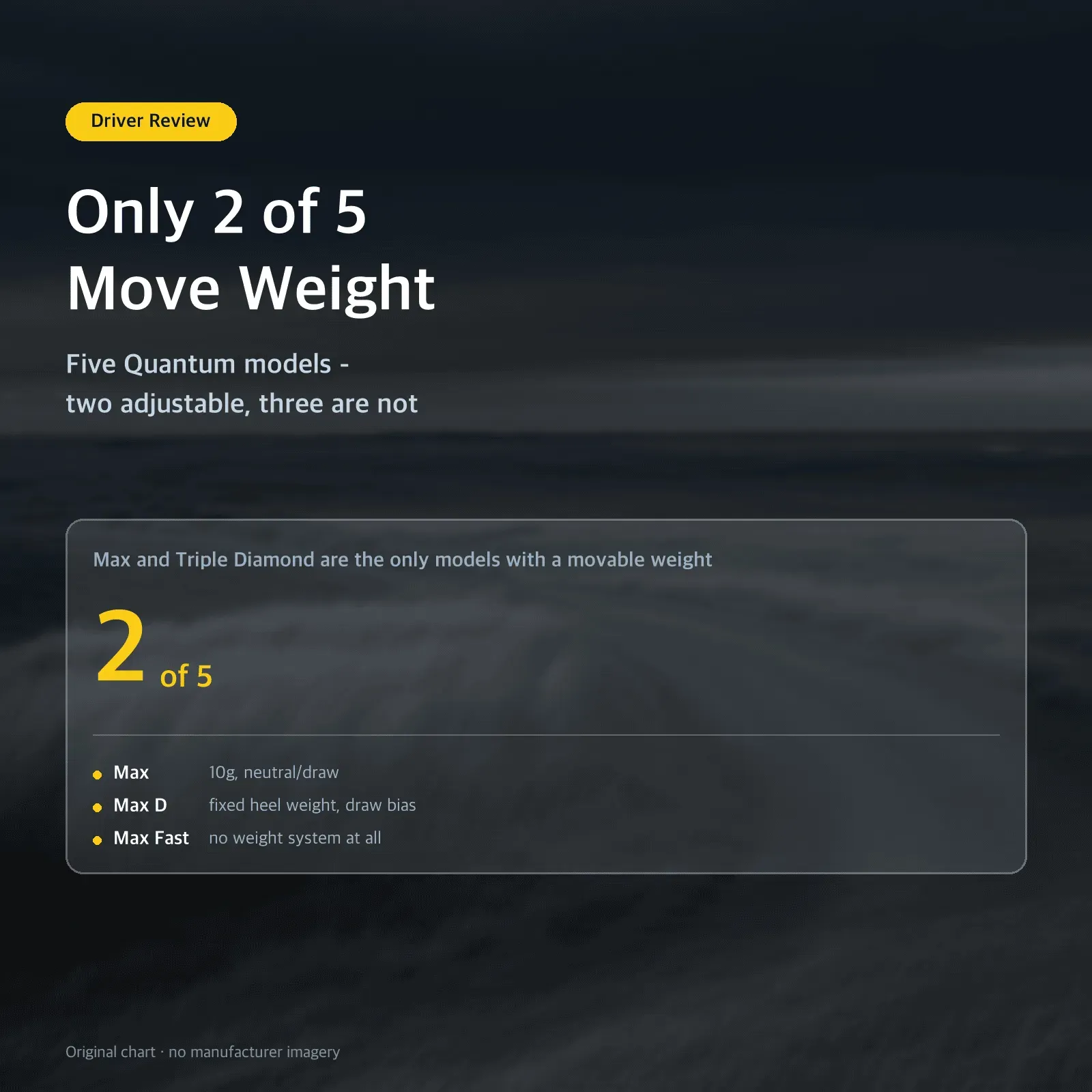
Of the five models, only two — Max and Triple Diamond — carry a movable weight (adjustable by gram position). Max D uses a fixed weight, and Max Fast has no weight system at all, relying instead on a 360° carbon chassis to cut weight and build forgiveness that way.
Hosel adjustability (OptiFit, eight configurations) is common to all five models. So loft and lie adjustment is identical across the entire line — the only thing that differs by model is whether the center of gravity itself can move.
3. Triple Diamond Max: almost nothing confirmed
The Triple Diamond Max column in the cross-reference table is mostly blank. Loft options, head volume, and standard length were all unconfirmed on the official page at time of research.
Callaway’s own marketing copy describes it as “a more forgiving variant of the Triple Diamond,” but exactly what numerical change (larger volume, redistributed weight) delivers that forgiveness doesn’t show up within the materials checked. Left blank rather than filled by guesswork.
4. Hosel adjustment is identical across all five
Weight-adjustment method differs by model, but the OptiFit hosel’s eight configurations are identical across all five — Max, Max D, Max Fast, Triple Diamond, and Triple Diamond Max. So loft and lie adjustment range is the same no matter which model you buy; model choice only matters if you care about adjusting the center of gravity (draw, fade, forgiveness).
This structure contrasts with PING’s G440 line, where weight-adjustment hardware is present or absent depending on the sub-model. Callaway keeps hosel adjustment universal across the line and draws its distinctions through weight-adjustment presence instead. Even brands solving the same “forgiveness vs. control” split make different choices about which adjustment axis to standardize and which to differentiate.
5. All five on one spectrum
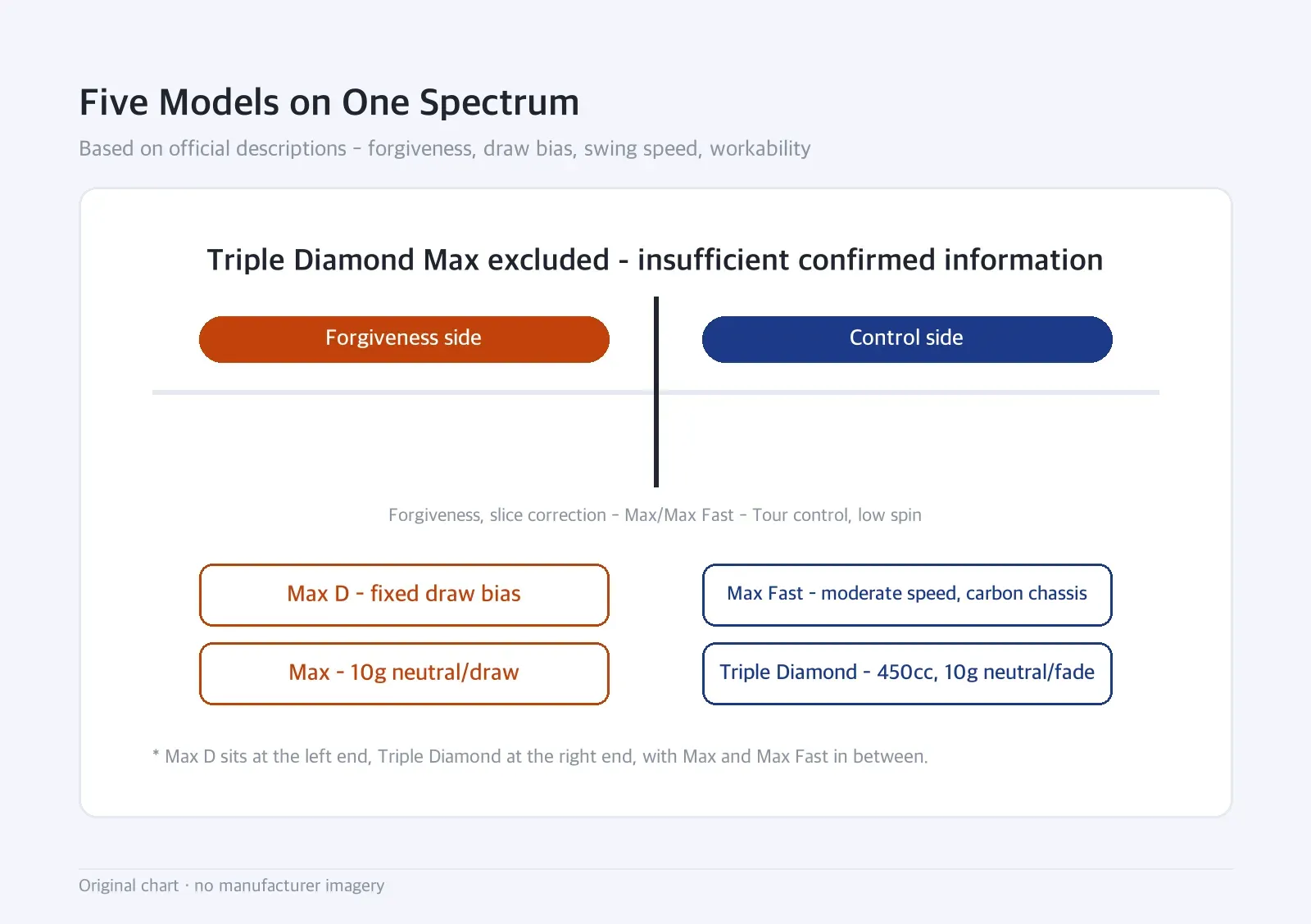
Based on official descriptions (forgiveness, draw bias, swing speed, workability), here’s a relative placement. Left is forgiveness and slice correction, right is tour control and low spin.
Max D sits at the left end, Triple Diamond at the right end, with Max and Max Fast in between. Triple Diamond Max is excluded from this placement due to insufficient confirmed information.
6. Who this driver fits
Judgment criteria inferred from confirmed specs.
- Golfers who want to move the center of gravity themselves to shape ball flight — Max (10g, neutral/draw) and Triple Diamond (10g, neutral/fade) are the two models with a movable weight.
- Golfers with a chronic slice who want a fixed draw-biased build — Max D locks in a draw bias via an internal heel weight. Know going in that it isn’t adjustable.
- Golfers who want a compact, tour-oriented head — Triple Diamond is the smallest of the five at 450cc.
This is less useful for:
- Golfers trying to distinguish the five models by loft/lie adjustment range — the eight OptiFit configurations are identical across all five; the only real differentiator is whether the weight moves.
- Golfers wanting Triple Diamond Max’s exact specs (loft, volume, length) to compare against the other models — mostly unconfirmed on the official page at time of research.
7. What we could not confirm
- Triple Diamond Max’s loft, head volume, and length — not confirmed on the official page at time of research.
- Swing weight common to all five models — no listing found.
- Lie angle — only Max’s figure (57.0°) is published; the other four could not be confirmed.
- The exact degree values of OptiFit’s eight configurations — only the count (“eight configurations”) was confirmed, not the individual angle values.
- Measured distance and shot-shape variance — omitted, since these vary by tester and conditions.
In one line
Of the five Quantum models, only Max and Triple Diamond let you move the weight yourself. Max D is a fixed draw build from the outset, and Max Fast doesn’t use a movable-weight system at all. If you’re looking for an “adjustable driver,” that distinction matters more than the name.
Tables and charts in this piece were built from scratch, and all figures come from Callaway’s official spec pages for the current Quantum generation. Where a value could not be confirmed, it was left blank.
Sources
- Callaway official product descriptions for all five Quantum models — forgiveness, draw bias, swing speed and workability, used for the relative placement.
🔴 Unconfirmed on the official page at time of research: loft options, head volume and standard length. The spectrum here is built from descriptions, not from numbers.
Confirmed live on Callaway’s official Quantum driver pages: 460cc for MAX/Max D/Max Fast, 450cc for Triple Diamond, Max’s 10g neutral/draw weight and 57.0° lie, the eight-configuration OptiFit hosel, Max D’s fixed draw-bias weighting, and Max Fast’s 360° carbon chassis with no movable weight. Triple Diamond Max remains unconfirmed, consistent with this piece. Items the manufacturer does not publish remain named as unconfirmed rather than estimated.