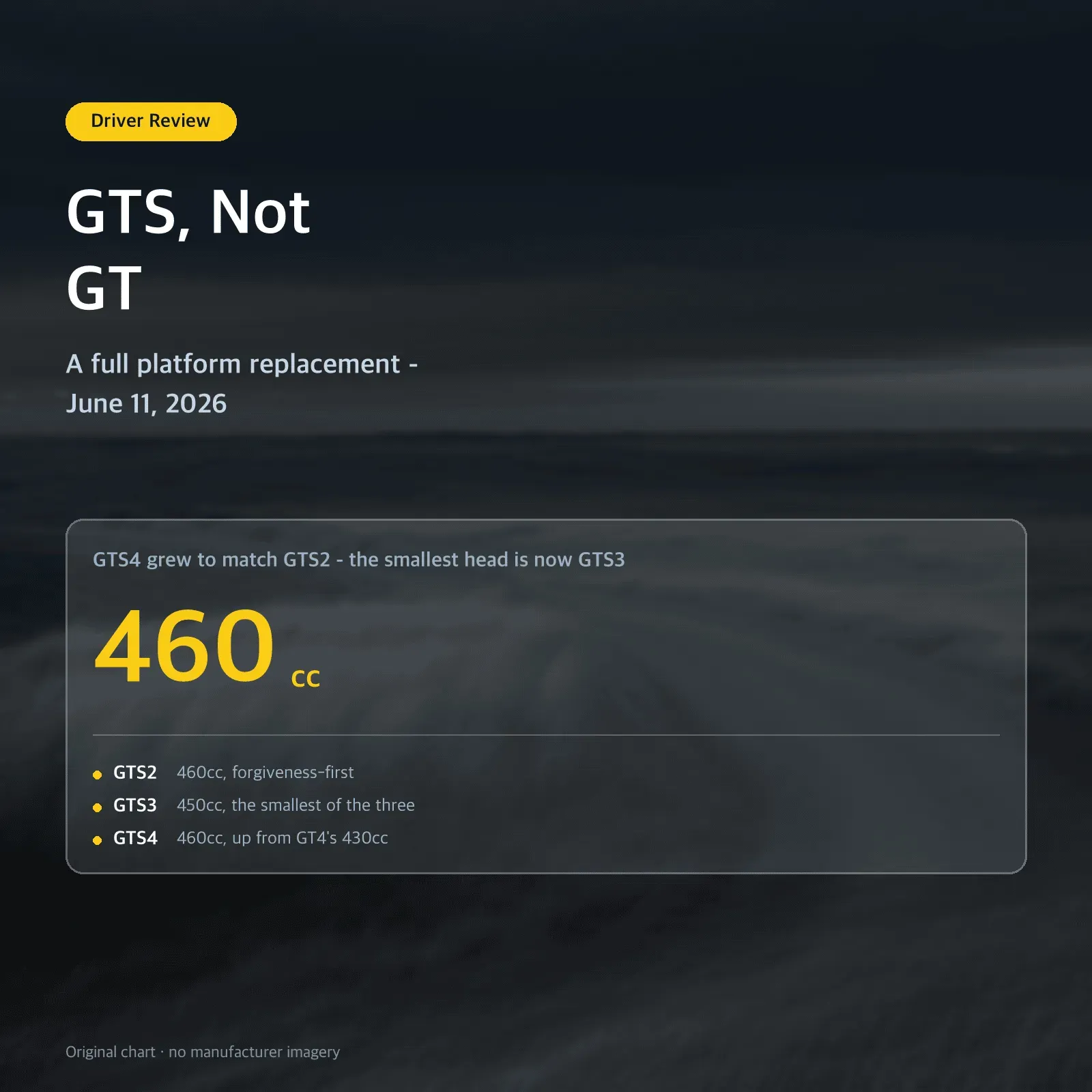
Search around for Titleist drivers and GT2, GT3, and GT4 still come up constantly. But Titleist fully replaced the GT line with GTS on June 11, 2026. The company describes this as the largest driver-platform overhaul since the move from TSR to GT.
So this piece starts from the official GTS2, GTS3, and GTS4 specs — not GT.
1. GT4 is gone, and GTS4 got bigger
| Model | Positioning | Head volume |
|---|---|---|
| GTS2 | Maximum forgiveness | 460cc |
| GTS3 | Precise adjustability | 450cc |
| GTS4 | Low spin | 460cc (was 430cc as GT4) |
GT4 Is Gone, and GTS4 Got Bigger — Titleist replaced the entire GT line with GTS on June 11, 2026. The old rule “the low-spin model is always the smallest” does not hold in this generation.
The character of the three GTS models maps roughly onto the previous GT naming.
- GTS2 — built for maximum forgiveness
- GTS3 — built for precise adjustability
- GTS4 — built for low spin
But there’s a notable shift in head volume. The previous GT4, at 430cc, was the smallest head among the three low-spin/compact models. The GTS4 comes in at 460cc — the same size as GTS2. The smallest head in the new generation is instead the GTS3, at 450cc.
In other words, the old rule that “the low-spin model is always the smallest” doesn’t hold in this generation. Assuming the old pattern carries forward without checking gets it wrong.
2. Cross-referenced spec table
| Model | Weight system | SureFit CG track | Standard length |
|---|---|---|---|
| GTS2 | 11g / 5g dual weight | No | 45.5 in |
| GTS3 | 8g sliding weight | Yes | 45.5 in |
| GTS4 | 8g sliding weight | Yes | 45.5 in |
Cross-Referenced Spec Table — GTS2 keeps adjustment simple to maximize forgiveness; GTS3 and GTS4 add a track-based system for precision and low spin.
Loft, head volume, weight system, and CG-track presence for all three models, overlaid.
The weight-adjustment structure differs by model. GTS2 uses only an 11g/5g dual-weight setup. GTS3 and GTS4 add a SureFit CG track — a sliding weight track that lets an 8g weight move fore and aft to shift the center of gravity itself.
In other words, GTS2 keeps its adjustment options simple in service of maximizing forgiveness, while GTS3 and GTS4 add a track-based adjustment system in service of precision and low spin. The forgiveness-focused model has the simpler adjustment hardware — that’s the pattern this table shows.
3. Loft options: four for GTS2 and GTS3, three for GTS4
Loft options run 8°, 9°, 10°, and 11° for GTS2 and GTS3 — four options — while GTS4 offers only 8°, 9°, and 10°. True to a low-spin build, the higher-loft option is dropped.
That said, this is only the stock loft range. The SureFit hosel’s own adjustment range (how many degrees of adjustment it allows) could not be confirmed with a specific figure in the official materials checked, so that item is left blank.
4. Standard length is 45.5 inches across all three
Weight system and head volume vary by model, but standard length is identical across GTS2, GTS3, and GTS4 at 45.5 inches. The low-spin model doesn’t shorten the shaft to add control.
A similar pattern shows up elsewhere in club design: emphasizing “control” doesn’t always mean shortening the club — brands often build that character into head volume or weight distribution instead. Titleist’s GTS line fits that pattern, drawing its character through CG-track presence and head volume rather than length.
5. All three on one spectrum
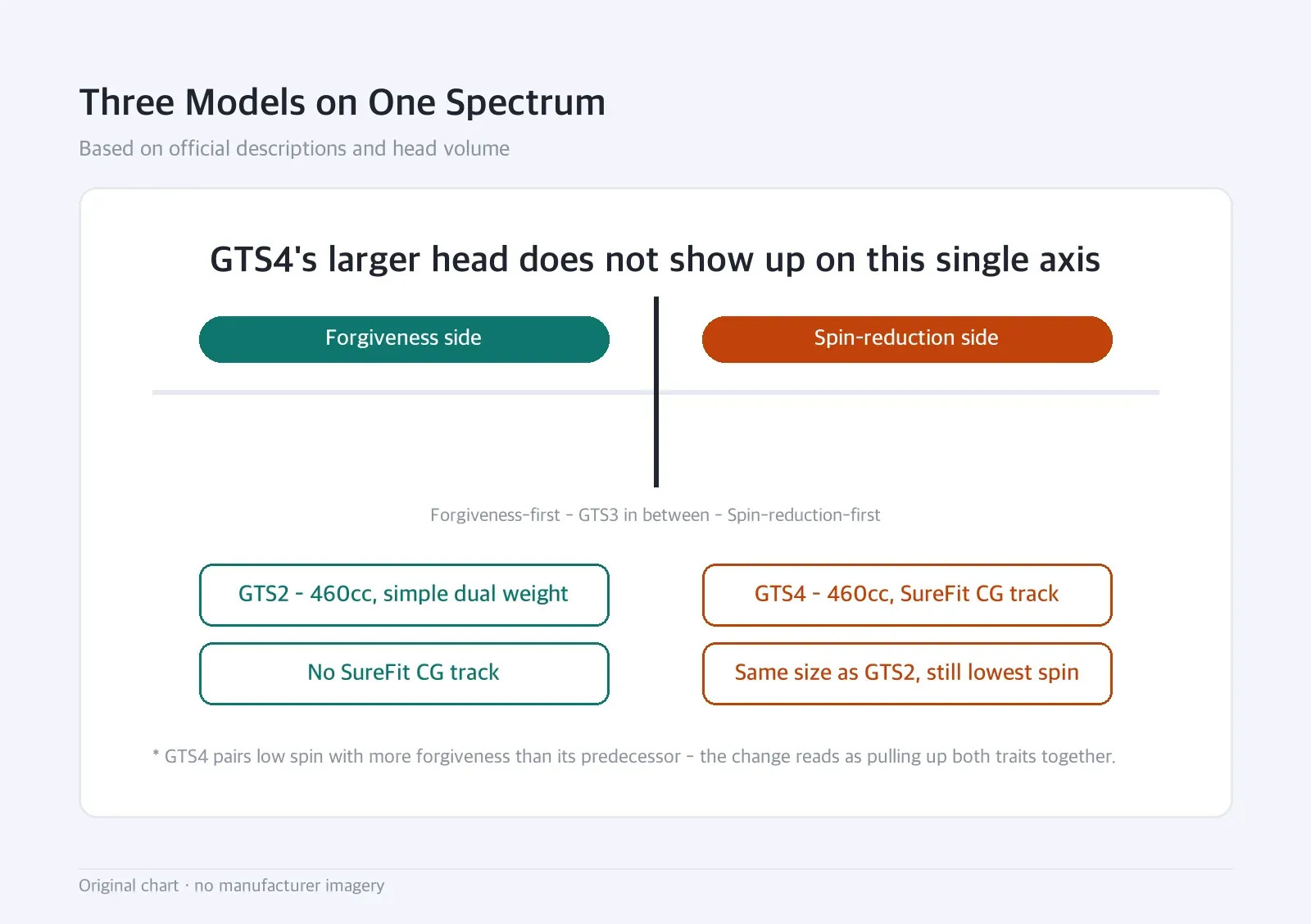
Based on official descriptions and head volume, here’s a relative placement. Left is forgiveness-first, right is spin-reduction-first.
GTS2 sits at the left, GTS4 at the right, GTS3 in between. But GTS4’s larger head compared with its predecessor doesn’t show up on this single axis — the change reads as keeping the “low spin” character while also pulling up “forgiveness” alongside it.
6. Who this driver fits
Judgment criteria inferred from confirmed specs.
- Golfers who want maximum forgiveness — GTS2 keeps adjustment simple with only an 11g + 5g dual weight at 460cc.
- Golfers who want to fine-tune center-of-gravity position directly — only GTS3 and GTS4 have the SureFit CG track, letting an 8g weight slide fore and aft.
- Golfers who want low spin without sacrificing head size — GTS4 comes in at 460cc, up from its predecessor’s 430cc, pairing low spin with more forgiveness than before.
This is less useful for:
- Golfers expecting GTS4 to have the smallest head, based on the old GT pattern — this generation’s smallest head is the GTS3, at 450cc.
- Golfers who want the SureFit hosel’s exact adjustment range in degrees — not confirmed in the official materials checked.
7. What we could not confirm
- Swing weight for all three models — no listing found in the official materials checked.
- Lie angle for all three models — likewise, not listed.
- SureFit hosel’s exact adjustment range in degrees — not confirmed.
- The exact number and spacing of SureFit CG track positions — whether the previous generation’s five-position system (H2, H1, N, T1, T2) carries over to GTS3 and GTS4 was not settled at time of research.
- Measured distance and spin — omitted, since these vary by tester and conditions.
In one line
GTS4 getting bigger than its predecessor is unusual across this kind of generational comparison — a case where the spec moved in a different direction rather than a straightforward upgrade. Judging GTS by GT-era assumptions gets this point wrong.
Tables and charts in this piece were built from scratch, and all figures come from Titleist’s official release materials for the current GTS generation. Where a value could not be confirmed, it was left blank.
Sources
- Titleist official GTS2, GTS3 and GTS4 specifications — this piece starts from GTS rather than the earlier GT.
🔴 Unconfirmed: the SureFit hosel’s own adjustment range in degrees could not be found as a specific figure in the official materials checked, so no number is given.
No archived URLs are recorded for these sources in the original research. Everything above is drawn from first-party manufacturer material; items the manufacturer does not publish are named as unconfirmed rather than estimated.