After reviewing PING, TaylorMade, Titleist, and Callaway’s current 2026 drivers one brand at a time, laying all four side by side was the obvious next step. “Which one flies furthest” is a manufacturer’s claim and can’t be verified. “Who lets you adjust what” can be checked directly from official spec sheets.
1. First — what’s being overlaid
| Brand | Model |
|---|---|
| PING | G440 Max |
| TaylorMade | Qi4D |
| Titleist | GTS2 |
| Callaway | Quantum Max |
The Four 2026 Flagships Being Overlaid — One current “forgiveness flagship” model chosen per brand. Three brands just completed a generation change: Qi35→Qi4D, GT→GTS2 (2026-06-11), Elyte→Quantum. PING’s G440 had no change here.
One current 2026 “forgiveness flagship” model was chosen from each brand.
- PING — G440 Max
- TaylorMade — Qi4D
- Titleist — GTS2
- Callaway — Quantum Max
These four were chosen not for brand recognition but because they represent “current versus previous generation.” Three brands recently completed a generation change: TaylorMade moved from Qi35 to Qi4D, Titleist from GT to GTS (as of 2026-06-11), and Callaway from Elyte to Quantum. PING’s G440 was already current, so there was no generation change within this comparison for that brand.
2. Official spec cross-table — 460cc across the board
| Model | Head volume | Movable weight |
|---|---|---|
| TaylorMade Qi4D | 460cc | 9g×2 / 4g×2, quad weight |
| Titleist GTS2 | 460cc | 11g + 5g, dual weight |
| Callaway Quantum Max | 460cc | 10g (neutral/draw) |
| PING G440 Max | 460cc | Not confirmed in this research |
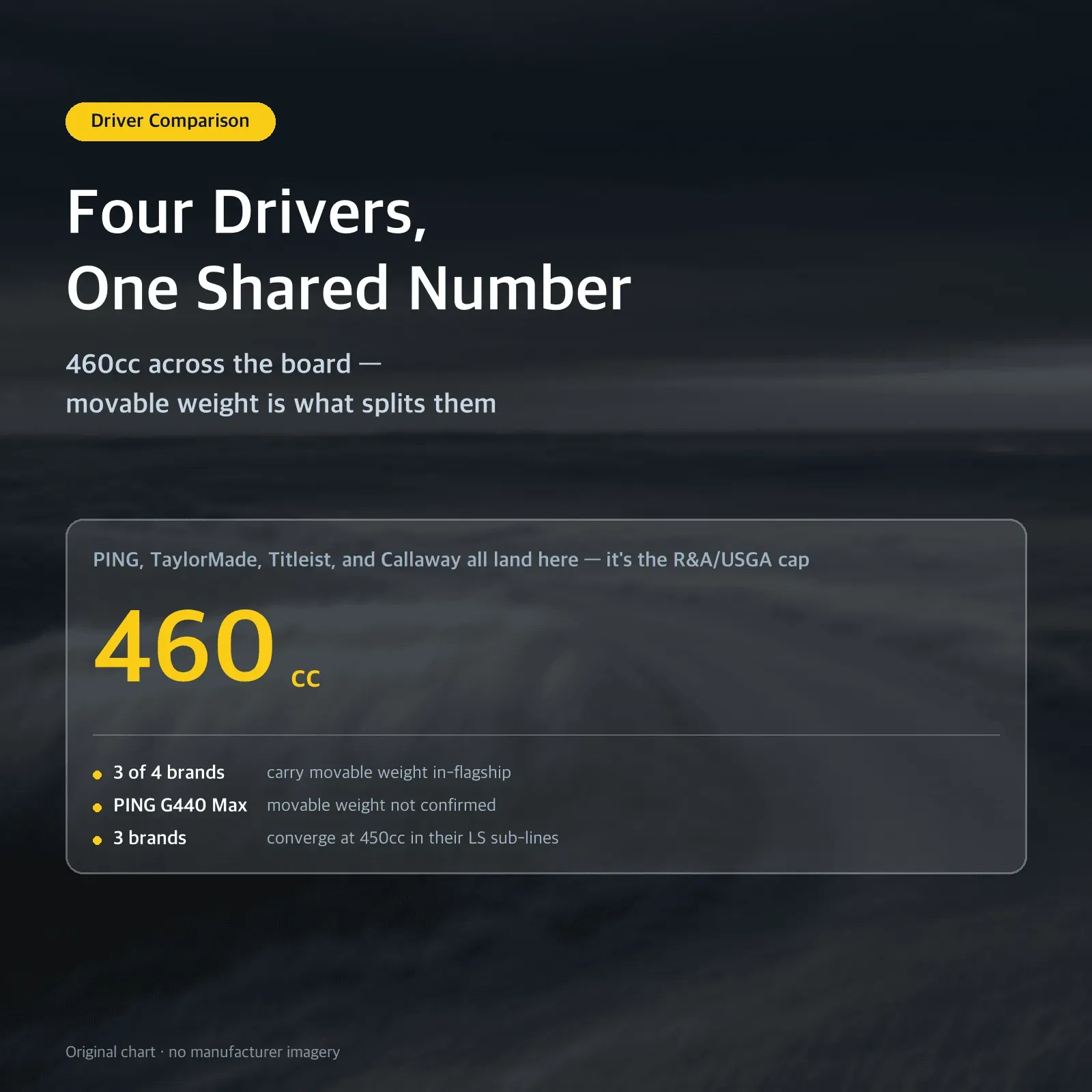
All Four Are 460cc — Movable Weight Is What Differs. Head volume is regulation-capped; movable weight is not. R&A and USGA cap driver head volume at 460cc — the identical number across all four is itself the finding.
Head volume starts identical: all four are 460cc. That’s not a differentiator — it’s a regulation. R&A and USGA cap driver head volume at 460cc, so among “forgiveness flagships,” this number can’t differ. The fact that all four land at exactly 460cc is itself the information this comparison delivers.
Where they differ is movable weight.
- TaylorMade Qi4D — 9g×2 / 4g×2, quad weight
- Titleist GTS2 — 11g + 5g dual weight
- Callaway Quantum Max — 10g (neutral/draw)
- PING G440 Max — movable weight not confirmed in this research
Three of the four put movable weight even into their “forgiveness flagship.” PING’s Max model alone carries none. PING’s adjustability sits instead in other sub-lines like K, SFT, and HL. Before overlaying the specs, it’s easy to assume “it’s a G440, of course it’s adjustable” — in practice, that depends entirely on which sub-line you’re looking at.
3. Three low-spin sub-lines converge on exactly 450cc
| Model | Head volume |
|---|---|
| PING LST | 450cc |
| Titleist GTS3 | 450cc |
| Callaway Triple Diamond | 450cc |
| TaylorMade Qi4D LS | Not listed on official page |
Three Brands’ Low-Spin Sub-Lines Converge at 450cc — Head volume of each brand’s compact, low-spin line. Trimming 10cc off the 460cc cap looks like a shared industry landing point for “low-spin compact.”
Overlaying just the head volumes of each brand’s low-spin, compact sub-line — PING LST, Titleist GTS3, Callaway Triple Diamond, and TaylorMade Qi4D LS.
PING LST, Titleist GTS3, and Callaway Triple Diamond converge exactly on 450cc — three brands. Trimming 10cc off the 460cc cap looks like a shared industry landing point for “low-spin compact.” TaylorMade Qi4D LS is the exception — its official page had no head volume listed at the time of research, so we couldn’t confirm whether it belongs in this convergence.
4. Overlaying the generation-change timing
Something else stood out while researching all four brands: how bunched their generation changes are. TaylorMade Qi4D, Titleist GTS, and Callaway Quantum all launched new in 2026, and Titleist even disclosed a specific date: June 11, 2026. PING’s G440, by contrast, was already current at the time of this research, and there was no generation change for that brand within this comparison.
That means the moment of researching drivers right now overlaps with three of the four brands having just released new models. It also means this is a period when the previous generation — GT, Elyte, Qi35 — is flooding the used market at once, which makes hunting a discounted previous-generation model a real option. That’s a question of market pricing, though, so no prices are given here.
5. Who discloses what
| Field | Disclosed by |
|---|---|
| Head volume | All four |
| Movable weight (grams) | TaylorMade, Titleist, Callaway |
| Adjustment range in degrees | PING (±1.5°), TaylorMade (4° sleeve) |
| Swingweight | PING only |
| Lie angle | Callaway only |
Who Discloses What — a Disclosure Matrix. Blanks are fields that brand simply doesn’t publish, not a research gap. Titleist and Callaway disclose the number of adjustable positions but not the exact degree range.
The disclosed items across all four flagships, laid out as a matrix.
Head volume is disclosed by all four. Movable weight in grams is undisclosed only by PING (at the flagship level). Adjustment range is stated in degrees by only PING (±1.5°) and TaylorMade (a 4° sleeve); Titleist and Callaway disclose the number of adjustable positions but not the exact degree range within the scope of this research. Only PING discloses swingweight, and only Callaway discloses lie angle.
In other words, the four brands don’t disclose the same information — what each brand puts on its spec sheet at all differs. The blanks in this table aren’t a research gap; they’re fields that brand simply doesn’t publish.
6. Who this comparison is useful for
A judgment framework drawn from the confirmed differences among the four brands.
- Golfers who want movable weight even in a “forgiveness flagship” — TaylorMade Qi4D, Titleist GTS2, and Callaway Quantum Max all carry movable weight even in their base models.
- Golfers who want adjustability specifically within PING — it’s not confirmed on the G440 Max itself, but it exists in the same lineup’s K, SFT, and HL sub-lines, covered separately.
- Golfers chasing a compact low-spin head — PING LST, Titleist GTS3, and Callaway Triple Diamond converge exactly on 450cc.
This may not fit:
- Golfers trying to separate the four brands by head volume — at the flagship level, all four are identically 460cc. That lack of differentiation is itself the conclusion of this comparison.
- Golfers trying to compare all four precisely by swingweight or lie angle — only PING discloses swingweight and only Callaway discloses lie angle, so the four can’t be lined up on those axes.
7. What we could not confirm
- PING G440 Max’s movable weight system — not confirmed on the official page.
- Swingweight for TaylorMade Qi4D, Titleist GTS2, and Callaway Quantum Max — no listing for any of the three.
- Lie angle for PING, TaylorMade, and Titleist — not confirmed.
- The exact degree range of Titleist and Callaway’s hosel adjustment — only the number of positions was confirmed; degree figures were not.
- Head volume for TaylorMade Qi4D LS — could not confirm whether it belongs in the three-brand 450cc convergence.
- Measured distance and feel — all four are manufacturer claims and unverifiable, so none are cited here.
In one line
460cc is a coincidence created by regulation. The real difference is whether weight can be moved at all, and which model has that feature. The first thing that surfaced from overlaying all four is that PING alone leaves its “forgiveness flagship” without movable weight — a different design direction from the other three brands, which build adjustable weight into their base models.
Every table and chart here was built directly, and every number comes from each brand’s official 2026 current-generation spec page. Anything we could not confirm was left blank.
Sources
- PING G440 Max Driver — official spec page — confirms 460cc head size and ±1.5° loft adjustability; live as of this check.
- Callaway Quantum Max Driver — official spec page — confirms 460cc head size, the 10g neutral/draw weight system, and 57.0° lie; live as of this check.
- The R&A — Rules of Equipment, Part 2: Conformance of Clubs — confirms the 460cc clubhead-volume cap (plus 10cc tolerance) cited as the reason all four drivers share the same number; live as of this check.
TaylorMade (taylormadegolf.com) and Titleist (titleist.com) block automated page access, so the Qi4D and GTS2 spec figures in this piece could not be independently reconfirmed against a live official page.