Looking into PING’s G440 driver, the first source of confusion is the naming. MAX, LST, SFT, K, HL — five different clubs all carry the “G440” name.
So this piece lines up all five official spec pages side by side. The short version: these five clubs aren’t a table you can rank by “which one goes farthest.” Each targets a different golfer.
1. How many G440 models exist right now
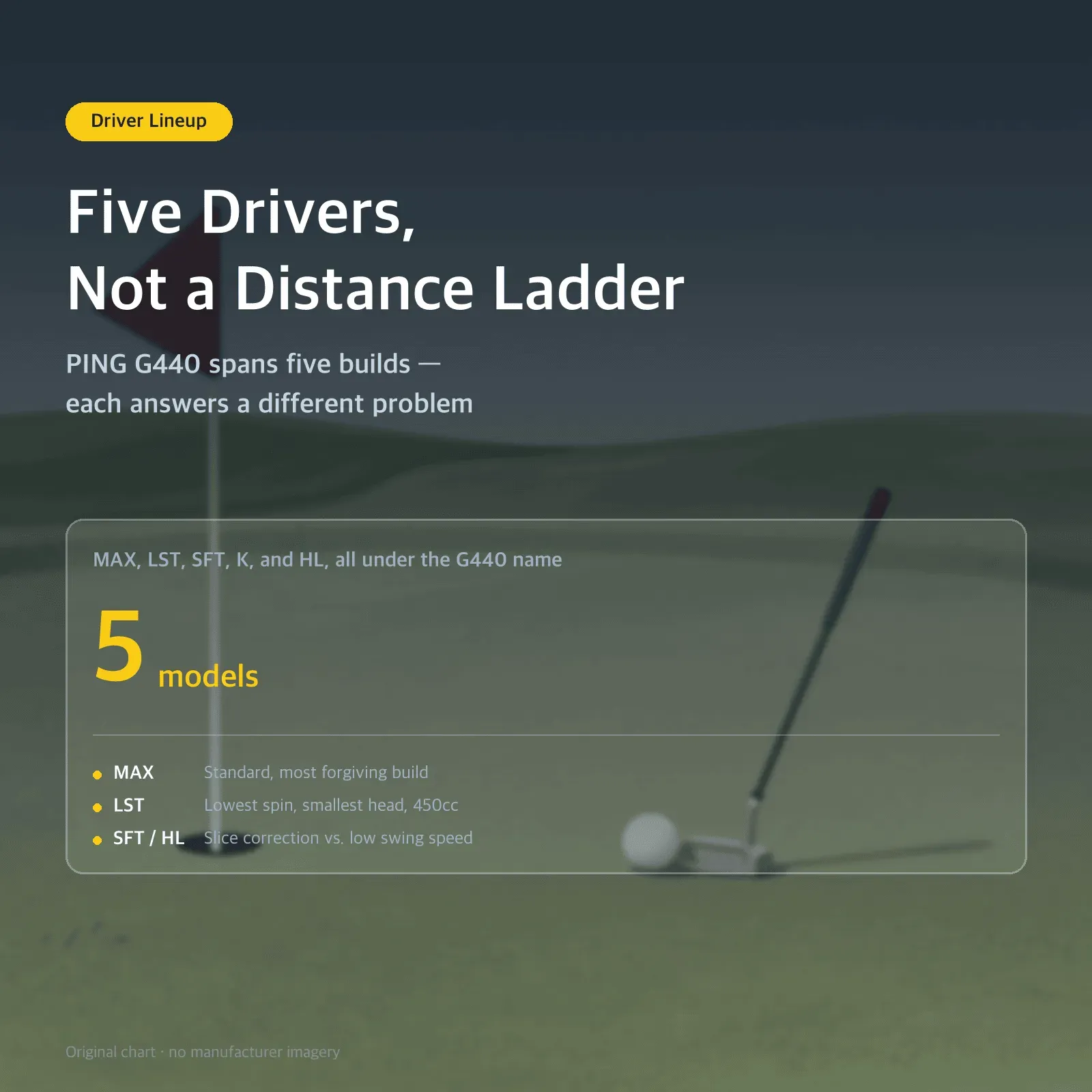
| Model | What it targets |
|---|---|
| MAX | The standard, most forgiving build |
| LST | Lowest spin, smallest head |
| SFT | Slice correction (Straight Flight) |
| K | PING’s own “most forgiving” label |
| HL | High Launch, for slower swing speeds |
Five G440 Models, Currently on Sale — Based on PING’s official site. MAX and K both lead with “forgiveness,” but the official descriptions diverge — the names alone don’t distinguish them.
Based on PING’s official site, five models under the G440 platform are currently on sale.
- MAX — the most forgiving standard build
- LST — lowest spin, smallest head
- SFT — slice-correction build (Straight Flight)
- K — the model PING itself labels as “most forgiving”
- HL — High Launch, built for slower swing speeds
MAX and K both lead with “forgiveness,” but the official descriptions diverge. MAX is the standard build in the base lineup. K uses a carbon crown and reduced sole weight to push the center of gravity lower and deeper, described by PING as delivering “record-setting MOI.” The names alone don’t distinguish them — you have to open the spec page.
2. Cross-referenced spec table
| Model | Head volume | Weight adjustment |
|---|---|---|
| MAX | 460cc | Not confirmed in this research |
| LST | 450cc | Not confirmed in this research |
| SFT | 460cc | Rear weight, biased toward draw |
| K | 460cc | 32g rear weight, three positions |
| HL | 460cc | 28g rear weight |
Cross-Referenced Spec Table — Head volume and weight adjustment, overlaid across all five. 460cc is the maximum allowed under R&A and USGA rules, so that number alone carries little distinguishing value.
Loft, head volume, adjustability, weight, length, and swing weight for all five models, overlaid.
Head volume is 450cc for LST alone; the other four are 460cc. Since 460cc is the maximum head size allowed under both R&A and USGA rules, that number by itself carries almost no distinguishing value. The weight-adjustment column is where the real differences show up.
- SFT — a movable rear weight biasing toward draw
- K — a 32g rear weight, adjustable across three positions
- HL — a 28g rear weight
- MAX — no weight-adjustment system was confirmed in this research
- LST — likewise, none confirmed
In other words, MAX (the “most basic”) and LST (the smallest) appear to rely on the loft sleeve (±1.5°) alone for adjustability, with the movable-weight function concentrated in K, SFT, and HL.
3. Slice correction and low swing speed are different problems
SFT and HL get confused often. Both get grouped as “easier to hit” drivers, but PING’s official descriptions target different problems.
SFT, “Straight Flight,” focuses on correcting a ball that curves right (a slice) using its rear weight. It targets a directional problem, independent of swing speed.
HL, “High Launch,” targets golfers whose swing speed itself is too slow to get the ball up in the air. Its 28g rear weight sets the center of gravity lower and further back to raise launch angle.
Both fall under “forgiveness,” but the reason for that forgiveness differs. If a slice is the issue, look at SFT. If clubhead speed is the issue, look at HL — that split is more useful in practice than the spec sheet alone.
4. Loft options also differ
Not all five models come in the same loft options. MAX, K, and HL offer 9°, 10.5°, and 12° — a spread that covers slower swing speeds through faster ones. LST and SFT offer only 9° and 10.5°.
This tracks with each model’s role. LST targets low spin and faster swings, so a launch-raising 12° option isn’t needed in the first place. SFT is focused on slice correction, and it appears it wasn’t extended to 12° for a similar reason. This interpretation is inferred from the option lineup, not a stated reason on PING’s own pages — worth flagging.
5. All five on one spectrum
| Forgiveness / high launch | Control / low spin | |
|---|---|---|
| Closest to this end | HL, SFT | LST |
| Middle | MAX, K | — |
| Basis | PING’s own wording + weight-adjustment structure | Same |
| Not | A ranking of measured distance | A ranking of measured distance |
All Five on One Spectrum — Based on PING’s own descriptive language, not a measured-distance ranking. MAX is the standard build; K is positioned by PING as the more forgiving of the two.
Based on PING’s own descriptive language, here’s a relative placement of the five models. Left is forgiveness and high launch; right is control and low spin.
HL and SFT sit toward the forgiveness end, LST toward the control end. MAX and K sit near each other in the middle — both marketed as “forgiving,” with MAX as the standard build and K positioned by PING as the more forgiving of the two.
This placement is not a ranking of measured distance. It’s based only on the language PING uses on its own pages and the disclosed weight-adjustment structure.
6. Who this driver fits
Judgment criteria inferred from confirmed specs.
- Golfers with a persistent slice — SFT is the model PING describes as using a movable rear weight to bias toward draw, independent of swing speed.
- Golfers with slower swing speed who can’t get the ball airborne — HL’s 28g rear weight lowers and shifts the center of gravity back to raise launch angle.
- Golfers with fast swing speeds looking to cut spin — LST is the only one of the five at 450cc, with only two loft options (9° and 10.5°).
This is less useful for:
- Golfers trying to choose between MAX and LST based on weight-adjustment features — neither model’s weight system was confirmed in this research; the adjustability sits with K, SFT, and HL.
- Golfers hoping to compare K’s MOI by number — only the phrase “record-setting MOI” is stated; no specific figure is published.
7. What we could not confirm
- Weight-adjustment systems for MAX and LST — not found on the official spec pages (unlike the other three models, which state theirs explicitly).
- Head weight (grams) for K and HL — not listed on the official pages.
- HL’s swing weight — not listed.
- MOI figures — only the phrase “record-setting” appears; no specific number is published.
- Measured distance and ball flight — omitted, since these vary by tester and conditions.
In one line
PING’s G440 isn’t a lineup you pick by “which goes farthest” — it’s a lineup you pick by identifying your own problem first (slice, low spin, low swing speed, or general forgiveness), then dialing in the weight position.
Tables and charts in this piece were built from scratch, and all figures come from PING’s official spec pages. Where a value could not be confirmed, it was left blank.
Sources
- PING official spec pages for all five G440 models — laid side by side, which is what resolves the naming confusion.
Confirmed live on PING’s official drivers page and the individual G440 MAX/LST/SFT/K/HL model pages: head volumes (460cc for MAX/SFT/K/HL, 450cc for LST), loft options, the “record-setting MOI” phrase for K, and the 32g standard vs. 28g HL rear-weight figures. Note: PING currently sells HL as three separate variants — MAX HL, SFT HL, K HL — rather than one standalone “HL” model as this piece’s five-way table implies; the underlying weight and loft figures still check out. Items the manufacturer does not publish remain named as unconfirmed rather than estimated.