Michelle Wie was sixteen, eleven days into her professional career, tied for fourth at the Samsung World Championship. On the seventh hole of the third round her ball was in a bush. She took an unplayable lie, dropped, chipped to fifteen feet, made par. A Sports Illustrated writer watching from the gallery thought the drop looked close to the hole. He paced it off after she walked away. Then he said nothing until the next afternoon.
By the time he spoke, Wie had already signed her card.
1. What happened, in order
| Step | What happened | Why it mattered |
|---|---|---|
| Saturday, 3rd round, par-5 7th | Wie’s ball is unplayable in a bush; she drops, chips to 15 feet, makes par | The drop location is now on record, on tape, and in her memory |
| Saturday, after the round | Michael Bamberger, a Sports Illustrated writer, paces off the drop spot and believes it is closer to the hole than the original lie | He does not raise it with an official that day |
| Saturday evening | Wie signs her scorecard for the round | The card is now signed without the penalty added |
| Sunday afternoon | Bamberger tells LPGA rules officials what he saw | Officials review NBC videotape of the drop |
| Sunday, after Wie’s final round | Officials rule the ball was dropped closer to the hole; Wie is disqualified | Not for the drop — for the card |
2. The drop itself was a two-stroke question
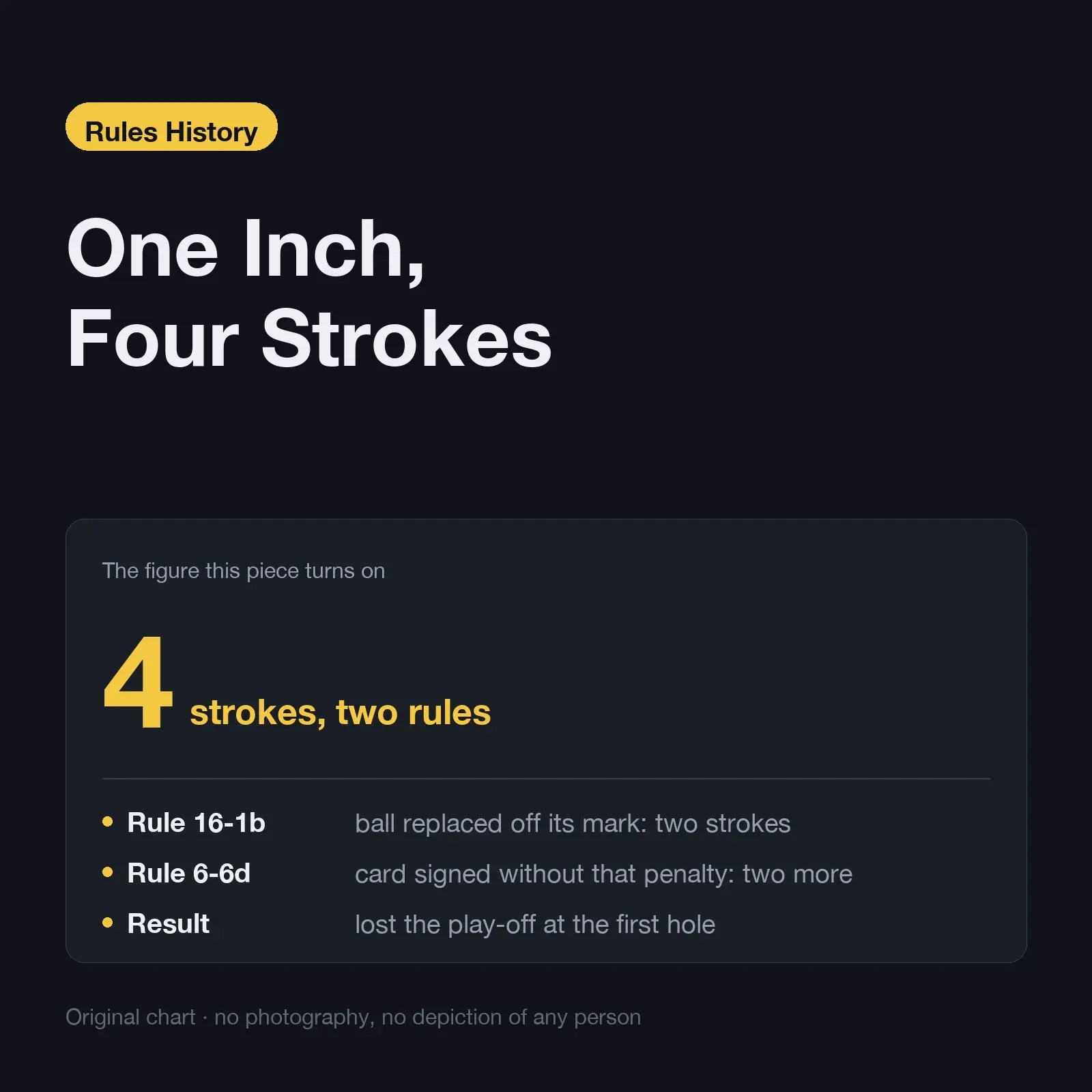
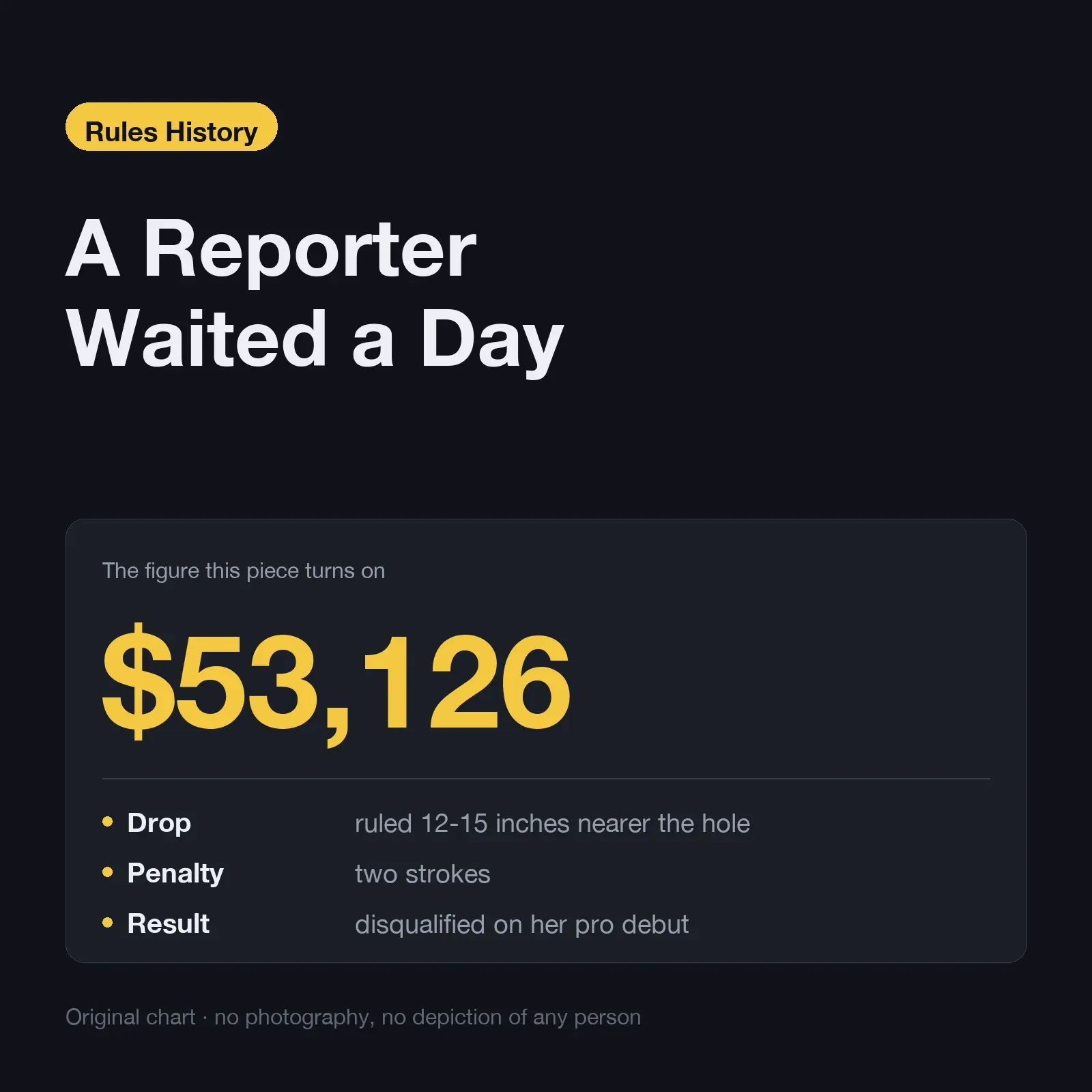
Rule 20-2c of the time required a ball dropped for an unplayable lie to be placed no nearer the hole than its original position. Rules official Robert O. Smith, after reviewing the tape, put it plainly: “The Rules of Golf are based on facts. The fact was, the ball was closer to the hole by 12 to 15 inches.” Wie’s side maintained the difference was about 3 inches. Either way, the violation on its own carries a two-stroke penalty — not a disqualification, and not close to costing her the tournament.
That is the same shape as Craig Stadler’s towel: the on-course infraction is small and correctable. What ends the week is what happens to the scorecard afterward.
3. The reporter’s day made the difference
Bamberger’s account of his own decision is on record: he watched the drop Saturday, believed it was wrong, and chose to say nothing to officials that day. He wanted to talk to Wie about it first — “I was still in my reporter’s mode. I wanted to talk to her first” — and by the time he raised it with LPGA officials, it was Sunday afternoon, and the card from Saturday had long been signed.
Had he flagged it to an official Saturday, before Wie signed, the fix is mechanical: two strokes added to her card, no disqualification, tournament continues. He flagged it a day later, and the fix became impossible — the rule for an incorrect scorecard does not care whether the player knew about the missing penalty.
This is the same mechanism Stadler ran into, with one variable reversed. Stadler’s caller, Robert Riegel, thought he was watching a live broadcast and phoned in immediately, trying to catch the penalty before the card was signed — and still triggered a DQ because the broadcast was actually a day-old replay. Bamberger was in the gallery in person, watching live, with no confusion about the date — and still waited a day to speak. In both cases the rule that turned two strokes into disqualification is the same one. What changed was whether the person with the information spoke while there was still a card to fix.
4. What she lost
$53,126 — the payout for the fourth-place finish she had earned on the course. It was her first tournament as a professional golfer. The disqualification did not affect her amateur record or any titles; it removed one paycheck from one event, eleven days into a career that had just started.
5. Rule changes came later, on a separate timeline
| When | What changed |
|---|---|
| October 2005 | Wie disqualified at the Samsung World Championship for an incorrect scorecard following an unplayable-lie drop |
| April 2011 | USGA/R&A Decision 33-7/4.5 — a player who signs an incorrect card because of a penalty they did not know about is penalized rather than disqualified |
| 2019 | Rule 14-3 rewritten: unplayable-lie and other relief drops made from knee height into a defined relief area, replacing the shoulder-height drop and stricter “no nearer the hole” measurement disputes of the earlier rule |
The 2019 rewrite changed how relief drops are measured and dropped, which is the exact kind of ambiguity that produced the 12-inches-versus-3-inches dispute in 2005. We have not found a source that names Wie’s case as a cause of that rewrite, and we are not asserting one. The sequence above is chronological, not causal.
Put this beside Stadler’s 1987 disqualification and the shape is identical, with one variable moved: his informant called immediately and was wrong about the day; hers waited a day and was right about everything. Six years later the governing bodies finally closed the gap, after Villegas and Harrington fell into it within a fortnight of each other.
6. What is confirmed and what is not
Confirmed — the hole (par-5 7th) and round (third, Saturday), the unplayable lie and drop, Bamberger’s identity and profession, his own account of watching Saturday and reporting Sunday afternoon, the review of NBC videotape, the disqualification for an incorrect scorecard, the $53,126 figure, and that this was Wie’s first professional tournament at age 16.
Not confirmed here — the exact distance of the drop. Rules official Robert O. Smith is quoted giving “12 to 15 inches”; Wie’s side is reported as maintaining roughly 3 inches. We report both figures as attributed rather than resolving them, because no source we opened settles which measurement is correct.
We also did not attempt to establish that Wie’s case influenced the 2019 rewrite of the unplayable-lie relief procedure. The dates line up in sequence; we found no document tying the two together.
In one line
The ball moved 12 to 15 inches; the reporter who saw it waited a day to say so, and that day cost Michelle Wie $53,126 on her pro debut.
Sources
- ESPN’s account of the disqualification — dates the round to Saturday, October 15, 2005, the disqualification to Sunday, October 16, names Michael Bamberger of Sports Illustrated, gives the 12-to-15-inches figure against Wie’s claim of 3 inches, quotes Bamberger’s reason for waiting a day (“I was still in my reporter’s mode. I wanted to talk to her first”), and confirms the $53,126 fourth-place payout.
- Fox News’s account of the disqualification — confirms the par-5 seventh hole, third round, the 12-to-15-inches measurement, quotes rules official Robert O. Smith (“The Rules of Golf are based on facts. The fact was, the ball was closer to the hole by 12 to 15 inches”), and confirms the $53,126 figure.
- Wikipedia’s article on Michelle Wie West — confirms the disqualification occurred at the 2005 Samsung World Championship, her first professional event, for signing an incorrect scorecard, and gives her birth date of October 11, 1989, placing her at 16 at the time of the tournament.
All three pages were opened and read on 30 August 2026. The drop distance is reported as “12 to 15 inches” by both ESPN and Fox News, attributed to rules official Robert O. Smith; Wie’s own estimate of roughly 3 inches appears in ESPN’s account and is reported here as her disputed figure, not resolved fact.