A separate piece compared driving irons, utility clubs, and fairway woods by their structure and typical trajectory.
This time, the comparison is by number. Overlaying only the lofts printed on official manufacturer spec sheets for all three categories produces a picture that doesn’t match the usual assumption.
There’s a zone where all three fight for the same slot, and a separate zone where nothing but the hybrid shows up at all.
1. The source is a manufacturer’s own table
| Hybrid | Loft | Matching iron | Matching wood |
|---|---|---|---|
| 2H | 17.0° | 2-iron | 5-wood |
| 3H | 20.0° | 3-iron | 7-wood |
| 4H | 23.0° | 4-iron | 9-wood |
| 5H | 26.0° | 5-iron | none |
| 6H | 30.0° | 6-iron | none |
| 7H | 34.0° | 7-iron | none |
The Source Is a Manufacturer’s Own Table — PING’s official G440 hybrid spec sheet, matching-iron and matching-wood columns. The last three list no matching wood — not an omission, but a real absence of a wood to fill that slot.
Ping’s official G440 hybrid spec sheet includes “matching iron” and “matching wood” columns — the maker’s own statement of what each hybrid is meant to replace.
- 2H — 17.0° · 2-iron · 5-wood
- 3H — 20.0° · 3-iron · 7-wood
- 4H — 23.0° · 4-iron · 9-wood
- 5H — 26.0° · 5-iron · none
- 6H — 30.0° · 6-iron · none
- 7H — 34.0° · 7-iron · none
The first three list a matching wood. The last three don’t — not an omission, but a real absence of a wood to fill that slot.
2. 17° to 24° — all three categories overlap
| Category | Models in this range |
|---|---|
| Fairway woods | 5-wood (~18°), 7-wood (~21°), 9-wood (~24°) |
| Hybrids | 2H (17°), 3H (20°), 4H (23°) |
| Driving irons | Roughly the 2-iron zone (17°–18°) |
17 to 24 Degrees - All Three Categories Overlap — The same angle produced three different ways. In this range, “which one to use” is a trade-off between trajectory and forgiveness, not a loft question.
This range has all three categories present at once:
- Fairway woods — 5-wood (roughly 18°), 7-wood (roughly 21°), 9-wood (roughly 24°)
- Hybrids — 2H (17°), 3H (20°), 4H (23°)
- Driving irons — roughly the 2-iron zone (17–18°)
The same angle is being produced three different ways. So in this range, “which one to use” isn’t a loft question. Any of the three can hit the same number.
What actually separates them is what the head does with that loft. A wood, with its large head and rearward center of gravity, launches higher; a driving iron sits low and penetrating; a hybrid sits in between.
So the choice in this range is a trade-off between trajectory and forgiveness, not a matter of matching an angle.
3. Past 26° — only the hybrid is left
| Category | Why it drops out |
|---|---|
| Fairway woods | A 9-wood sits ~24°; 11/13-wood is not a standard product |
| Driving irons | Designed from the start to launch low from a low loft |
| Hybrid (5H-7H) | The only option remaining, covering the 26–34° gap |
Past 26 Degrees - Only the Hybrid Is Left — Fairway woods and driving irons both drop out of this range. The alternative in this range is a 5- through 7-iron — still long, and holding a green with one is not easy.
This is the part worth the most attention.
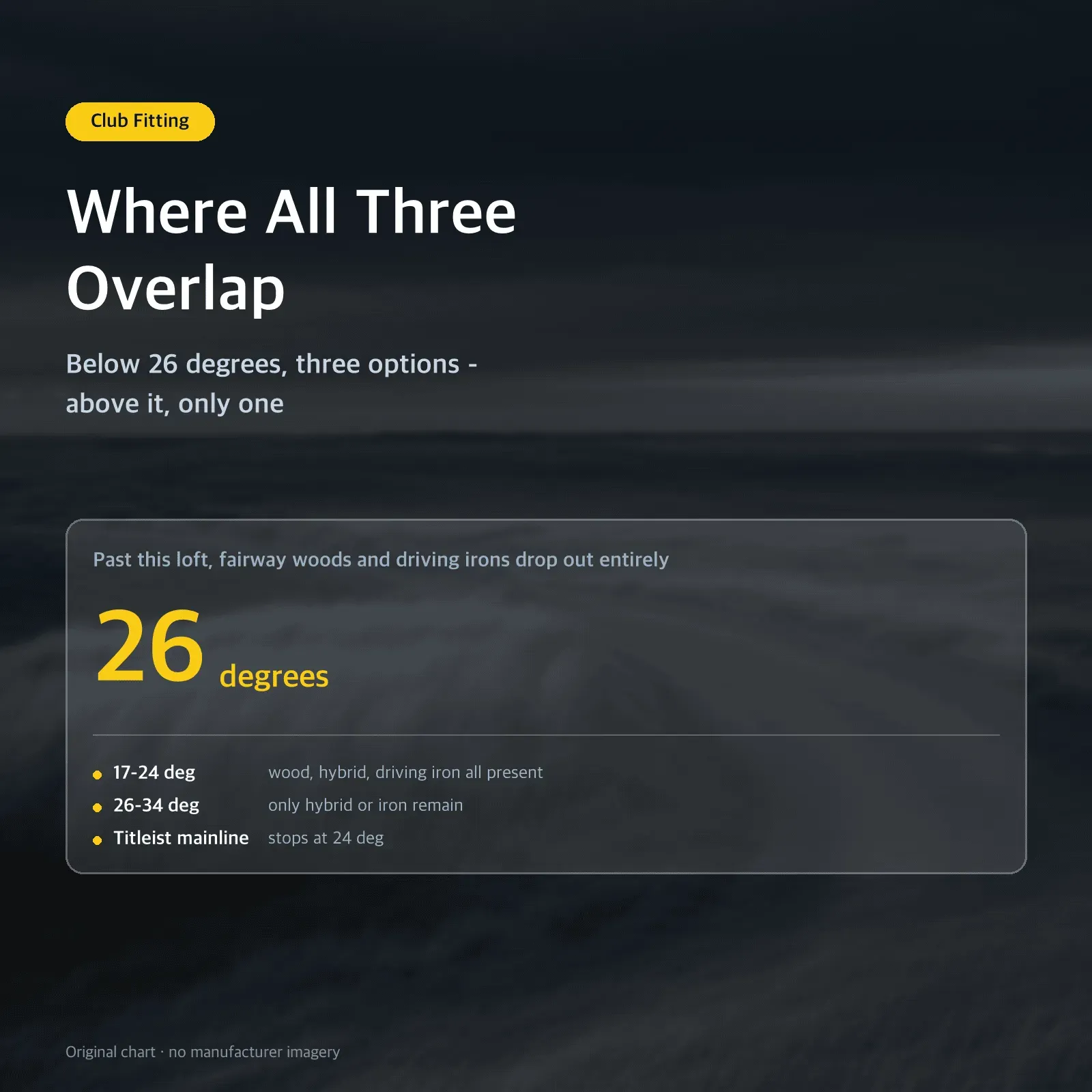
Past 26 degrees, fairway woods disappear. A 9-wood sits around 24 degrees; an 11-wood or 13-wood isn’t a standard product. A wood’s large head and rearward center of gravity make it structurally hard to keep pushing loft higher.
Driving irons don’t reach this range either — they were designed from the start to launch low from a low loft.
So between 26 and 34 degrees, the only options are an iron or a hybrid. Two choices, not three.
And the iron in that range is a 5- through 7-iron. Still long, even if not as long as a true long iron, and holding a green with one isn’t easy. That’s precisely the range many golfers find hardest.
That’s why the hybrid range extends this far — it’s covering a gap that a wood can’t reach and an iron makes difficult.
4. Not every brand builds that range at all
| Brand | Loft range | Models |
|---|---|---|
| PING G440 | 17 to 34° | 6 models |
| Callaway Quantum Max | 19 to 33° | 6 models |
| Titleist GT2 / GT3 | 19 to 24° only | 3 models |
Not Every Brand Builds That Range — Loft range and model count for each brand’s mainline hybrids. Titleist’s mainline hybrids only cover the overlap zone — reaching past 24° requires the separate GT1 extended line (26°/29°).
This is where brand differences become decisive.
- Ping G440 — 17° to 34°, six models
- Callaway Quantum Max — 19° to 33°, six models
- Titleist GT2 / GT3 — 19° to 24° only, three models
Ping and Callaway fill the 26-degree-plus range. Titleist stops at 24.
In effect, Titleist’s mainline hybrids only cover the zone where all three categories overlap. It has defined the hybrid as a tool for bridging woods and long irons specifically. To find anything past 24 degrees from that brand, its GT1 extended line (26° and 29°) is the only route.
Same category name, ranges that differ by more than 10 degrees — that gap comes down to each brand defining “hybrid” differently.
5. So how do you actually decide
Start by calculating how many degrees you need to fill.
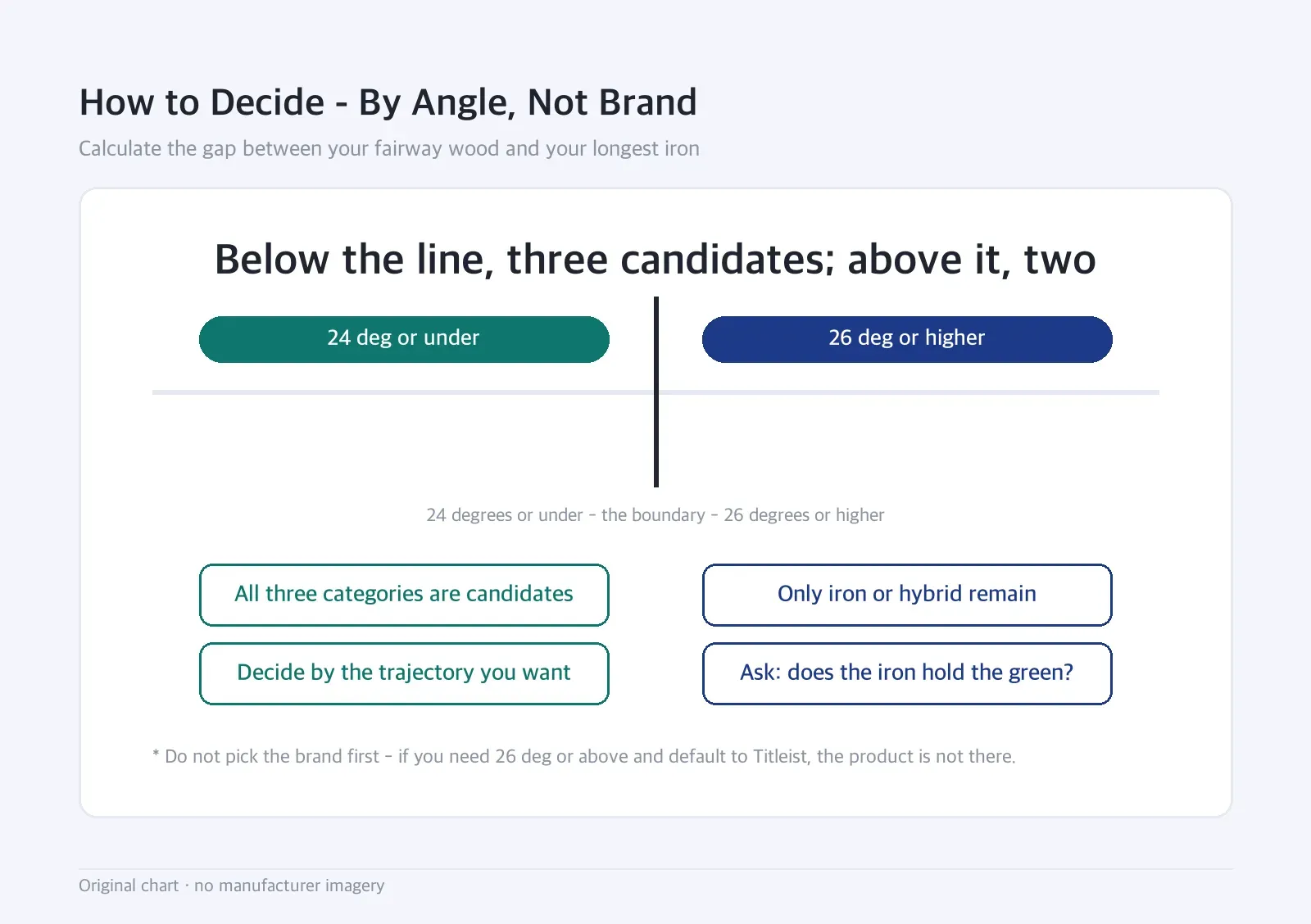
Check your fairway wood’s loft and your longest iron’s loft. The gap between them is the range you’re filling.
If that gap sits at 24 degrees or under, all three categories are candidates.
- Want to launch it high? A fairway wood.
- Want to keep it low and cut through wind, or hit it off the tee? A driving iron.
- Want something in between, one that also works from the rough? A hybrid.
In this range, decide by the trajectory you want, not the number.
If the gap sits at 26 degrees or higher, there are only two choices.
Keep the iron as is, or switch to a hybrid. Woods and driving irons aren’t in the running.
The deciding question here is simple: does that iron hold the green? If it does, there’s no reason to switch. If the ball lands and runs out immediately, that’s exactly the problem a hybrid in this range is built to solve.
Don’t pick the brand first. If you need something at 26 degrees or above and default to Titleist, the product isn’t there. Settling on the loft first, then the brand, is the right order.
6. Who this is useful for
Useful for golfers with a gap between their fairway wood and irons — that’s the 17–24° range, and all three categories are candidates. Choose by trajectory preference.
Useful for golfers whose 5- through 7-irons won’t hold a green — that’s the 26°-plus range, where a hybrid is effectively the only alternative.
Useful for golfers trying to cut down the number of clubs they carry — 17–24° is the range where one hybrid can cover both a wood slot and an iron slot.
Useful for golfers who want to settle on club composition before brand — once the angle is set, the field of viable brands narrows on its own.
Less useful for golfers who need something above 26° but want to stay with Titleist’s mainline — that loft isn’t in the standard line; the GT1 extended line is the only path.
Less useful for golfers trying to compare the three categories by number — a “3” in wood, hybrid, and iron numbering points at three entirely different lofts.
Less useful for golfers hoping a hybrid will add tee-shot distance — that’s closer to a driving iron’s or fairway wood’s actual purpose.
7. What we could not confirm
- Loft-by-number figures for fairway woods themselves — the numbers used here are back-calculated from Ping’s hybrid matching table; no fairway-wood spec sheet was directly confirmed in this research.
- The loft range for driving irons — varies by model, and no official figure was confirmed.
- Measured trajectory and landing-angle differences across the three categories — dependent on tester and conditions, so not cited.
- Matching-iron labeling from brands other than Ping — confirmed for Ping’s official spec sheet only.
- How much harder the three categories actually are to hit from the rough — frequently mentioned, but no disclosed figures found.
In one line
Between 17 and 24 degrees, fairway woods, hybrids, and driving irons all overlap. In that range, choose by the trajectory you want, not the angle.
Past 26 degrees, the picture changes. Woods can’t reach it, and driving irons were never built for it. It’s the iron as is, or a hybrid — and some brands don’t build a product for that range at all.
So when choosing a club, settle the angle you need to fill before you settle on a brand.
Sources
- PING G440 Hybrid — official spec page — confirms the 2H–7H loft table and matching-iron/matching-wood columns used as the source table in this piece.
- Callaway Quantum Max Hybrid — official spec page — confirms Callaway’s 19°–33° range across six models.
Titleist (titleist.com) blocks automated page access, so the GT2/GT3 19°–24° figures could not be independently reconfirmed against a live official page. No fairway-wood or driving-iron manufacturer spec sheet was found to directly confirm the back-calculated loft-by-number figures used in section 2; that gap is stated in the body rather than papered over.
🔴 Two gaps are stated in the body rather than filled: the fairway-wood loft-by-number figures are back-calculated from Ping’s hybrid matching table, with no fairway-wood spec sheet directly confirmed; and no official driving-iron loft range was confirmed, as it varies by model.