A compact head with some distance still in reserve — that’s the slot a specific group of irons is built for. TaylorMade’s P770 is the flagship example, and every major brand has its own entry in the same slot.
We overlaid the official spec sheets for four of them. What looked like four lines turned out to be two.
1. First — what counts as a “peer”?
| Model | Structure |
|---|---|
| Titleist T150 | Forged progressive dual-cavity, split tungsten. Not hollow |
| TaylorMade P770 | Forged hollow body |
| Mizuno Pro M-13 | Pocket cavity 4-5i, micro-slot 6-8i, forged 1025 9-GW |
| PING i240 | 431 stainless cast multi-material. Not forged |
What Counts as a Peer Here — grouped by intended slot, not structure; it varies brand to brand. PING i240 is an awkward structural fit but included anyway — the reason surfaces in the loft overlay.
This time we didn’t group by structure — this category is built differently brand to brand. So instead, we grouped by intended slot, and left the structural differences fully visible rather than papering over them.
- Titleist T150 — current 2025 model. Forged, progressive dual-cavity, split tungsten placement. Not hollow.
- Mizuno Pro M-13 — successor to Pro 243 (2026). Pocket cavity on 4–5, micro-slot on 6–8, single-piece forged 1025 on 9–GW. Structure changes by club number.
- PING i240 — successor to i230 (2025). 431 stainless cast multi-material. Not forged.
PING i240 is an awkward fit by structure alone. It’s included anyway — the reason surfaces later in this piece.
2. Overlay the lofts
| Club | T150 / M-13 | P770 / i240 |
|---|---|---|
| 4-iron | 22 deg | differs by 0.5 deg* |
| 5-iron | 25 deg | differs by 0.5 deg* |
| 6-iron | 28 deg | differs by 0.5 deg* |
| 7-iron | 32 deg | 33 deg |
| 8-iron | 36 deg | 37 deg |
| 9-iron | 40 deg | 41 deg |
| PW | 44 deg | 45 deg |
Four Lines, Two Loft Systems — 4-iron through PW, official spec. T150 and M-13 share identical lofts 4i-PW. P770 and i240 match exactly 7i-PW; at 4-6i the two differ from each other by half a degree (exact split not published).
We drew all four lines and looked again ourselves. Draw four, and only two show up.
Titleist T150 and Mizuno Pro M-13 share identical lofts from the 4-iron through PW: 22 / 25 / 28 / 32 / 36 / 40 / 44. Not a single number differs.
P770 and PING i240 match from the 7-iron through PW: 33 / 37 / 41 / 45. Only the top end, 4 through 6, differs — by half a degree.
3. The point this piece really wants to make
| System | Members | 7-iron loft |
|---|---|---|
| Weaker side | Titleist T150, Mizuno Pro M-13 | 32 deg |
| Stronger side | TaylorMade P770, PING i240 | 33 deg |
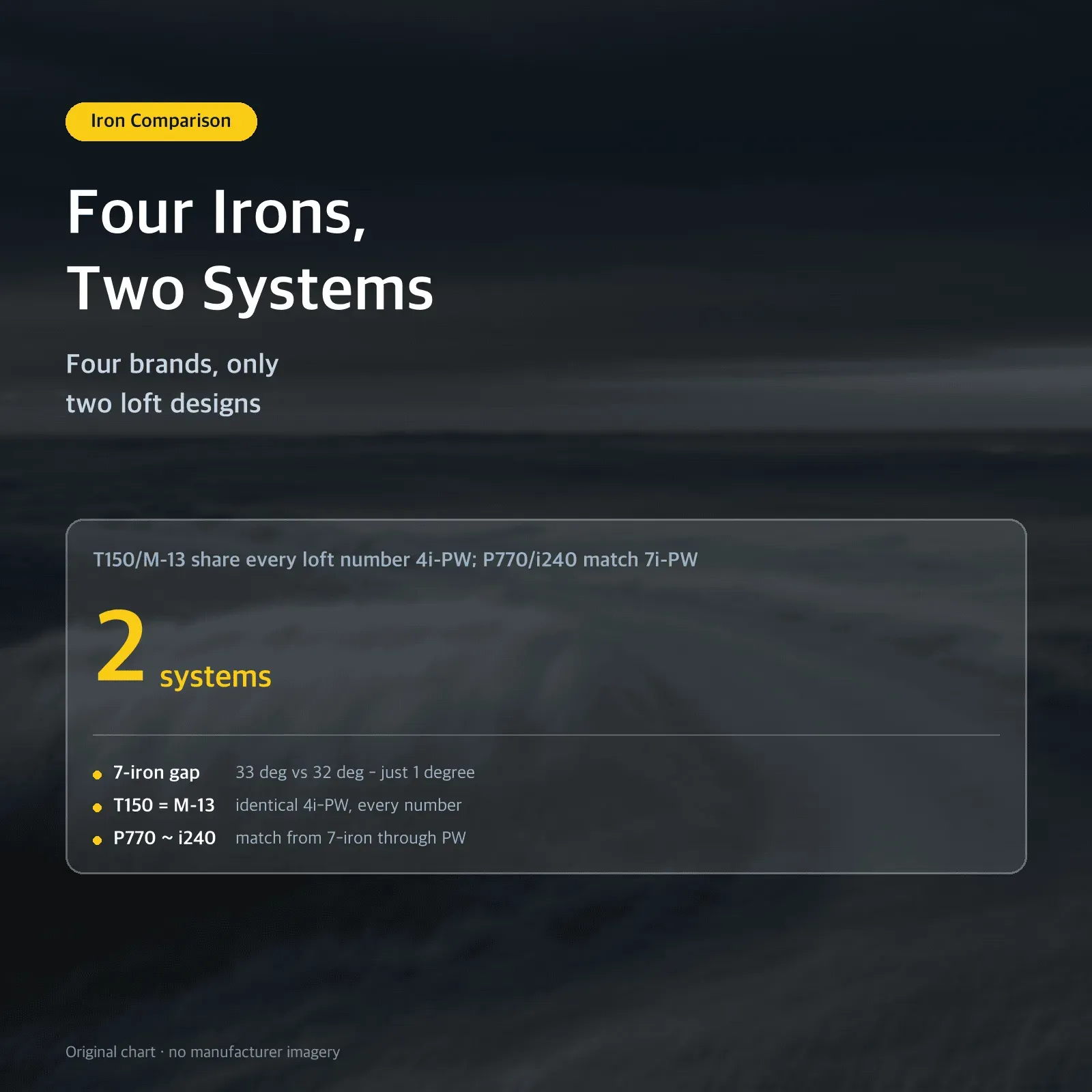
Two Systems, One Degree Apart — the 7-iron split defines the two loft designs. A degree of loft is worth roughly 2-3 yards — what actually separates the choice is shape, feel, and lie fit, not loft.
Four brands, but the loft design behind them is effectively two systems.
- Stronger side — P770, PING i240 (33° at the 7-iron)
- Weaker side — T150, Mizuno M-13 (32° at the 7-iron)
Four brands, two angle designs, and the gap between them is exactly 1 degree at the 7-iron.
What’s 1 degree worth in distance? A degree of iron loft is generally said to be worth roughly 2 to 3 yards. In other words, trying to separate these four clubs by “distance” is nearly pointless — a few yards of carry gets erased by that day’s conditions and turf alone.
So what actually separates the choice in this category isn’t loft. It’s the shape at address, the feel in your hands, and how the lie angle suits your swing. That’s why staring at a loft chart never resolves the decision.
4. Lie angle scatters across roughly a degree
| Model | 7-iron lie |
|---|---|
| Titleist T150 | 63.0 deg |
| TaylorMade P770 | 62.5 deg |
| Mizuno Pro M-13 | 62.0 deg |
| PING i240 | 62.0 deg (color-code standard, flat end) |
7-Iron Lie Angle Scatters — loft is tight across brands; lie scatters by about a degree. PING’s published value is a color-code “starting point,” not the club’s fixed character — lie is a fitting variable, not a ranking.
Loft is tight; lie scatters. At the 7-iron:
- Titleist T150 — 63.0°
- TaylorMade P770 — 62.5°
- Mizuno Pro M-13 — 62.0°
- PING i240 — 62.0°
PING shouldn’t be read at face value here. PING uses a color-code system for lie adjustment, so its published standard value (black dot) is deliberately set on the flat end. 62.0° on the chart is a “starting point,” not “this club’s character.”
A degree of lie affects direction. But lie is also an item that gets adjusted during fitting. It’s not something to rank on a catalog number — it’s something to ask “can this be fit to my lie?” about.
5. Why Mizuno looks longer
Length matters too. At the 7-iron, P770, T150, and i240 are all 37.00 inches; Mizuno M-13 alone is 37.25 inches.
Mizuno looks noticeably longer. But Mizuno has stated it changed its measurement convention to align with USGA/R&A standards, and that resulted in published lengths growing by roughly a quarter-inch. The club didn’t get longer — the ruler changed.
This is exactly the trap in comparing spec sheets across brands. The numbers are accurate, but the standard behind them isn’t shared. Comparing decimals across brands means checking what ruler produced them first.
6. What only PING offers
| Spec | 7-iron loft |
|---|---|
| Power | 31.5 deg |
| Stock | 33 deg |
| Retro | 35 deg |
What Only PING Offers — PING publishes three loft options for the same model, at the 7-iron. A 3.5-degree spread on one model alone. At PING, loft isn’t something you choose off the shelf — it’s something you order.
Saved for last on purpose — the real reason PING i240 belongs in this comparison.
PING publishes three loft options for the same model in its official spec sheet: stock, a stronger Power spec, and a weaker Retro spec. At the 7-iron, that’s a 3.5° spread — from 31.5° to 35°.
What that means: the “two-system” split described above is meaningless within PING’s own lineup from the start. At PING, loft isn’t something you choose — it’s something you order.
TaylorMade’s official P770 spec sheet has no such field. Just one stock line. Bending during a fitting can adjust loft in practice, of course, but that’s different from a manufacturer publishing it as an option on the chart.
7. Who this comparison is useful for
A judgment framework drawn from the confirmed differences among the four models.
- Golfers trying to pick between the four using a loft chart — there are really only two systems (T150/M-13 vs P770/i240), and even that gap is 1° at the 7-iron. This piece’s conclusion is that the choice should come from shape, feel, and lie — not loft.
- Golfers who want to fine-tune lie angle — the 7-iron figure ranges from 63.0° to 62.0° across brands, but that’s not a ranking — it’s a fitting variable, which this piece flags directly.
- Golfers who want loft as an ordering option rather than a fixed spec — only PING i240 publishes three specs (stock, Power, Retro; 31.5° to 35° at the 7-iron) directly on its official chart.
This may not fit:
- Golfers who take Mizuno M-13’s 0.25-inch longer length as a real physical difference — it’s the result of a measurement-standard change, not confirmed as a real-world difference.
- Golfers who want one confirmed loft number for P770 — TaylorMade’s own sources (product page vs. combo guide) disagree by 0.5–1°, and this piece could not settle which is correct.
8. What we could not confirm
- Offset for P770 and T150 — neither company’s official spec sheet has this field. PING i240 publishes it in inches; Mizuno M-13 publishes only bounce.
- Blade length across all four models — none publish it. Titleist describes it only as “progressive blade length” in words.
- P770’s loft, self-contradicted — TaylorMade’s official product page lists 19° / 41° / 45° for 3-iron / 9-iron / PW, while the same company’s official combo guide PDF lists 19.5° / 41.5° / 46°. This piece used the product-page values as the current 4th-generation baseline but could not confirm which is correct.
- Sole width and top-line thickness — no brand publishes numbers.
- Measured carry distance — not cited.
In one line
Four brands, each building their own compact iron — but the loft design behind them comes down to exactly two systems, a 1-degree gap at the 7-iron.
So this category isn’t chosen by loft chart. The angles are already essentially fixed; what actually varies is shape, feel, and lie. And at least one brand has turned loft itself into an order option.
Every chart here was built directly, and every number comes from each model’s current-generation official spec sheet. Anything we could not confirm was left blank.
Sources
- Official spec sheets for TaylorMade P770, Titleist T150, Mizuno Pro M-13 and Ping i240 — the four sheets overlaid here:
- TaylorMade P770 — 4-iron 22°, 7-iron 33°, PW 45°; 7-iron lie 62.5°, length 37.00”.
- Titleist T150 — 4-iron 22°, 7-iron 32°, PW 44°; 7-iron lie 63°, length 37”.
- Mizuno Pro M-13 — 4-iron 22°, 7-iron 32°, PW 44°; 7-iron lie 62°, length 37.25”.
- PING i240 — 7-iron stock loft 33.0°, Power Spec 31.5°, Retro Spec 35.0°; 7-iron lie 62.0°, offset 0.09”.
- Ping’s published color-code lie system — the reason its standard (black dot) value sits deliberately on the flat end and should not be ranked against other brands’ single figures.
- Mizuno’s statement on changing its measurement convention to align with USGA/R&A standards — the roughly quarter-inch growth in published lengths.
All four links above were opened directly and confirmed live as of August 2026, with every loft/lie/length/offset figure in this piece matching what’s on those pages — including PING’s Power/Retro loft spread and Mizuno’s 0.25-inch length-convention statement (confirmed on Srixon’s equivalent page in a companion piece; not independently re-confirmed on Mizuno’s own page in this pass). The piece’s point is that listing conventions differ by brand, so the published number alone is not comparable.