When a rules body rules that a club is nonconforming, most manufacturers back down. Rebuilding to spec is usually faster than fighting.
But there’s a case where that didn’t happen.
In 1987, PING began a dispute with the USGA. It ran for six years.
1. June 1987 — the ruling
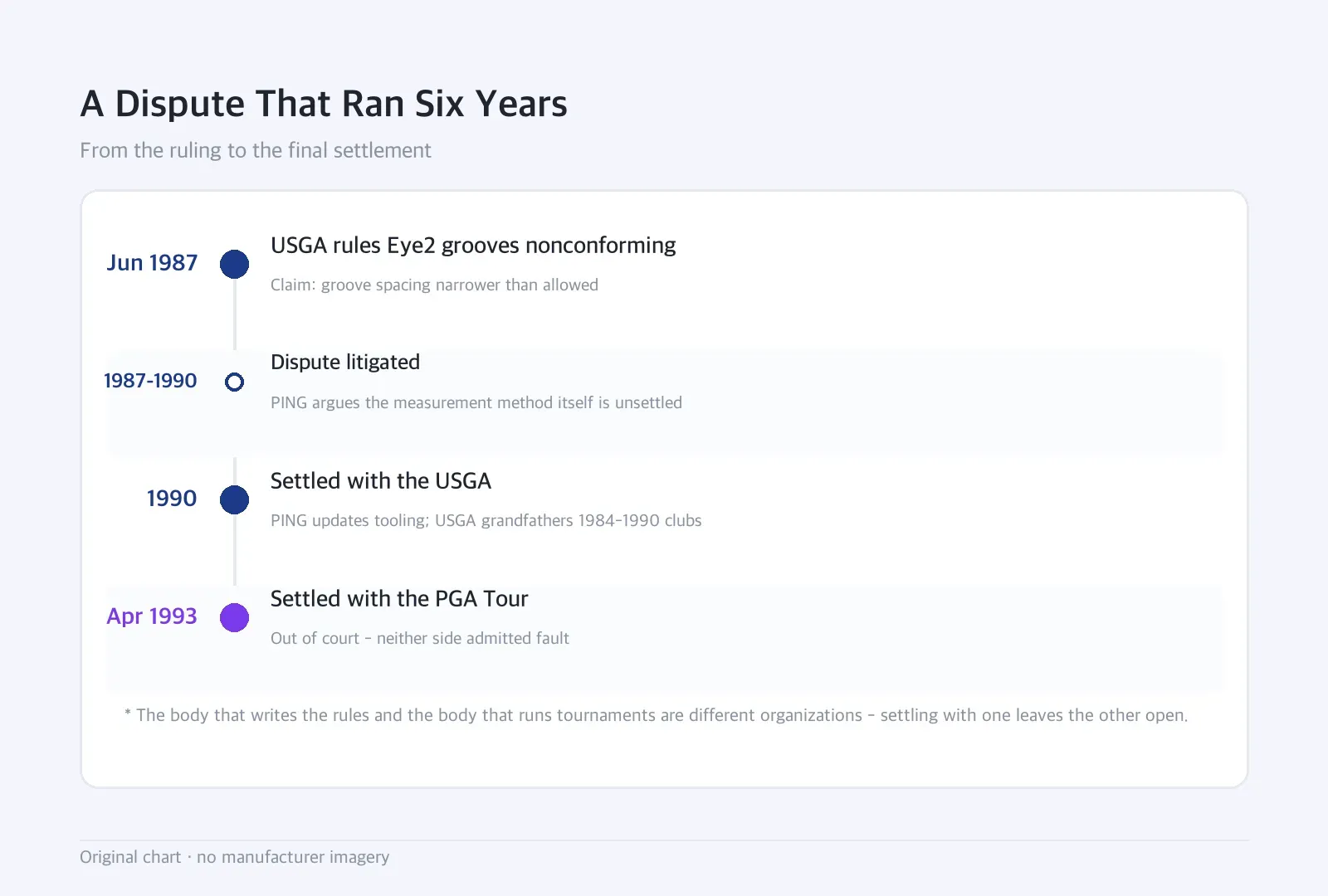
The USGA ruled that the grooves on the PING Eye2 iron did not conform to specification — the claim was that groove spacing was narrower than the rule allowed.
As covered separately, the Eye2 used square grooves, and the club was, by most accounts, the best-selling iron ever made.
In other words, this ruling declared the best-selling product on the market nonconforming.
2. PING’s response — “it depends how you measure it”
PING pushed back on two fronts.
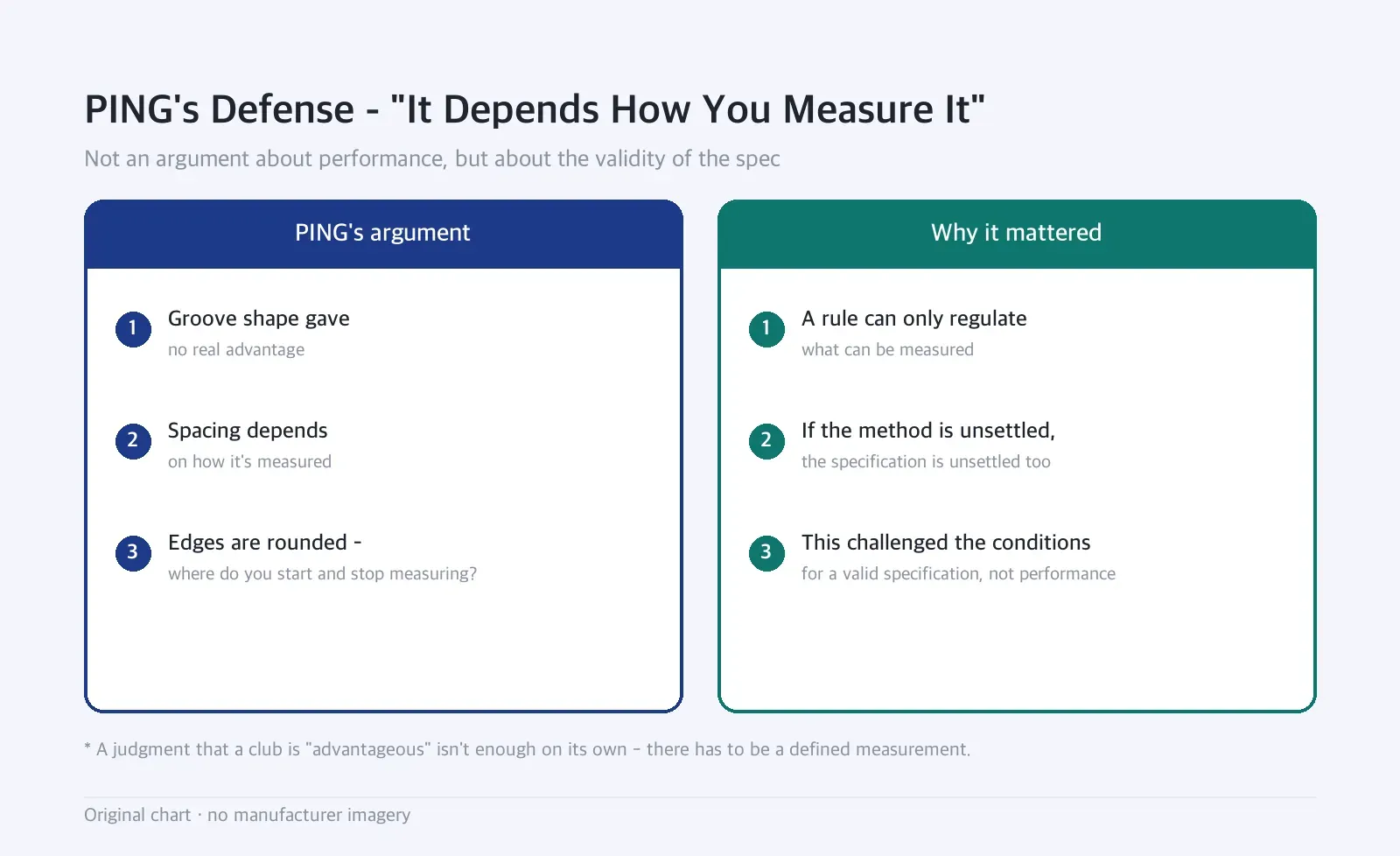
First, that the groove shape gave golfers no advantage.
Second, that groove spacing depends on how it’s measured.
The second point was the core of it.
A groove isn’t a channel with vertical walls. The edges are rounded, and the cross-section has an angle to it. That raises the question: where do you start and stop measuring “spacing”? You could measure top edge to top edge, bottom to bottom, or from some point in between.
Different reference points give different numbers. PING argued that, by its own measurement method, the grooves were within spec.
3. What this argument was actually aimed at
It’s worth pausing on why this argument carried weight.
A rule can only draw a line around something that can be measured. A judgment that “this club is advantageous” isn’t enough on its own to set a specification. There has to be a defined measurement — what to measure, how, and what limit it must not exceed.
But if the measurement method itself is unsettled, the specification is unsettled too. If the same club produces different values under two different methods, it’s unclear what the specification is actually regulating.
PING wasn’t arguing about performance. It was challenging the conditions required for a specification to be valid in the first place.
4. 1990 — a settlement with the USGA
The dispute went to court, and it was settled in 1990.
The terms involved concessions on both sides.
- PING — agreed to modify its tooling to match the USGA’s measurement method going forward
- USGA — agreed to grandfather U-groove Eye2 clubs produced between 1984 and 1990
In short: going forward, USGA’s method would apply, but clubs already made and sold would be recognized as they were.
That grandfathering provision was the heart of the settlement, and it’s covered separately in more detail.
5. Three more years with the PGA Tour
| Party / year | Terms |
|---|---|
| PING (1990) | Modify tooling to match the USGA’s method |
| USGA (1990) | Grandfather U-groove Eye2 clubs made 1984-1990 |
| PGA Tour (1993) | Out of court - neither side admitted fault |
What the Settlements Actually Said — Concessions on both sides, in two separate agreements. Going forward the USGA’s method applies, but clubs already made and sold were recognized as they were.
The USGA dispute ended in 1990, but litigation with the PGA Tour continued.
It was settled out of court in April 1993. The terms are notable:
- Neither side admitted fault
- U-grooves remained legal on tour
| Takeaway | Status |
|---|---|
| Not necessarily final — a rules body’s ruling can be contested legally - and here it was | Confirmed |
| Method is part of the spec — a number without a defined measurement method isn’t a working spec | Confirmed |
| 2010 groove revision — likely informed by this episode, not built on confirmed evidence | Inference |
What This Case Left Behind — Two confirmed takeaways, and one inference. The 2010 revision set both a number and a method together - a cross-sectional area and a minimum edge radius.
Start to finish, this ran six years.
It’s also worth noting that the USGA and PGA Tour dispute were handled separately. The body that writes the rules and the body that runs the tournaments are different organizations. Settling with one leaves the other still open.
6. What this case left behind
The dispute settled a few things clearly.
A rules body’s ruling is not necessarily final. There is room to contest it legally, and here it actually happened.
Measurement method is part of a specification. Setting a number without defining how to measure it doesn’t produce a working specification. Specifications since have moved toward stating a measurement method alongside the number.
And the groove issue resurfaced twenty years later — the 2010 groove-specification revision. That version set both a number and a defined method together: a cross-sectional area of 0.0030 square inches per inch of groove, and a minimum edge radius of 0.010 inches.
It appears the 1987 episode informed that. But this connection is inference, not something built on confirmed evidence.
7. Who this is useful for
Based on what could be confirmed:
- Golfers interested in equipment specifications — a case showing that a number alone doesn’t make a working specification.
- Golfers curious how much authority a rules body has — a ruling was contested, and the challenge succeeded in part.
- Golfers curious why wedge groove rules look the way they do — this dispute sits behind that.
- Golfers looking at a secondhand Eye2 — clubs made between 1984 and 1990 carry a special status.
This is less useful for:
- Golfers who only need the current specification — the 2010 specification applies today.
- Golfers comparing club performance — this piece is about a specification dispute.
8. What we could not confirm
- The exact groove-spacing specification at the time and the Eye2’s measured values — we could not confirm these.
- The specific difference between the two sides’ measurement methods — we could confirm only the general “it depends how you measure it” argument.
- The claims and amounts sought in the litigation.
- The full settlement text.
- Why the PGA Tour litigation took three additional years.
- Whether this case was actually incorporated into the 2010 specification — what’s noted above is inference.
In one line
In 1987 the USGA ruled the PING Eye2’s grooves nonconforming, and PING did not back down.
Its core defense wasn’t about performance — it was that “spacing depends on how you measure it.” If the measurement method is unsettled, so is the specification.
PING settled with the USGA in 1990, and settled out of court with the PGA Tour in April 1993. Neither side admitted fault.
A rare case of a rules body contesting a manufacturer and having to give ground.
The years and sequence here are drawn from confirmed sources; inference is marked as inference.
Sources
- USGA ruling of June 1987 — the finding that PING Eye2 groove spacing did not conform to specification.
- The 1990 settlement between PING and the USGA — PING agreeing to match the USGA’s measurement method going forward, the USGA agreeing to grandfather U-groove Eye2 clubs made between 1984 and 1990.
Both are recorded in contemporaneous newspaper coverage, linked above; the case filings themselves were not examined. Dates and the terms of the settlement are stated as recorded; the litigation’s internal arguments were not examined.